Buffers above the regulatory minimum
This chapter describes buffers that banks are expected to maintain above the minimum risk-based capital requirements, as well as the capital conservation requirements that apply to banks that do not maintain such buffers.
- Effective as of: 15 Dec 2019
- Last update: 15 Dec 2019
- Status Current
Capital conservation buffer
30.1
This chapter outlines the operation of the capital conservation buffer, which is designed to ensure that banks build up capital buffers outside periods of stress which can be drawn down as losses are incurred. The requirement is based on simple capital conservation rules designed to avoid breaches of minimum capital requirements.
30.2
A capital conservation buffer of 2.5%, comprised of Common Equity Tier 1 (CET1), is established above the regulatory minimum capital requirement.1 Capital distribution constraints will be imposed on a bank when capital levels fall within this range. Banks will be able to conduct business as normal when their capital levels fall into the conservation range as they experience losses. The constraints imposed only relate to distributions, not the operation of the bank.
1 Footnote
| 1 | Common Equity Tier 1 must first be used to meet the minimum capital and total loss-absorbing capacity (TLAC) requirements if necessary (including the 6% Tier 1, 8% Total capital requirements), before the remainder can contribute to the capital conservation buffer. |
30.3
The distribution constraints imposed on banks when their capital levels fall into the range increase as the banks’ capital levels approach the minimum requirements. By design, the constraints imposed on banks with capital levels at the top of the range would be minimal. This reflects an expectation that banks’ capital levels will from time to time fall into this range. The Basel Committee does not wish to impose constraints for entering the range that would be so restrictive as to result in the range being viewed as establishing a new minimum capital requirement.
30.4
The table below shows the minimum capital conservation ratios a bank must meet at various levels of CET1 capital ratios. The applicable conservation standards must be recalculated at each distribution date. For example, a bank with a CET1 capital ratio in the range of 5.125% to 5.75% is required to conserve 80% of its earnings in the subsequent payment period (ie pay out no more than 20% in terms of dividends, share buybacks and discretionary bonus payments). If the bank wants to make payments in excess of the constraints imposed by this regime, it would have the option of raising capital in the private sector equal to the amount above the constraint which it wishes to distribute. This would be discussed with the bank’s supervisor as part of the capital planning process. The CET1 ratio includes amounts used to meet the 4.5% minimum CET1 requirement, but excludes any additional CET1 needed to meet the 6% Tier 1 and 8% Total Capital requirements, and also excludes any CET1 needed to meet the total loss-absorbing capacity (TLAC) requirement. For example, a bank with 8% CET1 and no Additional Tier 1 or Tier 2 capital, that has 10% of non-regulatory-capital TLAC instruments, would meet its minimum risk-based capital and risk-based TLAC requirements, but would have a zero conservation buffer and therefore be subject to the 100% constraint on capital distributions.
| Individual bank minimum capital conservation standards | |
| CET1 Ratio | Minimum Capital Conservation Ratios (expressed as a percentage of earnings) |
| 4.5% - 5.125% | 100% |
| >5.125% - 5.75% | 80% |
| >5.75% - 6.375% | 60% |
| >6.375% - 7.0% | 40% |
| > 7.0% | 0% |
1 FAQ
| FAQ1 | RBC30.4 shows the minimum capital conservation ratios a bank must meet at various CET1 ratios. RBC30.5(4) states that the capital conservation buffer “must be capable of being drawn down”, but that “banks should not choose in normal times to operate in the buffer range simply to compete with other banks and win market share”. Are the following interpretations correct, despite implying some discontinuities in the levels of capital conservation? (a) A non-global systemically important bank (G-SIB) with a CET1 ratio between 5.125% and 5.75% may distribute up to 20% of its earnings, provided that in doing so its CET1 ratio does not fall below 5.125%, ie a bank may only fall into the final quartile of the capital conservation buffer as a result of making losses, rather than distributions. (b) A non-G-SIB with a 10.51% CET1 ratio and no Additional Tier 1 and Tier 2 capital (ie meeting minimum capital and buffer requirements solely with CET1) may make distributions equivalent to only 0.01% of risk-weighted assets (RWA), while a bank with a CET1 ratio of 10.45% (and no Additional Tier 1 and Tier 2 capital) may distribute up to 60% of its earnings, providing its CET1 ratio does not fall into the next quartile of the buffer. The limits on distributions set out in the Basel III buffers framework are not intended to operate as set out in interpretations (a) and (b). As stated in RBC30.3, capital buffers are not intended to be viewed as a minimum capital requirement. By design, the constraints imposed on banks with capital levels at the top of the range are minimal and the Committee expects that banks’ capital levels will, where necessary, be allowed to fall into the buffer range. The capital conservation ratios set out in RBC30.4 need only take into account the current CET1 ratio of a bank (ie before the next distribution is made). Nonetheless, banks should discuss proposed distributions with their supervisors, who will consider these in the light of banks’ capital plans to rebuild buffers over an appropriate timeframe (as anticipated in RBC30.5(4)). It should be noted that Basel standards constitute minimum requirements and jurisdictions may decide to apply a more conservative treatment. |
30.5
Set out below are a number of other key aspects of the requirements:
- Elements subject to the restriction on distributions: Items considered to be distributions include dividends and share buybacks, discretionary payments on other Tier 1 capital instruments and discretionary bonus payments to staff. Payments that do not result in a depletion of CET1, which may for example include certain scrip dividends, are not considered distributions. The distribution restrictions do not apply to dividends which satisfy all three of the following conditions:
- the dividends cannot legally be cancelled by the bank;
- the dividends have already been removed from CET1; and
- the dividends were declared in line with the applicable capital conservation standards (as set out in RBC30.4) at the time of declaration.
- Definition of earnings: Earnings are defined as distributable profits calculated prior to the deduction of elements subject to the restriction on distributions. Earnings are calculated after the tax which would have been reported had none of the distributable items been paid. As such, any tax impact of making such distributions are reversed out. Where a bank does not have positive earnings and has a CET1 ratio less than 7% (or higher if the capital conservation buffer has been expanded by other buffers), it would be restricted from making positive net distributions.
- Solo or consolidated application: The framework should be applied at the consolidated level, ie restrictions would be imposed on distributions out of the consolidated group. National supervisors would have the option of applying the regime at the solo level to conserve resources in specific parts of the group.
- Additional supervisory discretion: Although the buffer must be capable of being drawn down, banks should not choose in normal times to operate in the buffer range simply to compete with other banks and win market share. To ensure that this does not happen, supervisors have the additional discretion to impose time limits on banks operating within the buffer range on a case-by-case basis. In any case, supervisors should ensure that the capital plans of banks seek to rebuild buffers over an appropriate timeframe.
Countercyclical buffer
30.6
Losses incurred in the banking sector can be extremely large when a downturn is preceded by a period of excess credit growth. These losses can destabilise the banking sector and spark a vicious circle, whereby problems in the financial system can contribute to a downturn in the real economy that then feeds back on to the banking sector. These interactions highlight the particular importance of the banking sector building up additional capital defences in periods where the risks of system-wide stress are growing markedly.
30.7
The countercyclical buffer aims to ensure that banking sector capital requirements take account of the macro-financial environment in which banks operate. It will be deployed by national jurisdictions when excess aggregate credit growth is judged to be associated with a build-up of system-wide risk to ensure the banking system has a buffer of capital to protect it against future potential losses. This focus on excess aggregate credit growth means that jurisdictions are likely to only need to deploy the buffer on an infrequent basis. The buffer for internationally-active banks will be a weighted average of the buffers deployed across all the jurisdictions to which it has credit exposures. This means that they will likely find themselves subject to a small buffer on a more frequent basis, since credit cycles are not always highly correlated across jurisdictions.
30.8
The countercyclical buffer regime consists of the following elements:
- National authorities will monitor credit growth and other indicators that may signal a build up of system-wide risk and make assessments of whether credit growth is excessive and is leading to the build up of system-wide risk. Based on this assessment they will put in place a countercyclical buffer requirement when circumstances warrant. This requirement will be released when system-wide risk crystallises or dissipates.
- Internationally active banks will look at the geographic location of their private sector credit exposures and calculate their bank specific countercyclical capital buffer requirement as a weighted average of the requirements that are being applied in jurisdictions to which they have credit exposures.
- The countercyclical buffer requirement to which a bank is subject will extend the size of the capital conservation buffer. Banks will be subject to restrictions on distributions if they do not meet the requirement.
National countercyclical buffer requirements
30.9
Each Basel Committee member jurisdiction will identify an authority with the responsibility to make decisions on the size of the countercyclical capital buffer. If the relevant national authority judges a period of excess credit growth to be leading to the build up of system-wide risk, they will consider, together with any other macroprudential tools at their disposal, putting in place a countercyclical buffer requirement. This will vary between zero and 2.5% of risk weighted assets, depending on their judgement as to the extent of the build up of system-wide risk.2
1 Footnote
| 2 | National authorities can implement a range of additional macroprudential tools, including a buffer in excess of 2.5% for banks in their jurisdiction, if this is deemed appropriate in their national context. However, the international reciprocity provisions set out in this regime treat the maximum countercyclical buffer as 2.5%. |
30.10
The document entitled “ Guidance for national authorities operating the countercyclical capital buffer ”, sets out the principles that national authorities have agreed to follow in making buffer decisions. This document provides information that should help banks to understand and anticipate the buffer decisions made by national authorities in the jurisdictions to which they have credit exposures.
30.11
To give banks time to adjust to a buffer level, a jurisdiction will pre-announce its decision to raise the level of the countercyclical buffer by up to 12 months.3 Decisions by a jurisdiction to decrease the level of the countercyclical buffer will take effect immediately. The pre-announced buffer decisions and the actual buffers in place for all Committee member jurisdictions will be published on the Bank for International Settlements’ (BIS) website .
FAQ1, FAQ2, FAQ3, FAQ41 Footnote, 4 FAQs
| 3 | Banks outside of this jurisdiction with credit exposures to counterparties in this jurisdiction will also be subject to the increased buffer level after the pre-announcement period in respect of these exposures. However, in cases where the pre-announcement period of a jurisdiction is shorter than 12 months, the home authority of such banks should seek to match the preannouncement period where practical, or as soon as possible (subject to a maximum preannouncement period of 12 months), before the new buffer level comes into effect. |
| FAQ1 | What are authorities required to disclose when they set the countercyclical capital buffer rate or change the previously announced rate? How should this be disclosed to other authorities, banks, and the general public? Authorities need to communicate all buffer decisions. All decisions should also be reported promptly to the BIS. This will enable a list of prevailing buffers, pre-announced buffers, and policy announcements to be published on a dedicated page at the Basel Committee's website ( www.bis.org/bcbs/ccyb/index.htm ). Authorities are expected to provide regular updates on their assessment of the macro-financial situation and the prospects for potential buffer actions to prepare banks and their stakeholders for buffer decisions. Explaining how buffer decisions were made, including the information used and how it is synthesised, will help build understanding and the credibility of buffer decisions. Authorities are free to choose the communication vehicles they see as most appropriate for their jurisdiction. Authorities are not formally required to publish a given set of information regarding their countercyclical capital buffer regime and policy decisions. However, as noted in Guidance for national authorities operating the countercyclical capital buffer, since the credit-to-GDP guide should be considered as a useful starting reference point, there is a need to disclose the guide on a regular basis. |
| FAQ2 | How often are authorities expected to communicate buffer decisions? Do they need to communicate a decision to leave a previously announced countercyclical capital buffer rate unchanged? Authorities should communicate buffer decisions at least annually. This includes the case where there is no change in the prevailing buffer rate. More frequent communications should be made, however, to explain buffer actions when they are taken. |
| FAQ3 | How much time do banks have to build up the capital buffer add-on? Are there differences between decisions by home and host supervisors? The time period between the policy announcement date and the effective date for any increase in the countercyclical buffer is to give banks time to meet the additional capital requirements before they take effect. This time period should be up to 12 months, ie if deemed necessary by the host supervisor, the effective date may be accelerated to less than 12 months following the policy announcement date. Under jurisdictional reciprocity, home authorities should seek to ensure their banks meet any accelerated timeline where practical, and in any case, subject to a maximum of 12 months following the host jurisdiction’s policy announcement date. Finally, banks have discretion to meet the buffer sooner. |
| FAQ4 | When there has been a decrease in the buffer rate, how quickly can banks use the portion of the buffer that has been released? Under Basel III, banks may, in accordance with applicable processes, use the released portion of the countercyclical capital buffer that has been built up as soon as the relevant authority announces a reduction in the capital buffer add-on rate (including the case where the buffer is released in response to a sharp downturn in the credit cycle). This is intended to reduce the risk that the supply of credit will be constrained by regulatory requirements, with potential consequences for the real economy. This timeline also applies to reciprocity; that is, banks in other jurisdictions may also use the buffer immediately once the host authority reduces the buffer rate for credit exposures to its jurisdiction. Notwithstanding this, home and subsidiary regulators could prohibit capital distributions if they considered it imprudent under the circumstances. |
Bank specific countercyclical buffer
30.12
Banks will be subject to a countercyclical buffer that varies between zero and 2.5% to total risk weighted assets.4 The buffer that will apply to each bank will reflect the geographic composition of its portfolio of credit exposures. Banks must meet this buffer with CET1 or be subject to the restrictions on distributions set out in RBC30.17.
FAQ1, FAQ21 Footnote, 2 FAQs
| 4 | As with the capital conservation buffer, the framework will be applied at the consolidated level. In addition, national supervisors may apply the regime at the solo level to conserve resources in specific parts of the group. |
| FAQ1 | Does the countercyclical capital buffer apply to total RWA (credit, market, and operational risk), or only to credit risk exposures? The bank-specific buffer add-on rate (ie the weighted average of countercyclical capital buffer rates in jurisdictions to which the bank has private sector credit exposures) applies to bank-wide total RWA (including credit, market, and operational risk) as used in for the calculation of all risk-based capital ratios, consistent with it being an extension of the capital conservation buffer. |
| FAQ2 | At what level of consolidation should the countercyclical capital buffer be calculated? Consistent with SCO10, the minimum requirements are applied at the consolidated level. In addition, national authorities may apply the regime at the solo level to conserve resources in specific parts of the group. Host authorities would have the right to demand that the countercyclical capital buffer be held at the individual legal entity level or consolidated level within their jurisdiction, in line with their implementation of the Basel capital requirements. |
30.13
Internationally active banks will look at the geographic location of their private sector credit exposures (including non-bank financial sector exposures) and calculate their countercyclical capital buffer requirement as a weighted average of the buffers that are being applied in jurisdictions to which they have an exposure. Credit exposures in this case include all private sector credit exposures that attract a credit risk capital charge or the risk weighted equivalent trading book capital charges for specific risk, the incremental risk charge and securitisation.
FAQ1, FAQ2, FAQ3, FAQ4, FAQ5, FAQ6, FAQ7, FAQ88 FAQs
| FAQ1 | What are “private sector credit exposures”? “Private sector credit exposures” refers to exposures to private sector counterparties which attract a credit risk capital charge in the banking book, and the risk-weighted equivalent trading book capital charges for specific risk, the incremental risk charge, and securitisation. Interbank exposures and exposures to the public sector are excluded, but non-bank financial sector exposures are included. |
| FAQ2 | What does “geographic location” mean? How should the geographic location of exposures on the banking book and the trading book be identified? The geographic location of a bank’s private sector credit exposures is determined by the location of the counterparties that make up the capital charge, irrespective of the bank’s own physical location or its country of incorporation. The location is identified according to the concept of ultimate risk. The geographic location identifies the jurisdiction whose announced countercyclical capital buffer add-on rate is to be applied by the bank to the corresponding credit exposure, appropriately weighted. |
| FAQ3 | For which jurisdictions is reciprocity mandatory? Reciprocity is mandatory for all Basel Committee member jurisdictions. A full list of jurisdictions can be found at www.bis.org/bcbs/membership.htm . The Basel Committee will continue to review the potential for mandatory reciprocity of other non-member jurisdictions’ frameworks and, in the interim, strongly encourages voluntary reciprocity. |
| FAQ4 | What is the maximum level of the buffer rate for which reciprocity is mandatory? Reciprocity is mandatory for Basel Committee member jurisdictions up to 2.5% under the Basel framework, irrespective of whether host authorities require a higher add-on. |
| FAQ5 | When should the host authorities’ rates be reciprocated, and can there be deviations (higher or lower)? Home authorities must reciprocate buffer add-on rates imposed by any other member jurisdiction, in accordance with the scope of mandatory reciprocity and applicable processes. In particular, home authorities should not implement a lower buffer add-on in respect of their bank’s credit exposures to the host jurisdiction, up to a maximum of the buffer rate of 2.5%. For levels in excess of the relevant maximum buffer add-on rate, home authorities may, but are not required to, reciprocate host authorities’ buffer requirements. In general, home authorities will always be able to require that the banks they supervise maintain higher buffers if they judge the host authorities’ buffer to be insufficient. |
| FAQ6 | How do banks learn about different countercyclical capital buffer requirements in different countries? When member jurisdictions make changes to the countercyclical capital buffer add-on rate, authorities are expected to promptly notify the BIS, so that authorities can require their banks to comply with the new rate. A list of prevailing and pre-announced buffer add-on rates is to be published on the Basel Committee's website ( www.bis.org/bcbs/ccyb/index.htm ). |
| FAQ7 | What are the reciprocity requirements for sectoral countercyclical capital buffers or for countercyclical capital buffers introduced by non-Basel Committee members? National authorities can implement a range of additional macroprudential tools, including a sectoral countercyclical capital buffer, if this is deemed appropriate in their national context. The Basel III mandatory reciprocity provisions only apply to the countercyclical capital buffer, as defined in the Basel III framework, and not to sectoral requirements or other macroprudential tools, or to countercyclical capital buffer requirements introduced by jurisdictions outside the scope of mandatory reciprocity. However, the Basel III standards do not preclude an authority from voluntarily reciprocating beyond the mandatory reciprocity provisions for the countercyclical capital buffer or from reciprocating other policy tools. |
| FAQ8 | How is the final bank-specific buffer add-on calculated? The final bank-specific buffer add-on amount is calculated as the weighted average of the countercyclical capital buffer add-on rates applicable in the jurisdiction(s) in which a bank has private sector credit exposures (including the bank’s home jurisdiction) multiplied by total risk-weighted assets. The weight for the buffer add-on rate applicable in a given jurisdiction is the credit risk charge that relates to private sector credit exposures allocated to that jurisdiction, divided by the bank’s total credit risk charge that relates to private sector credit exposures across all jurisdictions. Where the private sector credit exposures (as defined in RBC30.13(FAQ1)) to a jurisdiction, including the home jurisdiction, are zero, the weight to be allocated to the particular jurisdiction would be zero. |
30.14
The weighting applied to the buffer in place in each jurisdiction will be the bank’s total credit risk charge that relates to private sector credit exposures in that jurisdiction,5 divided by the bank’s total credit risk charge that relates to private sector credit exposures across all jurisdictions.
FAQ11 Footnote, 1 FAQ
| 5 | When considering the jurisdiction to which a private sector credit exposure relates, banks should use, where possible, an ultimate risk basis; ie it should use the country where the guarantor of the exposure resides, not where the exposure has been booked. |
| FAQ1 | What is the difference between (the jurisdiction of) “ultimate risk” and (the jurisdiction of) “immediate counterparty” exposures? The concepts of “ultimate risk” and “immediate risk” are those used by the BIS’ International Banking Statistics . The jurisdiction of “immediate counterparty” refers to the jurisdiction of residence of immediate counterparties, while the jurisdiction of “ultimate risk” is where the final risk lies. For the purpose of the countercyclical capital buffer, banks should use, where possible, exposures on an “ultimate risk” basis. Table A.1 illustrates the potential differences in determining jurisdictions of ultimate risk versus immediate counterparty for various types of credit exposure. For example, a bank could face the situation where the exposures to a borrower is in one jurisdiction (country A), and the risk mitigant (eg guarantee) is in another jurisdiction (country B). In this case, the “immediate counterparty” is in country A, but the “ultimate risk” is in country B. Identifying geographic location “Ultimate risk” versus “immediate counterparty” Table A.1
Ultimate risk Immediate counterparty Borrower located in jurisdiction A: No guarantee A A Guarantee located in jurisdiction A A A Guaranteed with counterparty located in jurisdiction A A A
Borrower located in country A: Guarantee located in jurisdiction B B A Guaranteed with counterparty located in jurisdiction B B A Is a branch of parent located in country B B A
Repo transaction with counterparty in jurisdiction A (independent of geographical location of risk of collateral A A
Securitisation exposures issued in jurisdiction A: Debtor of the underlying exposure is located in jurisdiction A A A Debtor of the underlying exposure is located in jurisdiction B B1 A
Project finance; borrower in jurisdiction A with project located in jurisdiction B B A
Collective investment undertakings located in jurisdiction A Depends on whether the bank has a debt or equity claim on the investment vehicle2 A
Trading book exposures to jurisdiction A: Standardised Approach A A Advanced Approach A A 1 Based on a “see-through” approach, whereby the jurisdiction of ultimate risk is defined as the residence of the debtor of the underlying credit, security or derivatives contract. If this cannot be implemented, the “immediate counterparty” exposure should be used.
2 The bank has a debt claim on the investment vehicle, the ultimate risk exposure should be allocated to the jurisdiction where the vehicle (or if applicable, its parent/guarantor) resides. If the bank has an equity claim, the ultimate risk exposure should be allocated proportionately to the jurisdictions where the ultimate risk exposures of the vehicle reside. |
30.15
For the value-at-risk (VaR) charge for specific risk, the incremental risk charge and the comprehensive risk measurement charge, banks should work with their supervisors to develop an approach that would translate these charges into individual instrument risk weights that would then be allocated to the geographic location of the specific counterparties that make up the charge. However, it may not always be possible to break down the charges in this way due to the charges being calculated on a portfolio by portfolio basis. In such cases, the charge for the relevant portfolio should be allocated to the geographic regions of the constituents of the portfolio by calculating the proportion of the portfolio’s total exposure at default (EAD) that is due to the EAD resulting from counterparties in each geographic region.
FAQ1, FAQ22 FAQs
| FAQ1 | What does “geographic location” mean? How should the geographic location of exposures on the banking book and the trading book be identified? The geographic location of a bank’s private sector credit exposures is determined by the location of the counterparties that make up the capital charge, irrespective of the bank’s own physical location or its country of incorporation. The location is identified according to the concept of ultimate risk. The geographic location identifies the jurisdiction whose announced countercyclical capital buffer add-on rate is to be applied by the bank to the corresponding credit exposure, appropriately weighted. |
| FAQ2 | What are the relevant exposures on the trading book for the computation of geographical weights in the buffer add-on? As noted in RBC30.13 and RBC30.15, private sector credit exposures subject to the market risk capital framework are the risk weighted equivalent trading book capital charges for specific risk, the incremental risk charge, and securitisation. For the VaR for specific risk, the incremental risk charge, and the comprehensive risk measures, banks should work with their supervisors to develop an approach that would translate these charges into individual instrument risk weights that would then be allocated to the geographic location of specific counterparties. However, it may not always be possible to break down the charges in this way due to the charges being calculated on a portfolio by portfolio basis. In such cases, one method is that the charge for the relevant portfolio should be allocated to the geographic regions of the constituents of the portfolio by calculating the proportion of the portfolio’s total EAD that is due to the EAD resulting from counterparties in each geographic region. The Basel Committee will monitor implementation practices and provide more prescriptive guidance should circumstances warrant it. |
Extension of the capital conservation buffer
30.17
The table below shows the minimum capital conservation ratios a bank must meet at various levels of the CET1 capital ratio.6 When the countercyclical capital buffer is zero in all of the regions to which a bank has private sector credit exposures, the capital levels and restrictions set out in the table are the same as those set out in RBC30.1 to RBC30.5.
| Individual bank minimum capital conservation standards | |
| Common Equity Tier 1 (including other fully loss absorbing capital) | Minimum Capital Conservation Ratios |
| Within first quartile of buffer | 100% |
| Within second quartile of buffer | 80% |
| Within Third quartile of buffer | 60% |
| Within Fourth quartile of buffer | 40% |
| Above top of buffer | 0% |
1 Footnote
| 6 | Consistent with the conservation buffer, the CET1 ratio in this context includes amounts used to meet the 4.5% minimum CET1 requirement, but excludes any additional CET1 needed to meet the 6% Tier 1 and 8% Total Capital requirements and the minimum TLAC requirement. |
30.18
For illustrative purposes, the following table sets out the conservation ratios a bank must meet at various levels of CET1 capital if the bank is subject to a 2.5% countercyclical buffer requirement.
| Individual bank minimum capital conservation standards, when a bank is subject to a 2.5% countercyclical requirement | |
| Common Equity Tier 1 Ratio (including other fully loss absorbing capital) | Minimum Capital Conservation Ratios (expressed as a percentage of earnings) |
| 4.5% - 5.75% | 100% |
| >5.75% - 7.0% | 80% |
| >7.0% - 8.25% | 60% |
| >8.25% - 9.5% | 40% |
| > 9.5% | 0% |
Frequency of calculation of the countercyclical buffer requirements
30.19
Banks must ensure that their countercyclical buffer requirements are calculated and publically disclosed with at least the same frequency as their minimum capital requirements. The buffer should be based on the latest relevant jurisdictional countercyclical buffers that are available at the date that they calculate their minimum capital requirement.
Capital conservation best practice
30.20
Outside of periods of stress, banks should hold buffers of capital above the regulatory minimum. Implementation of the buffers in this chapter will help increase sector resilience going into a downturn, and provide the mechanism for rebuilding capital during the early stages of economic recovery. Retaining a greater proportion of earnings during a downturn will help ensure that capital remains available to support the ongoing business operations of banks through the period of stress.
30.21
When buffers have been drawn down, one way banks should look to rebuild them is through reducing discretionary distributions of earnings. This could include reducing dividend payments, share-backs and staff bonus payments. Banks may also choose to raise new capital from the private sector as an alternative to conserving internally generated capital. The balance between these options should be discussed with supervisors as part of the capital planning process.
30.22
Greater efforts should be made to rebuild buffers the more they have been depleted. Therefore, in the absence of raising capital in the private sector, the share of earnings retained by banks for the purpose of rebuilding their capital buffers should increase the nearer their actual capital levels are to the minimum capital requirement.
30.23
It is not acceptable for banks which have depleted their capital buffers to use future predictions of recovery as justification for maintaining generous distributions to shareholders, other capital providers and employees. These stakeholders, rather than depositors, must bear the risk that recovery will not be forthcoming. It is also not acceptable for banks which have depleted their capital buffers to try and use the distribution of capital as a way to signal their financial strength. Not only is this irresponsible from the perspective of an individual bank, putting shareholders’ interests above depositors, it may also encourage other banks to follow suit. As a consequence, banks in aggregate can end up increasing distributions at the exact point in time when they should be conserving earnings.
This standard describes the scope of application of the Basel Framework.
This standard describes the criteria that bank capital instruments must meet to be eligible to satisfy the Basel capital requirements, as well as necessary regulatory adjustments and transitional arrangements.
This standard describes the framework for risk-based capital requirements.
This standard describes how to calculate capital requirements for credit risk.
This standard describes how to calculate capital requirements for market risk and credit valuation adjustment risk.
This standard describes how to calculate capital requirements for operational risk.
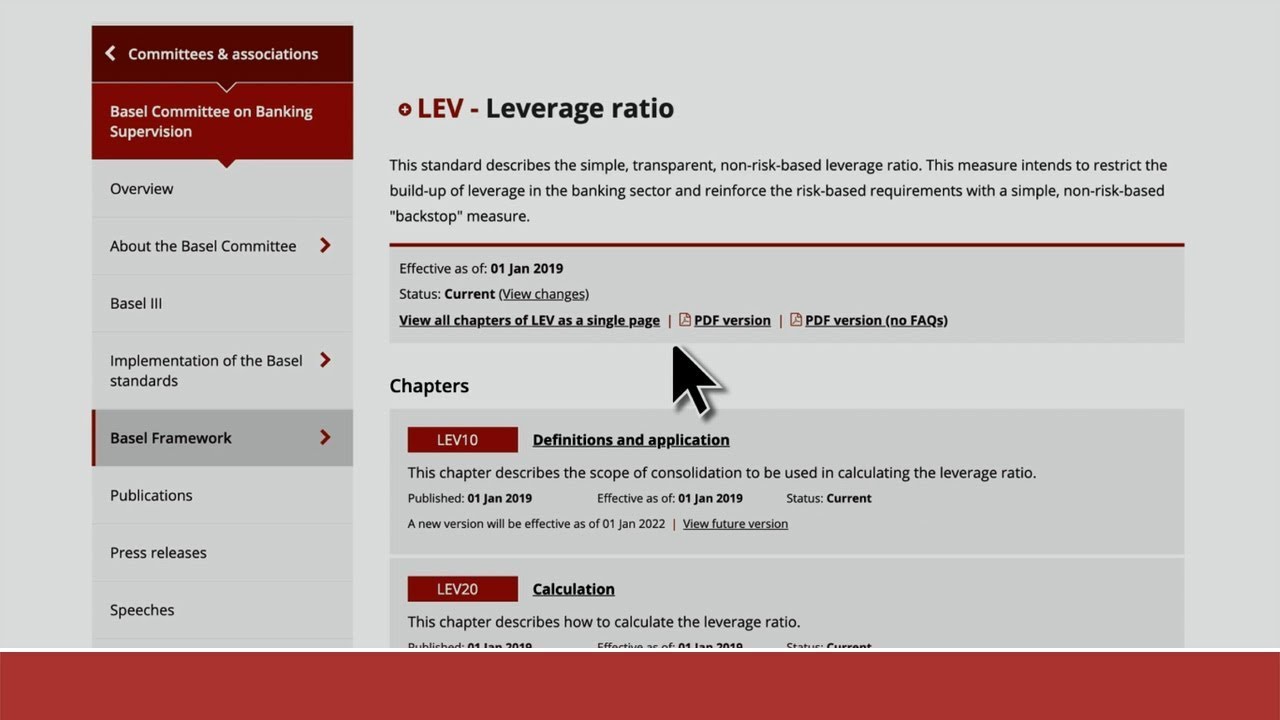
This standard describes the simple, transparent, non-risk-based leverage ratio. This measure intends to restrict the build-up of leverage in the banking sector and reinforce the risk-based requirements with a simple, non-risk-based "backstop" measure.
This standard describes the Liquidity Coverage Ratio, a measure which promotes the short-term resilience of a bank's liquidity risk profile.
The net stable funding ratio requires banks to maintain a stable funding profile in relation to the composition of their assets and off-balance-sheet activities.
Large exposures regulation limits the maximum loss that a bank could face in the event of a sudden counterparty failure to a level that does not endanger the bank's solvency. This standard requires banks to measure their exposures to a single counterparty or a group of connected counterparties and limit the size of large exposures in relation to their capital.
This standard establishes minimum standards for margin requirements for non-centrally cleared derivatives. Such requirements reduce systemic risk with respect to non-standardised derivatives by reducing contagion and spillover risks and promoting central clearing.
The Pillar 2 supervisory review process ensures that banks have adequate capital and liquidity to support all the risks in their business, especially with respect to risks not fully captured by the Pillar 1 process, and encourages good risk management.
This standard sets out disclosure requirements, which aim to encourage market discipline.
The Basel Core Principles provide a comprehensive standard for establishing a sound foundation for the regulation, supervision, governance and risk management of the banking sector.