High-quality liquid assets
This chapter defines the qualifying criteria for high-quality liquid assets.
- Effective as of: 15 Dec 2019
- Last update: 05 Jun 2020
- Status Current
Introduction
30.1
The numerator of the Liquidity Coverage Ratio (LCR) is the "stock of high-quality liquid assets (HQLA)". Under the standard, banks must hold a stock of unencumbered HQLA to cover the total net cash outflows (as defined in LCR40) over a 30-day period under the stress scenario prescribed in LCR20. In order to qualify as HQLA, assets should be liquid in markets during a time of stress and, ideally, be central bank eligible. The following paragraphs set out the characteristics that such assets should generally possess and the operational requirements that they should satisfy.1
FAQ11 Footnote, 1 FAQ
| 1 | Refer to the sections on “Definition of HQLA” (LCR30.30 to LCR30.47) and “Operational requirements” (LCR30.13 to LCR30.28) for the characteristics that an asset must meet to be part of the stock of HQLA and the definition of “unencumbered” respectively. |
| FAQ1 | Regarding the reform of benchmark reference rates, what guidance can the Committee provide on the assessment of eligibility of instruments as HQLA? Solely for the purpose of implementing benchmark rate reforms, when a type of instrument that references an interbank offered rate (IBOR) and has historically qualified as eligible HQLA is being replaced with an equivalent type of instrument that references an alternative references rate, supervisors can take into account anticipated increases in the liquidity of the replacement instrument during the transition period when determining whether it qualifies as HQLA. |
Characteristics of HQLA
30.2
Assets are considered to be HQLA if they can be easily and immediately converted into cash at little or no loss of value. The liquidity of an asset depends on the underlying stress scenario, the volume to be monetised and the timeframe considered. Nevertheless, there are certain assets that are more likely to generate funds without incurring large discounts in sale or repurchase agreement (repo) markets due to fire-sales even in times of stress. This section outlines the factors that influence whether or not the market for an asset can be relied upon to raise liquidity when considered in the context of possible stresses. These factors should assist supervisors in determining which assets, despite meeting the criteria from LCR30.40 to LCR30.45, are not sufficiently liquid in private markets to be included in the stock of HQLA.
30.3
As outlined by the characteristics described below, the test of whether liquid assets are of “high quality” is that, by way of sale or repo, their liquidity-generating capacity is assumed to remain intact even in periods of severe idiosyncratic and market stress. Lower-quality assets typically fail to meet that test. An attempt by a bank to raise liquidity from lower-quality assets under conditions of severe market stress would entail acceptance of a large fire-sale discount or haircut to compensate for high market risk. That may not only erode the market’s confidence in the bank, but would also generate mark-to-market losses for banks holding similar instruments and add to the pressure on their liquidity position, thus encouraging further fire sales and declines in prices and market liquidity. In these circumstances, private market liquidity for such instruments is likely to disappear quickly.
30.4
HQLA (except Level 2B assets as defined below in LCR30.44 to LCR30.46) should ideally be eligible at central banks2 for intraday liquidity needs and overnight liquidity facilities. In the past, central banks have provided a further backstop to the supply of banking system liquidity under conditions of severe stress. Central bank eligibility should thus provide additional confidence that banks are holding assets that could be used in events of severe stress without damaging the broader financial system. That in turn would raise confidence in the safety and soundness of liquidity risk management in the banking system.
1 Footnote
| 2 | In most jurisdictions, HQLA should be central bank eligible in addition to being liquid in markets during stressed periods. In jurisdictions where central bank eligibility is limited to an extremely narrow list of assets, a supervisor may allow unencumbered, non-central bank eligible assets that meet the qualifying criteria for Level 1 or Level 2 assets to count as part of its stock (see Definition of HQLA beginning from LCR30.30). |
30.5
However, central bank eligibility does not by itself constitute the basis for the categorisation of an asset as HQLA.
Fundamental characteristics
30.6
Low risk: assets that are less risky tend to have higher liquidity. High credit standing of the issuer and a low degree of subordination increase an asset’s liquidity. Low sensitivity to interest rate and market risk, low legal risk, low inflation risk and denomination in a convertible currency with low foreign exchange risk all enhance an asset’s liquidity.
30.7
Ease and certainty of valuation: an asset’s liquidity increases if market participants are more likely to agree on its valuation. Assets with more standardised, homogenous and simple structures tend to be more fungible, promoting liquidity. The pricing formula of a high-quality liquid asset must be easy to calculate and not depend on strong assumptions. The inputs into the pricing formula must also be publicly available. In practice, this should exclude most structured or exotic products.
30.8
Low correlation with risky assets: the stock of HQLA should not be subject to wrong-way (highly correlated) risk. For example, assets issued by financial institutions are more likely to be illiquid in times of liquidity stress in the banking sector.
30.9
Listed on a developed and recognised exchange: being listed increases an asset’s transparency.
Market-related characteristics:
30.10
Active and sizable market: the asset should have active outright sale or repo markets at all times. This means that:
- There should be historical evidence of market breadth and market depth. This could be demonstrated by low bid-ask spreads, high trading volumes, and a large and diverse number of market participants. Diversity of market participants reduces market concentration and increases the reliability of the liquidity in the market.
- There should be robust market infrastructure in place. The presence of multiple committed market makers increases liquidity as quotes will most likely be available for buying or selling HQLA.
30.11
Low volatility: Assets whose prices remain relatively stable and are less prone to sharp price declines over time will have a lower probability of triggering forced sales to meet liquidity requirements. Volatility of traded prices and spreads over benchmarks are simple proxy measures of market volatility. There should be historical evidence of relative stability of market terms (eg prices and haircuts) and volumes during stressed periods.
30.12
Flight to quality: historically, the market has shown tendencies to move into these types of assets in a systemic crisis. The correlation between proxies of market liquidity and banking system stress is one simple measure that could be used.
Operational requirements
30.13
All assets in the stock of HQLA are subject to the following operational requirements. The purpose of the operational requirements is to recognise that not all assets outlined in LCR30.40 to LCR30.45 that meet the asset class, risk-weighting and credit-rating criteria should be eligible for the stock as there are other operational restrictions on the availability of HQLA that can prevent timely monetisation during a stress period.
30.14
These operational requirements are designed to ensure that the stock of HQLA is managed in such a way that the bank can, and is able to demonstrate that it can, immediately use the stock of assets as a source of contingent funds; and that the stock of assets is available for the bank to convert into cash through outright sale or repo, to fill funding gaps between cash inflows and outflows at any time during the 30-day stress period, with no restriction on the use of the liquidity generated.
30.15
A bank must periodically monetise a representative proportion of the assets in the stock through repo or outright sale, in order to test its access to the market, the effectiveness of its processes for monetisation, the availability of the assets, and to minimise the risk of negative signalling during a period of actual stress. This requirement for periodic monetisation may be satisfied by transactions carried out through a bank’s normal course of business.
FAQ11 FAQ
| FAQ1 | What is “a representative proportion of the assets in the stock” banks are supposed to “periodically monetise … through repo or outright sale”? The extent, subject and frequency of HQLA monetisation necessary to comply with LCR30.15 should be assessed on a case by case basis. It is generally the responsibility of banks to incorporate the intent of LCR30.15 in their management of liquid assets and be able to demonstrate to supervisors an approach which is appropriate rather than ex ante stipulations. |
30.16
All assets in the stock must be unencumbered. “Unencumbered” means free of legal, regulatory, contractual or other restrictions on the ability of the bank to liquidate, sell, transfer or assign the asset. An asset in the stock must not be pledged (either explicitly or implicitly) to secure, collateralise or credit-enhance any transaction, nor be designated to cover operational costs (such as rents and salaries). Assets received in reverse repo and securities financing transactions that are held at the bank, have not been rehypothecated, and are legally and contractually available for the bank's use, can be considered as part of the stock of HQLA. In addition, assets which qualify for the stock of HQLA that have been pre-positioned or deposited with, or pledged to, the central bank or a public sector entity (PSE) but have not been used to generate liquidity may be included in the stock.3
FAQ1, FAQ21 Footnote, 2 FAQs
| 3 | If a bank has deposited, pre-positioned or pledged Level 1, Level 2 and other assets in a collateral pool and no specific securities are assigned as collateral for any transactions, it may assume that assets are encumbered in order of increasing liquidity value in the LCR, ie assets ineligible for the stock of HQLA are assigned first, followed by Level 2B assets, then Level 2A and finally Level 1. This determination must be made in compliance with any requirements, such as concentration or diversification, of the central bank or PSE. |
| FAQ1 | A bank has a reverse repurchase agreement, receiving collateral that consists of a pool of assets including non-HQLA. Can the whole portion of Level 1 and Level 2 assets of the collateral basket be counted towards HQLA (subject to the other requirements on HQLA-eligible assets)? An HQLA-eligible asset received as a component of a pool of collateral for a secured transaction (eg reverse repo) can be included in the stock of HQLA (with associated haircuts) to the extent that it can be monetised separately. |
| FAQ2 | If a bank pledges a pool of HQLA and non-HQLA collateral with a clearing entity such as a central counterparty against secured funding transactions, may it count any HQLA-eligible securities that are held as part of the collateral pool, but remain unused at end-of-day as part of the stock of HQLA? Does this requirement apply to derivatives as well? The bank may count the unused portion of HQLA-eligible collateral pledged towards its stock of HQLA (with associated haircuts). If the bank cannot determine which specific assets remain unused, it may assume that assets are encumbered in order of increasing liquidity value, consistent with the methodology set out in footnote 3 of LCR30. Assets in a pool that is intended to (exclusively or additionally) collateralise derivatives transactions are not readily available within the meaning of the operational requirements. |
30.17
A bank must exclude from the stock those assets that, although meeting the definition of “unencumbered” specified in LCR30.16, the bank does not have the operational capability to monetise to meet outflows during the stress period. Operational capability to monetise assets requires having procedures and appropriate systems in place, including providing the function identified in LCR30.18 with access to all necessary information to execute monetisation of any asset at any time. Monetisation of the asset must be executable, from an operational perspective, in the standard settlement period for the asset class in the relevant jurisdiction.
30.18
The stock must be under the control of the function charged with managing the liquidity of the bank (eg the treasurer), meaning the function has the continuous authority, and legal and operational capability, to monetise any asset in the stock. Control must be evidenced either by maintaining assets in a separate pool managed by the function with the sole intent for use as a source of contingent funds, or by demonstrating that the function can monetise the asset at any point in the 30-day stress period and that the proceeds of doing so are available to the function throughout the 30-day stress period without directly conflicting with a stated business or risk-management strategy. For example, an asset should not be included in the stock if the sale of that asset, without replacement throughout the 30-day period, would remove a hedge that would create an open risk position in excess of internal limits.
30.19
A bank is permitted to hedge the market risk associated with ownership of the stock of HQLA and still include the assets in the stock. If it chooses to hedge the market risk, the bank must take into account (in the market value applied to each asset) the cash outflow that would arise if the hedge were to be closed out early (in the event of the asset being sold).
30.20
In accordance with Principle 9 of the Sound Principles, a bank “should monitor the legal entity and physical location where collateral is held and how it may be mobilised in a timely manner”. Specifically, it should have a policy in place that identifies legal entities, geographical locations, currencies and specific custodial or bank accounts where HQLA are held. In addition, the bank should determine whether any such assets should be excluded for operational reasons and therefore have the ability to determine the composition of its stock on a daily basis.
30.21
As noted in LCR10.7 and LCR10.8, qualifying HQLA that are held to meet statutory liquidity requirements at the legal entity or sub-consolidated level (where applicable) may only be included in the stock at the consolidated level to the extent that the related risks (as measured by the legal entity’s or sub-consolidated group’s net cash outflows in the LCR) are also reflected in the consolidated LCR. Any surplus of HQLA held at the legal entity can only be included in the consolidated stock if those assets would also be freely available to the consolidated (parent) entity in times of stress.
30.22
In assessing whether assets are freely transferable for regulatory purposes, banks should be aware that assets may not be freely available to the consolidated entity due to regulatory, legal, tax, accounting or other impediments. Assets held in legal entities without market access should only be included to the extent that they can be freely transferred to other entities that could monetise the assets.
30.23
In certain jurisdictions, large, deep and active repo markets do not exist for eligible asset classes, and therefore such assets are likely to be monetised through outright sale. In these circumstances, a bank must exclude from the stock of HQLA those assets where there are impediments to sale, such as large fire-sale discounts which would cause it to breach minimum solvency requirements, or requirements to hold such assets, including, but not limited to, statutory minimum inventory requirements for market-making.
30.24
Banks must not include in the stock of HQLA any assets, or liquidity generated from assets, they have received under right of rehypothecation, if the beneficial owner has the contractual right to withdraw those assets during the 30-day stress period.4
30.25
Assets received as collateral for derivatives transactions that are not segregated and are legally able to be rehypothecated may be included in the stock of HQLA provided that the bank records an appropriate outflow for the associated risks as set out in LCR40.49.
30.26
As stated in Principle 8 of the Sound Principles, a bank should actively manage its intraday liquidity positions and risks to meet payment and settlement obligations on a timely basis under both normal and stressed conditions and thus contribute to the smooth functioning of payment and settlement systems. Banks and regulators should be aware that the LCR stress scenario does not cover expected or unexpected intraday liquidity needs.
30.27
While the LCR must be met and reported in a single currency, banks should be able to meet their liquidity needs in each currency and maintain HQLA consistent with the distribution of their liquidity needs by currency. The bank should be able to use the stock to generate liquidity in the currency and jurisdiction in which the net cash outflows arise. As such, the LCR by currency should be monitored and reported to allow the bank and its supervisor to track any potential currency mismatch issues that could arise, as outlined in SRP50. In managing foreign exchange liquidity risk, the bank should take into account the risk that its ability to swap currencies and access the relevant foreign exchange markets may erode rapidly under stressed conditions. It should be aware that sudden, adverse exchange rate movements could sharply widen existing mismatched positions and alter the effectiveness of any foreign exchange hedges in place.
30.28
In order to mitigate cliff effects that could arise, if an eligible liquid asset became ineligible (eg due to rating downgrade), a bank is permitted to keep such assets in its stock of liquid assets for an additional 30 calendar days. This would allow the bank additional time to adjust its stock as needed or replace the asset.
Diversification of the stock of HQLA
30.29
The stock of HQLA should be well diversified within the asset classes themselves (except for sovereign debt of the bank’s home jurisdiction or from the jurisdiction in which the bank operates; central bank reserves; central bank debt securities; and cash). Although some asset classes are more likely to remain liquid irrespective of circumstances, ex ante it is not possible to know with certainty which specific assets within each asset class might be subject to shocks ex post. Banks should therefore have policies and limits in place in order to avoid concentration with respect to asset types, issue and issuer types, and currency (consistent with the distribution of net cash outflows by currency) within asset classes.
Definition of HQLA
30.31
There are two categories of assets that can be included in the stock. Assets to be included in each category are those that the bank is holding on the first day of the stress period, irrespective of their residual maturity. “Level 1” assets can be included without limit, while “Level 2” assets can only comprise up to 40% of the stock.
30.32
Some jurisdictions may have an insufficient supply of Level 1 assets (or both Level 1 and Level 2 assets) in their domestic currency to meet the aggregate demand of banks with significant exposures in this currency. To address this situation, the Committee has developed alternative treatments for holdings in the stock of HQLA, which are expected to apply to a limited number of currencies and jurisdictions. These alternative treatments and the eligibility criteria are set out in LCR31.
30.33
Supervisors may also choose to include within Level 2 an additional class of assets (Level 2B assets). If included, these assets must not comprise more than 15% of the total stock of HQLA. They must also be included within the overall 40% cap on Level 2 assets.
30.34
The 40% cap on Level 2 assets and the 15% cap on Level 2B assets must be determined after the application of required haircuts, and after taking into account the unwind of short-term securities financing transactions and collateral swap transactions maturing within 30 calendar days that involve the exchange of HQLA.
30.35
The maximum amount of adjusted Level 2 assets is equal to two-thirds of the adjusted amount of Level 1 assets after haircuts have been applied. The calculation of the 40% cap on Level 2 assets will take into account any reduction in eligible Level 2B assets on account of the 15% cap on Level 2B assets.5
1 Footnote
| 5 | When determining the calculation of the 15% and 40% caps, supervisors may, as an additional requirement, separately consider the size of the pool of Level 2 and Level 2B assets on an unadjusted basis. |
30.36
Further, the calculation of the 15% cap on Level 2B assets must take into account the impact on the stock of HQLA of the amounts of HQLA involved in secured funding, secured lending and collateral swap transactions maturing within 30 calendar days. The maximum amount of adjusted Level 2B assets is equal to the ratio of 15/85 times the sum of the adjusted amounts of Level 1 and Level 2A assets, or, in cases where the 40% cap is binding, up to a maximum of 1/4 times the adjusted amount of Level 1 assets, both after haircuts have been applied.
30.37
The adjusted amount of Level 1 assets is defined as the amount of Level 1 assets that would result after unwinding those short-term secured funding, secured lending and collateral swap transactions involving the exchange of any HQLA for any Level 1 assets (including cash) that meet, or would meet if held unencumbered, the operational requirements for HQLA set out in LCR30.13 to LCR30.25. The adjusted amount of Level 2A assets is defined as the amount of Level 2A assets that would result after unwinding those short-term secured funding, secured lending and collateral swap transactions involving the exchange of any HQLA for any Level 2A assets that meet, or would meet if held unencumbered, the operational requirements for HQLA set out in LCR30.13 to LCR30.25. The adjusted amount of Level 2B assets is defined as the amount of Level 2B assets that would result after unwinding those short-term secured funding, secured lending and collateral swap transactions involving the exchange of any HQLA for any Level 2B assets that meet, or would meet if held unencumbered, the operational requirements for HQLA set out in LCR30.13 to LCR30.25. In cases where collateral received in a short-term secured lending or collateral swap transaction would meet the operational requirements if held unencumbered, but has been rehypothecated in a short-term secured funding or collateral swap transaction, both transactions must be unwound for the purpose of calculating the adjusted HQLA amounts. In this context, short-term transactions are transactions with a maturity date up to and including 30 calendar days. Relevant haircuts must be applied prior to calculation of the respective caps.
30.38
The formula for the calculation of the stock of HQLA is as follows:

30.39
In the formula in LCR30.38, the adjustments for the 15% and the 40% are calculated as follows:


Level 1 assets
30.40
Level 1 assets can comprise an unlimited share of the pool and are not subject to a haircut under the LCR.6 However, national supervisors may wish to require haircuts for Level 1 securities based on, among other things, their sensitivity to interest rate and market risk, credit and liquidity risk, and typical repo haircuts.
1 Footnote
| 6 | For purpose of calculating the LCR, Level 1 assets in the stock of HQLA must be measured at an amount no greater than their current market value. |
30.41
Level 1 assets are limited to:
- coins and banknotes;
- central bank reserves (including required reserves),7 to the extent that the central bank policies allow them to be drawn down in times of stress;8
- marketable securities representing claims on or guaranteed by sovereigns, central banks, PSEs, the Bank for International Settlements, the International Monetary Fund, the European Central Bank and European Community, the European Stability Mechanism, the European Financial Stability Facility or multilateral development banks,9 and satisfying all of the following conditions:
- assigned a 0% risk weight under the standardised approach to credit risk;10
- traded in large, deep and active repo or cash markets, characterised by a low level of concentration;
- have a proven record as a reliable source of liquidity in the markets (through repo or outright sale) even during stressed market conditions; and
- not an obligation of a financial institution or any of its affiliated entities.11
- where the sovereign has a non-0% risk weight, sovereign or central bank debt securities issued in domestic currencies by the sovereign or central bank in the country in which the liquidity risk is being taken or in the bank's home country; and
- where the sovereign has a non-0% risk weight, domestic sovereign or central bank debt securities issued in foreign currencies are eligible up to the amount of the bank's stressed net cash outflows in that specific foreign currency stemming from the bank's operations in the jurisdiction where the bank's liquidity risk is being taken.
5 Footnotes, 2 FAQs
| 7 | In this context, central bank reserves would include banks’ overnight deposits with the central bank, and term deposits with the central bank: (i) that are explicitly and contractually repayable on notice from the depositing bank; or (ii) that constitute a loan against which the bank can borrow on a term basis or on an overnight but automatically renewable basis (only where the bank has an existing deposit with the relevant central bank). Other term deposits with central banks are not eligible for the stock of HQLA; however, if the term expires within 30 days, the term deposit could be considered as an inflow per LCR40.87. |
| 8 | Local supervisors should discuss and agree with the relevant central bank the extent to which central bank reserves should count towards the stock of liquid assets, ie the extent to which reserves are able to be drawn down in times of stress. |
| 9 | The Basel III liquidity framework follows the categorisation of market participants applied in CRE20, unless otherwise specified. |
| 10 | This paragraph includes only marketable securities that qualify for CRE20.7. When a 0% risk-weight has been assigned at national discretion according to the provision in CRE20.8, the treatment should follow LCR30.41(4) or LCR30.41(5). |
| 11 | This requires that the holder of the security must not have recourse to the financial institution or any of the financial institution's affiliated entities. In practice, this means that securities, such as government-guaranteed issuance during the financial crisis, which remain liabilities of the financial institution, would not qualify for the stock of HQLA. The only exception is when the bank also qualifies as a PSE under CRE20 where securities issued by the bank could qualify for Level 1 assets if all necessary conditions are satisfied. |
| FAQ1 | Does “the sovereign” in LCR30.41(4) and LCR30.41(5) refer to the bank’s home country, host country, the country in which the bank does not have any presence but has liquidity risk exposure denominated in that currency, or all of them? Sovereign and central bank debt securities, even with a rating below AA–, should be considered eligible as Level 1 assets only when these assets are issued by the sovereign or central bank in the bank’s home country or in host countries where the bank has a presence via a subsidiary or branch. Therefore, LCR30.41(4) and LCR30.41(5) do not apply to a country in which the bank’s only presence is liquidity risk exposures denominated in the currency of that country. |
| FAQ2 | In LCR30.41(5), could a bank use non-0% risk-weighted sovereign or central bank debt securities issued in foreign currencies to offset the amount of that specific foreign currency exposure in a country other than the issuing sovereign’s or central bank’s home country? In LCR30.41(5), the amount of non-0% risk-weighted sovereign/central bank debt issued in foreign currencies included in Level 1 is strictly limited to the foreign currency exposure in the jurisdiction of the issuing sovereign/central bank. |
Level 2 assets
30.42
Level 2 assets (comprising Level 2A assets and any Level 2B assets permitted by the supervisor) can be included in the stock of HQLA, subject to the requirement that they comprise no more than 40% of the overall stock after haircuts have been applied. The method for calculating the cap on Level 2 assets and the cap on Level 2B assets is set out in LCR30.34 to LCR30.39.
30.43
A 15% haircut is applied to the current market value of each Level 2A asset held in the stock of HQLA. Level 2A assets are limited to the following:
- Marketable securities representing claims on or guaranteed by sovereigns, central banks, PSEs or multilateral development banks that satisfy all of the following conditions:12
- assigned a 20% risk weight under CRE20;
- traded in large, deep and active repo or cash markets characterised by a low level of concentration;
- have a proven record as a reliable source of liquidity in the markets (through repo or outright sale) even during stressed market conditions (ie maximum decline of price not exceeding 10% or increase in haircut not exceeding 10 percentage points over a 30-day period during a relevant period of significant liquidity stress); and
- not an obligation of a financial institution or any of its affiliated entities.13
- Corporate debt securities (including commercial paper)14 and covered bonds15 that satisfy all the following conditions:
- in the case of corporate debt securities: not issued by a financial institution or any of its affiliated entities;
- in the case of covered bonds: not issued by the bank itself or any of its affiliated entities;
- either: (i)
have a long-term credit rating from a recognised external credit assessment institution (ECAI) of at least AA-16 or in the absence of a long-term rating, a short-term rating equivalent in quality to the long-term rating; or
(ii)do not have a credit assessment by a recognised ECAI but are internally rated as having a probability of default (PD) corresponding to a credit rating of at least AA-;
- traded in large, deep and active repo or cash markets characterised by a low level of concentration; and
- have a proven record as a reliable source of liquidity in the markets (through repo or outright sale) even during stressed market conditions: ie maximum decline of price or increase in haircut over a 30-day period during a relevant period of significant liquidity stress not exceeding 10%.
5 Footnotes, 1 FAQ
| 12 | LCR30.41(4) or LCR30.41(5) may overlap with LCR30.43(1) in terms of sovereign and central bank securities with a 20% risk weight. In such a case, the assets can be assigned to the Level 1 category according to LCR30.41(4) or LCR30.41(5), as appropriate. |
| 13 | This requires that the holder of the security must not have recourse to the financial institution or any of the financial institution's affiliated entities. In practice, this means that securities, such as government-guaranteed issuance during the financial crisis, which remain liabilities of the financial institution, would not qualify for the stock of HQLA. The only exception is when the bank also qualifies as a PSE under CRE20 where securities issued by the bank could qualify for Level 1 assets if all necessary conditions are satisfied. |
| 14 | Corporate debt securities (including commercial paper) in this respect include only plain-vanilla assets whose valuation is readily available based on standard methods and does not depend on private knowledge, ie these do not include complex structured products or subordinated debt. |
| 15 | Covered bonds are bonds issued and owned by a bank or mortgage institution and are subject by law to special public supervision designed to protect bondholders. Proceeds deriving from the issue of these bonds must be invested in conformity with the law in assets which, during the whole period of the validity of the bonds, are capable of covering claims attached to the bonds and which, in the event of the failure of the issuer, would be used on a priority basis for the reimbursement of the principal and payment of the accrued interest. |
| 16 | In the event of split ratings, the applicable rating should be determined according to the method used in the standardised approach for credit risk. Local rating scales (rather than international ratings) of a supervisor-approved ECAI that meet the eligibility criteria outlined in CRE21.2 can be recognised if corporate debt securities or covered bonds are held by a bank for local currency liquidity needs arising from its operations in that local jurisdiction. This also applies to Level 2B assets. |
| FAQ1 | While corporate debt securities with a rating between A+ and BBB– whose maximum decline of price does not exceed 20% may be included in Level 2B according to LCR30.45(2), and corporate debt securities with a rating of at least AA– whose maximum decline of price does not exceed 10% may be included in Level 2A according to LCR30.43(2), there is no explicit assignment of corporate debt securities with a rating of at least AA– whose maximum decline of price is between 10 and 20%? Corporate debt securities with a rating of at least AA– whose maximum decline of price or increase in haircuts over a 30-day period during a relevant period of significant liquidity stress is between 10 and 20% may count towards Level 2B assets provided that they meet all other requirements stated in LCR30.45(2). |
Level 2B assets
30.44
Certain additional assets (Level 2B assets) may be included in Level 2 at the discretion of national authorities. In choosing to include these assets in Level 2 for the purpose of the LCR, supervisors must ensure that such assets fully comply with the qualifying criteria. Supervisors should also ensure that banks have appropriate systems and measures to monitor and control the potential risks (eg credit and market risks) that banks could be exposed to in holding these assets.
30.45
A larger haircut is applied to the current market value of each Level 2B asset held in the stock of HQLA. Level 2B assets are limited to the following:
- Residential mortgage backed securities (RMBS) that satisfy all of the following conditions may be included in Level 2B, subject to a 25% haircut:
- not issued by, and the underlying assets have not been originated by, the bank itself or any of its affiliated entities;
- have a long-term credit rating from a recognised ECAI of AA or higher, or in the absence of a long-term rating, a short-term rating equivalent in quality to the long-term rating;
- traded in large, deep and active repo or cash markets characterised by a low level of concentration;
- have a proven record as a reliable source of liquidity in the markets (through repo or outright sale) even during stressed market conditions, ie a maximum decline of price not exceeding 20% or increase in haircut over a 30-day period not exceeding 20 percentage points during a relevant period of significant liquidity stress;
- the underlying asset pools are restricted to residential mortgages and cannot contain structured products;
- the underlying mortgages are “full recourse” loans (ie in the case of foreclosure the mortgage owner remains liable for any shortfall in sales proceeds from the property) and have a maximum loan-to-value ratio (LTV) of 80% on average at issuance; and
- the securitisations are subject to “risk retention” regulations which require issuers to retain an interest in the assets they securitise.
- Corporate debt securities (including commercial paper)17 that satisfy all of the following conditions may be included in Level 2B, subject to a 50% haircut:
- not issued by a financial institution or any of its affiliated entities;
- either: (i)
have a long-term credit rating from a recognised ECAI of at least BBB- or in the absence of a long-term rating, a short-term rating equivalent in quality to the long-term rating; or
(ii)do not have a credit assessment by a recognised ECAI but are internally rated as having a PD corresponding to a credit rating of at least BBB-;
- traded in large, deep and active repo or cash markets characterised by a low level of concentration; and
- have a proven record as a reliable source of liquidity in the markets (through repo or outright sale) even during stressed market conditions, ie a maximum decline of price not exceeding 20% or increase in haircut over a 30-day period not exceeding 20 percentage points during a relevant period of significant liquidity stress.
- Common equity shares that satisfy all of the following conditions may be included in Level 2B, subject to a 50% haircut:
- not issued by a financial institution or any of its affiliated entities;
- exchange-traded and centrally cleared;
- a constituent of major stock index (or indices) of the home jurisdiction where the liquidity risk is taken, as decided by the supervisor in the jurisdiction where the index is located;
- denominated in the domestic currency of a bank’s home jurisdiction or in the currency of the jurisdiction where a bank’s liquidity risk is taken;
- traded in large, deep and active repo or cash markets characterised by a low level of concentration; and
- have a proven record as a reliable source of liquidity in the markets (through repo or outright sale) even during stressed market conditions, ie a maximum decline of price not exceeding 40% or increase in haircut over a 30-day period not exceeding 40 percentage points during a relevant period of significant liquidity stress.
1 Footnote, 8 FAQs
| 17 | Corporate debt securities (including commercial paper) in this respect include only plain-vanilla assets whose valuation is readily available based on standard methods and does not depend on private knowledge, ie these do not include complex structured products or subordinated debt. |
| FAQ1 | Does the maximum LTV criterion of 80% mean that the average pool LTV is to be less than 80% or that each loan has to have less than 80% LTV? The LTV requirement in LCR30.45(1) refers to the weighted average (by loan balance) LTV of the portfolio of underlying mortgages, not to any individual mortgage, ie mortgages that have an LTV greater than 80% are not excluded per se. |
| FAQ2 | Does “at issuance” in LCR30.45(1) refer to the issuance of the RMBS or of the underlying mortgages? “At issuance” refers to the time when the RMBS are issued, ie the average LTV of the underlying mortgages at the time of the issuance of the RMBS must not be higher than 80%. |
| FAQ3 | While corporate debt securities rated BBB+ to BBB– may be included in Level 2B according to LCR30.45(2), there is no explicit assignment of sovereign debt securities with such a rating. How should those securities be treated? Sovereign and central bank debt securities rated BBB+ to BBB– that are not included in the definition of Level 1 assets according to LCR30.41(4) or LCR30.41(5) may be included in the definition of Level 2B assets with a 50% haircut within the 15% cap for all Level 2B assets. |
| FAQ4 | Securities representing claims on PSEs are not part of the definition of Level 2B assets in LCR30.45. Can such securities from PSEs whose risk weight under the standardised approach for credit risk is higher than 20%, but which have a rating of at least BBB– and whose maximum price decline does not exceed 20% still be classified as Level 2B? Yes, PSE debt securities with a rating of at least BBB– whose maximum decline of price or increase in haircuts over a 30-day period during a relevant period of significant liquidity stress does not exceed 20% may count towards Level 2B assets provided that they meet all other requirements stated in LCR30.45(2). |
| FAQ5 | LCR30.45(3)(c) refers to a “major stock index in the home jurisdiction or where the liquidity risk is taken, as decided by the supervisor in the jurisdiction where the index is located”. It is not clear what is meant by “taking a risk”. Equities that are a constituent of a major stock index can only be assigned to the stock of HQLA if the stock index is located within the home jurisdiction of the bank or if the bank has liquidity risk exposure through a branch or other legal entity in that jurisdiction. |
| FAQ6 | When considering which common equity shares might satisfy the criteria for Level 2B assets of a maximum decline of share price not exceeding 40% over a “relevant period of significant liquidity stress”, we assume that this criterion does not need to be applied for time periods prior to the shares’ inclusion in the major index. Indicators of volatility prior to the shares’ inclusion in the index will not be representative of current or future pricing. The criterion must be satisfied by all equity shares that enter the stock of HQLA. A consistent stressed period should be used for justification and whether the share was part of the index during that timeframe is not relevant. |
| FAQ7 | LCR30.45(3)(f) only allows equity securities that have not experienced a 40% drop in price during a 30-day period. Most stocks with a long history have dropped more than 40% (eg via crashes in 1999, 2002, 2009). In our study we saw that only young companies with a short history on the market qualify for this requirement. Hence, young risky stocks can be included but not the more stable companies/stocks. Was this really the intention? Determining the appropriate stress period for meeting market performance requirements is a matter of national discretion. However, it is not the intention of the Basel Committee to exclude all established companies and include only young companies. |
| FAQ8 | Equities eligible as Level 2B HQLA must be a constituent of a major stock index as decided by the supervisor in the jurisdiction where the index is located. Could confirmation be given on a centralised basis by the Basel Committee as to which indices are deemed to be “major” ones? The issue is the responsibility of national authorities. The Basel Committee will not provide such a list. |
30.46
In addition, supervisors may choose to include within Level 2B assets the undrawn value of any contractual committed liquidity facility (CLF) provided by a central bank, where this has not already been included in HQLA in accordance with LCR31.12. When including such facilities within Level 2B assets, the following conditions apply:
- The facility (termed a restricted-use committed liquidity facility, or RCLF) must, in normal times, be subject to a commitment fee on the total (drawn and undrawn) facility amount that is at least the greater of:
- 75 basis points per annum; or
- at least 25 basis points per annum above the difference in yield on the assets used to secure the RCLF and the yield on a representative portfolio of HQLA after adjusting for any material differences in credit risk.
- In periods of market-wide stress the commitment fee on the RCLF (drawn and undrawn amount) may be reduced, but remain subject to the minimum requirements applicable to CLFs used by countries with insufficient HQLA (set out in LCR31).
- The RCLF must be supported by unencumbered collateral of a type specified by the central bank. The collateral must be held in a form which supports immediate transfer to the central bank should the facility need to be drawn and sufficient (post-haircut) to cover the total size of the facility. Collateral used to support a RCLF cannot simultaneously be used as part of HQLA.
- Conditional on the bank being assessed to be solvent, the RCLF contract must otherwise be irrevocable prior to maturity and involve no other ex post credit decision by the central bank. The commitment period must exceed the 30-day stress period stipulated by the LCR framework.
- Central banks that offer RCLFs to banks in their jurisdiction should disclose their intention to do so and, to the extent that facilities are not available to all banks in the jurisdiction, to which class(es) of banks they may be offered. National authorities should also disclose whether RCLFs (offered domestically, or by central banks in other jurisdictions) are able to be included within the HQLA of banks within their jurisdiction. National authorities should disclose when they consider there to be a market-wide stress that justifies an easing of the RCLF terms.
Treatment of Shari’ah compliant banks
30.47
Shari’ah compliant banks face a religious prohibition on holding certain types of assets, such as interest-bearing debt securities. Even in jurisdictions that have a sufficient supply of HQLA, an insurmountable impediment to the ability of Shari’ah compliant banks to meet the LCR requirement may still exist. In such cases, national supervisors in jurisdictions in which Shari’ah compliant banks operate have the discretion to define Shari’ah compliant financial products (such as Sukuk) as alternative HQLA applicable to such banks only, subject to such conditions or haircuts that the supervisors may require. The intention of this treatment is not to allow Shari’ah compliant banks to hold fewer HQLA. The minimum LCR standard, calculated based on alternative HQLA (post-haircut) recognised as HQLA for these banks, should not be lower than the minimum LCR standard applicable to other banks in the jurisdiction concerned. National supervisors applying such treatment for Shari’ah compliant banks should comply with supervisory monitoring and disclosure obligations similar to those set out in LCR31.
FAQ11 FAQ
| FAQ1 | According to LCR30.47, “national supervisors in jurisdictions which Shari’ah compliant banks operate have the discretion to define Shari’ah compliant financial products (such as Sukuk) as alternative HQLA applicable to such banks only”. What about Shari’ah-compliant financial products that do not need alternative treatment, ie that meet the operational requirements as set out in LCR30.13 to LCR30.28 as well as the relevant conditions of the corresponding asset type as set out in LCR30.29 to LCR30.31, LCR30.33, LCR30.34, LCR30.40 to LCR30.45 and generally feature the characteristics as set out in LCR30.2 to LCR30.12, can non-Shari’ah compliant banks hold these as HQLA? Yes. The limitation to Shari’ah compliant banks applies only to Shari’ah compliant financial products that would not otherwise meet HQLA requirements. For Shari’ah-compliant financial products that meet the requirements for recognition as HQLA as set out above, any bank can count them towards its stock of HQLA. Competent authorities may further specify the HQLA eligibility of Shari’ah compliant financial products in their jurisdictions. |
This standard describes the scope of application of the Basel Framework.
This standard describes the criteria that bank capital instruments must meet to be eligible to satisfy the Basel capital requirements, as well as necessary regulatory adjustments and transitional arrangements.
This standard describes the framework for risk-based capital requirements.
This standard describes how to calculate capital requirements for credit risk.
This standard describes how to calculate capital requirements for market risk and credit valuation adjustment risk.
This standard describes how to calculate capital requirements for operational risk.
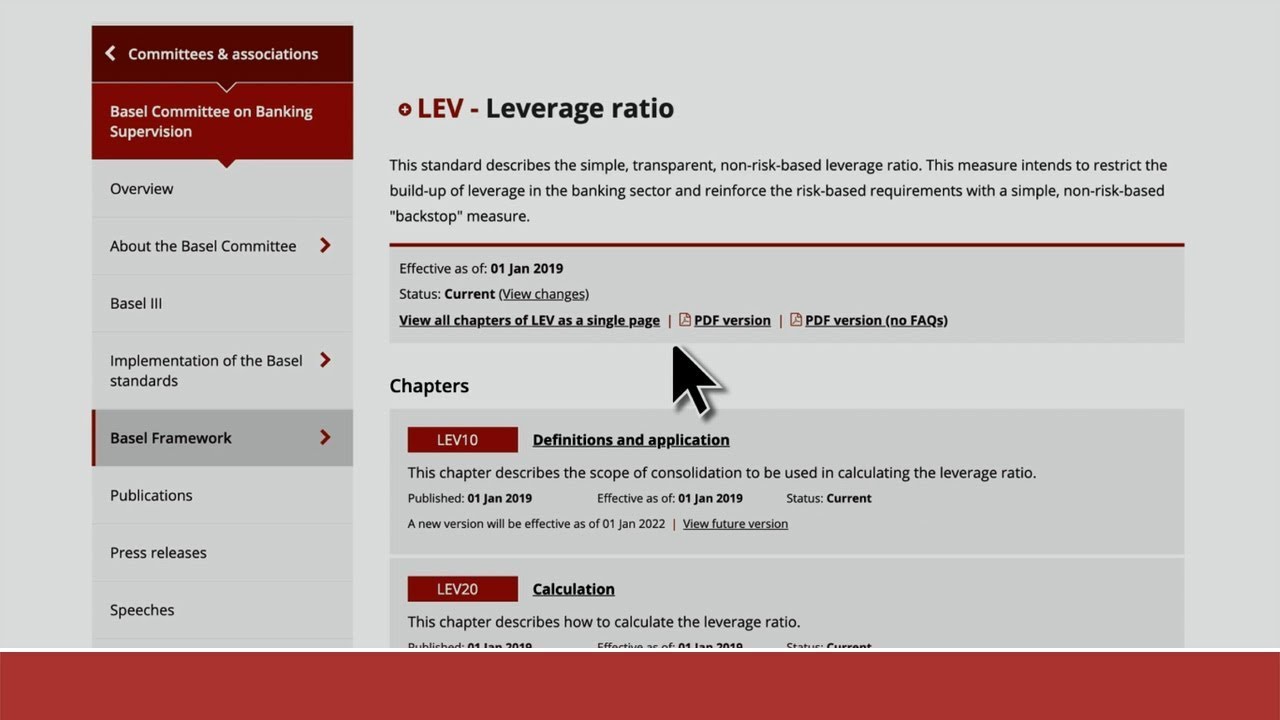
This standard describes the simple, transparent, non-risk-based leverage ratio. This measure intends to restrict the build-up of leverage in the banking sector and reinforce the risk-based requirements with a simple, non-risk-based "backstop" measure.
This standard describes the Liquidity Coverage Ratio, a measure which promotes the short-term resilience of a bank's liquidity risk profile.
The net stable funding ratio requires banks to maintain a stable funding profile in relation to the composition of their assets and off-balance-sheet activities.
Large exposures regulation limits the maximum loss that a bank could face in the event of a sudden counterparty failure to a level that does not endanger the bank's solvency. This standard requires banks to measure their exposures to a single counterparty or a group of connected counterparties and limit the size of large exposures in relation to their capital.
This standard establishes minimum standards for margin requirements for non-centrally cleared derivatives. Such requirements reduce systemic risk with respect to non-standardised derivatives by reducing contagion and spillover risks and promoting central clearing.
The Pillar 2 supervisory review process ensures that banks have adequate capital and liquidity to support all the risks in their business, especially with respect to risks not fully captured by the Pillar 1 process, and encourages good risk management.
This standard sets out disclosure requirements, which aim to encourage market discipline.
The Basel Core Principles provide a comprehensive standard for establishing a sound foundation for the regulation, supervision, governance and risk management of the banking sector.