Timeline
For more than nine decades, the Bank for International Settlements has been the main meeting place and cooperative body for central banks from across the world. Throughout its history, the BIS has played a role in many of the key events and developments that have marked and shaped the global monetary and financial system. This timeline highlights the most important of these historic events and developments, organised in five thematic categories.
The central bank community
From its establishment in 1930, the BIS has been the prime meeting place for central bankers. Today, the BIS has 63 shareholding member central banks, who collectively hold all the votes at the Bank's Annual General Meeting. This timeline lists the main events in the BIS's institutional history, and shows how it grew from a predominantly European organisation into a truly global one.
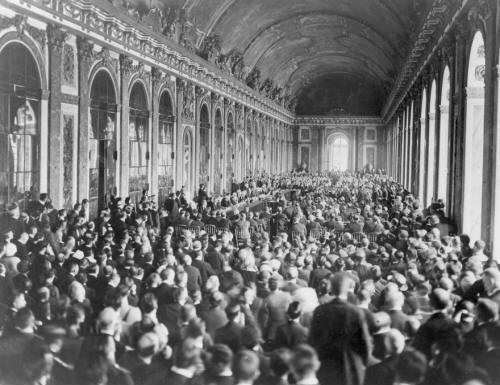
On 28 June 1919, the Treaty of Versailles was signed at the eponymous palace near Paris, in the Hall of Mirrors. It brought the First World War formally to an end and imposed a heavy reparations burden on Germany. The reparations issue was a major source of contention between the Great Powers throughout the 1920s. © BIS Historical Archive
- During the classical gold standard era - during which the value of the main currencies was fixed in gold - the central banks of the western world cooperated only sporadically, usually in times of crisis.
- During the First World War, many economies suffered from spiralling inflation and abandoned the gold standard. After the war, most countries sought to re-establish their currencies on a sound footing, based on a gold exchange standard. The 1922 League of Nations Conference in Genoa called for closer central bank cooperation to help restore the post-war monetary system.
- By 1927, all the major currencies had been stabilised on the basis of the gold exchange standard. The time seemed right to intensify the cooperation between the major central banks to help improve the stability of the international monetary system.
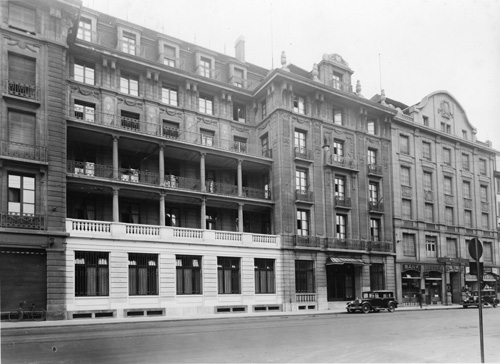
The BIS finds its home in the former Savoy Hôtel de l'Univers opposite the central railway station in Basel. The Bank will remain in this neoclassical building until the mid-1970s. © BIS Historical Archive
- In July 1929, the Hague Conference reaches an agreement to revise the reparations payments imposed on Germany by the Treaty of Versailles. This includes the establishment of an international bank to help Germany settle its reparations obligations. The central banks take this opportunity to set up the Bank for International Settlements, which is mandated both to manage reparation payments and to foster central bank cooperation.
- The second Hague Conference in January 1930 approves the plan to establish the BIS. The Bank is set up as an international organisation and as a company owned by shareholding member central banks. Basel, Switzerland, is chosen as the location. The BIS opens its doors on 17 May 1930.
- At its outset, the BIS Board of Directors comprises the governors of the BIS's founder central banks - those of Belgium, France, Germany, Italy and the United Kingdom. In addition, the central bank governors of Switzerland (as the BIS host country), the Netherlands and Sweden are elected to sit on the BIS Board. The Board of Directors meets 10 times a year in Basel to discuss the affairs of the BIS and the state of the international monetary and financial system. The US Federal Reserve and the Bank of Japan decline invitations to participate directly. Shareholding membership of the BIS is quickly extended. By the end of 1931, it stands at 24 European central banks and two non-European private sector banking groups (one each from Japan and the United States).
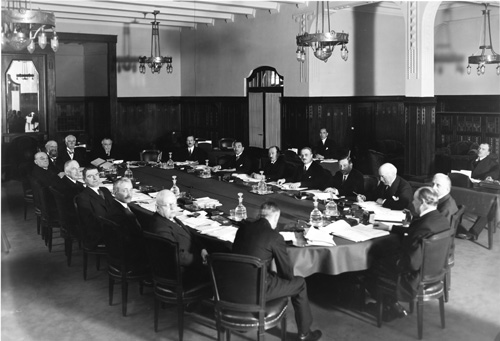
A BIS Board of Directors meeting in Basel, 1931. © BIS Historical Archive
- The onset of the Great Depression, the cancellation of reparation payments (1931-32) and the collapse of the gold exchange standard (1931-33) are serious blows to the international monetary system and to the BIS. Central bank governors nevertheless continue to attend the regular meetings of the Board of Directors. During the late 1930s, as international tensions grow, the BIS focuses its attention on technical central bank cooperation, for instance in clearing arrangements and gold custody services.
- In September 1939, the BIS Board of Directors decides to suspend meetings for the duration of the war. The BIS continues operations on a reduced scale in line with a self-imposed declaration of neutrality. However, the BIS's neutrality is viewed with increasing suspicion by the UK and US authorities as the BIS continues to engage in transactions with Germany's Reichsbank, and Axis-controlled central banks increasingly dominate the Bank's shareholding. As a result, the BIS's assets held in the United States are blocked.
- In July 1944, the Bretton Woods Conference decides to establish the International Monetary Fund (IMF) and the World Bank, and votes for the BIS's dissolution "at the earliest possible moment". The resolution is carried against the objections of many European central bankers and other influential conference participants, such as the British economist John Maynard Keynes.
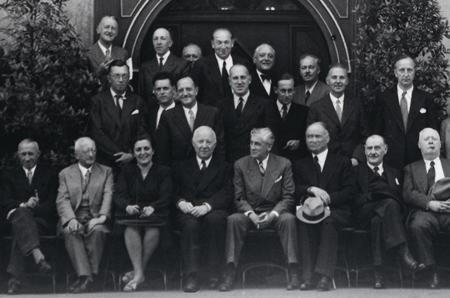
Participants in the BIS Annual General Meeting pose in front of the Schützenhaus Restaurant in Basel, May 1948. © BIS Historical Archive
- In December 1946, the BIS Board of Directors gathers in Basel for the first time since the war's end. They decide that the BIS should focus its attention on intra-European cooperation, particularly for the restoration of currency convertibility and the liberalisation of cross-border payments within Europe.
- In May 1948, the BIS signs an agreement by which it hands over to the Tripartite Commission for the Restitution of Monetary Gold some 3.7 tonnes of gold received from the German Reichsbank during the war, and which was afterwards found to have been looted from German-occupied territories. In exchange, the US authorities unblock the assets held by the BIS in the United States, and agree to give no effect to the Bretton Woods resolution calling for the Bank's dissolution.
- In September 1950, the European Payments Union (EPU) is created, with the aim of restoring multilateral trade and payments between its 18 European member states. As the EPU's designated agent bank, the BIS calculates the monthly bilateral trade balances between all EPU countries and ensures that surpluses and deficits are settled through payments or credits. The system ensures a gradual return to liberalised trade and free currency convertibility within Europe.
- At the end of 1958, the EPU is wound up. Currency convertibility in western Europe has been successfully restored. The Bretton Woods system of fixed but adjustable exchange rates takes effect.
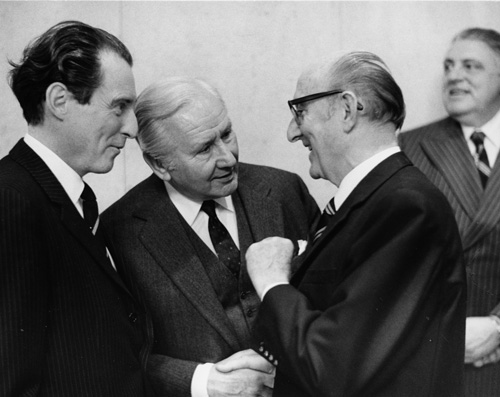
Michael Dealtry (BIS), Leslie O'Brien (Bank of England) and Otmar Emminger (Bundesbank) in discussion during a BIS meeting, 1970s. © BIS Historical Archive
- As the world's main reserve currencies, the stability of the US dollar and pound sterling on the foreign exchange markets proves critical for the viability of the Bretton Woods system of fixed and freely convertible currencies. The US monetary authorities reach out to their European counterparts at the BIS to discuss how best to support the smooth operation of the international monetary system. From December 1960 onwards, officials of the Federal Reserve regularly attend BIS meetings in Basel.
- In 1964, the European Economic Community creates a permanent Committee of Governors of the central banks of the EEC member states to monitor and discuss monetary policy issues. The EEC governors decide that the Committee should have its meetings and secretariat at the BIS in Basel.
- From 1964, officials from the Bank of Canada and the Bank of Japan join their European and US colleagues at regular meetings of the Gold and Foreign Exchange Committee at the BIS, thereby turning this into a G10 committee. It is renamed as the Markets Committee in 2002.
- In June 1969, a BIS Extraordinary General Meeting increases the Bank's capital and removes from the Bank's Statutes all references to the Young Plan (which deal with German WWI reparations). This opens the way for the Bank of Canada and the Bank of Japan to become BIS shareholding members in January 1970.
- The Reserve Bank of Australia and the South African Reserve Bank, representing two major gold-producing countries, become shareholding members of the BIS in 1970-71.
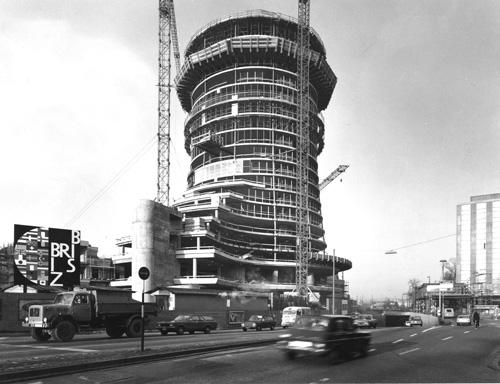
Construction of the BIS Tower, the Bank's new offices, designed by Basel architect Martin Burckhardt, starts in 1972 and is completed in 1977. © BIS Historical Archive
- A foreign exchange markets crisis and the adoption of free floating for the world's main currencies in March 1973 marks the end of the Bretton Woods fixed exchange rate regime.
- On 13 March 1979, at the BIS in Basel, the EEC central banks sign the agreement creating the European Monetary System and the European Currency Unit (ECU).
- In 1988-89, the European Community Committee for the Study of Economic and Monetary Union (Delors Committee) meets at the BIS in Basel. It outlines the conditions for a phased introduction of European monetary union.
- In July 1990, the BIS sets up a Service for Eastern European Countries to coordinate technical assistance to the central banks of the former communist bloc.
- In December 1993, the BIS's role as host and secretariat to the Committee of EC Governors comes to an end with the creation of the European Monetary Institute (EMI). In November 1994, the EMI completes its move from Basel to Frankfurt, where, in 1998, it is replaced by the European Central Bank (ECB).
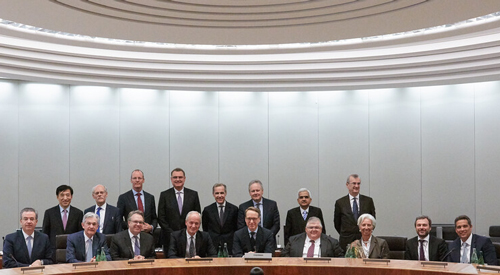
The BIS Board of Directors gathered in Basel, January 2020. Standing from left to right: Juyeol Lee, Stefan Ingves, Klaas Knot, Thomas Jordan, Mark Carney, Stephen S Poloz, Shaktikanta Das and François Villeroy de Galhau. Seated from left to right: Alejandro Díaz de León, Jerome H Powell, John C Williams, Hermann Greve, Jens Weidmann, Agustín Carstens, Christine Lagarde, Pierre Wunsch and Roberto Campos Neto. © BIS Historical Archive
- In 1996, for the first time in 25 years, the BIS's membership is enlarged as the Board of Directors invites nine emerging market central banks to become shareholding members of the BIS.
- In July 1998, the BIS opens its first Representative Office for Asia and the Pacific in Hong Kong SAR. A Host Country Agreement is concluded with the People's Republic of China.
- In July 1998, the Financial Stability Institute (FSI) is created by the BIS and the Basel Committee on Banking Supervision to assist supervisory authorities around the world in strengthening prudential supervision.
- In February 1999, the BIS Global Economy Meeting meets for the first time, comprising the governors of BIS member central banks from the major advanced and emerging market economies.
- In November 1999, a further four central banks are invited to become shareholding members of the BIS.
- In March 2001, the Asian Consultative Council is established as a forum between the BIS Board of Directors and management and the BIS's Asian member central banks.
- In November 2002, the BIS opens a Representative Office for the Americas in Mexico City. A Host Country Agreement is concluded with Mexico.
- In May 2003, six additional central banks are invited to become BIS shareholding members.
- In May 2008, the Consultative Council for the Americas is established as an advisory committee to the BIS Board of Directors.
- In 2011, four additional central banks are invited to become BIS shareholding members.
- In 2020, three additional central banks are invited to become BIS shareholding members, bringing the total to 63 member central banks. These central banks represent countries that together generate approximately 95% of global GDP.
A bank for central banks
The BIS was created as an international organisation, and also as a bank. As a bank, its clients are exclusively central banks and other international organisations. The BIS provides reserves management services to its clients. Historically, it has also played a role in providing liquidity in times of financial crisis.

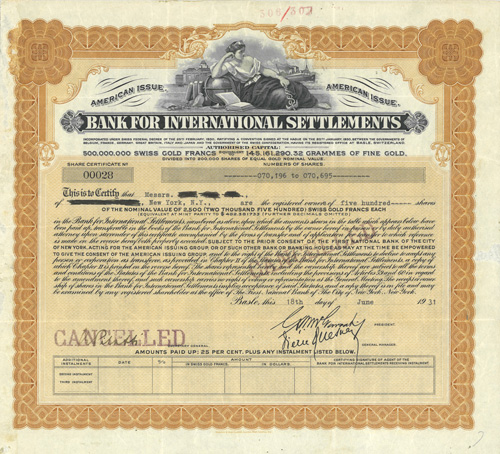
Bank for International Settlements shares certificate, American issue, 1931. © BIS Historical Archive
- The BIS Banking Department is established to manage the Bank's capital and to offer financial services to BIS member central banks. This includes opening sight accounts for BIS member central banks and offering gold custody services.
- During the 1931 financial crisis, the BIS organises and contributes to the emergency credits granted to the central banks of Austria, Hungary, Germany, Danzig and Yugoslavia.
- German reparation payments are suspended, first, temporarily through the Hoover moratorium (July 1931), and then permanently by the Lausanne Agreement (July 1932). As a result, the BIS's role in settling reparation payments comes to an end, and its balance sheet shrinks by more than half.
- As from July 1934, Germany suspends further payments through the BIS for the service of the Dawes and Young "reparation" loans (transfer moratorium). Disregarding the role of the BIS as Trustee, Germany instead concludes bilateral clearing agreements with the creditor nations.
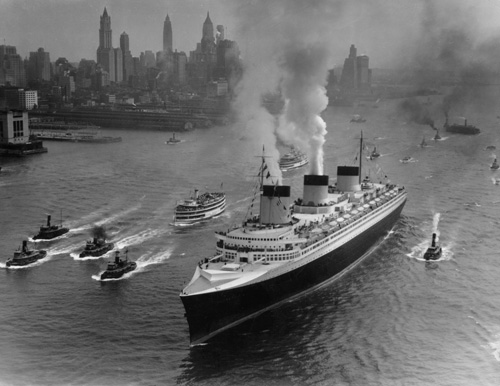
The steamship SS Normandie enters the port of New York in the 1930s. In the late 1930s, ocean liners like this one regularly transported central bank gold from Europe to the safety of the United States at the behest of the BIS. © Keystone
- In the autumn of 1938, in the wake of the Sudetenland crisis, European central banks make use of the BIS's services to ship their gold reserves from Europe to the United States. Between 1938 and 1940, the BIS ships more than 140 tonnes of gold to the safety of New York on behalf of member central banks.
- On 18 March 1939, the BIS executes a transfer order received from the Czechoslovak National Bank to transfer its gold reserves, held on a BIS account at the Bank of England, to a German Reichsbank account. It soon transpires that the order, dated three days after the entry of German troops in Prague, has been issued under duress. It should therefore never have been executed.
- From the outbreak of the Second World War in September 1939, the volume of BIS banking operations declines rapidly. However, throughout the war, the BIS continues to receive interest payments from the German Reichsbank in respect of the investments the BIS had made in German bonds back in 1930-31. The largest part of these interest payments were made in gold. After the war, it transpired that most of the gold used by the Reichsbank for these payments had been looted in the German-occupied territories.
- Faced with orders received from the central banks of the Baltic states to transfer their gold holdings with the BIS first to the German Reichsbank and later to the State Bank of the Soviet Union, the BIS decides not to execute these orders and to freeze these assets. These same gold holdings will be released 50 years later to the respective central banks when the Baltic states regain independence from the Soviet Union.
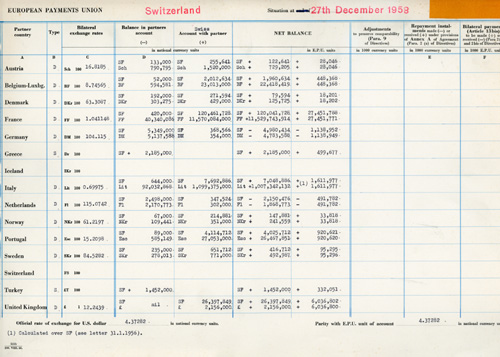
Monthly overview summarising Switzerland's balance of payments position vis-à-vis other EPU member states, December 1958. The BIS provided accounting services to the EPU and acted as its agent. © BIS Historical Archive
- In September 1950, the BIS assumes its functions as paying agent for the European Payments Union.
- The London Agreement on German Debts, signed in February 1953, provides for the resumption of German payments in respect of the Dawes and Young Loans, reinstating the BIS as trustee for both loans (this role comes to an end in 2010, when the last bonds are redeemed).
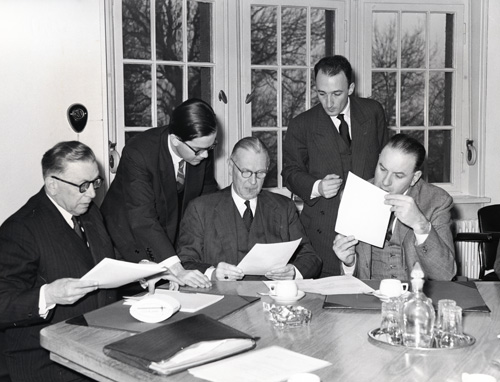
Signature of a BEF 100 million loan agreement on behalf of the European Coal and Steel Community (ECSC), 20 December 1957. © BIS Historical Archive
- In March 1961, following tensions on the foreign exchange markets, the central bank governors convened at the BIS conclude the Basel Agreement on mutual support. Short-term credits are granted to the Bank of England to shore up the pound.
- In November 1961, to counter price fluctuations on the free gold market, seven European central banks and the US Federal Reserve create a "Gold Pool" to sell and buy gold on the London market with the aim of defending the official gold price. The Gold Pool is managed by the BIS and the Bank of England.
- In 1962, the BIS and a number of central banks join the swap network inaugurated by the Federal Reserve Bank of New York, opening reciprocal credit lines that can be drawn upon in the central banks' respective currencies in order to ease pressure on the exchange markets. The central banks swap network will be very active, growing steadily throughout the 1960s and 1970s, to be revived in the wake of the 2007-09 Great Financial Crisis.
- The weakness of pound sterling on the exchange markets poses a threat to the stability of the Bretton Woods system. The BIS coordinates support for the pound through a number of central bank credits and two so-called Sterling Group Arrangements (1966 and 1968). In July 1968, the BIS coordinates a short-term credit arrangement to the Bank of France in support of the French franc. A third Sterling Group Arrangement follows in 1977.
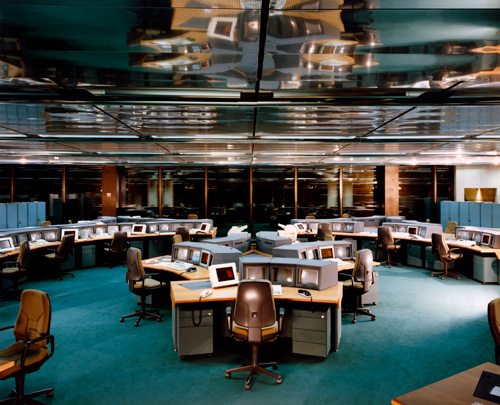
In the late 1980s, the BIS inaugurated a state-of-the-art banking dealing room to better serve its central bank customers. © BIS Historical Archive
- On 1 June 1973, the European Monetary Cooperation Fund is created. It is run by the Committee of EEC Governors and the BIS is appointed as its agent.
- In the wake of the 1982-83 sovereign debt crisis in emerging market economies, the BIS coordinates and contributes to standby credits for a number of central European and Latin American central banks - usually to bridge the gap until an IMF arrangement can be put in place.
- In March 1986, through an agreement with the ECU Banking Association, the BIS becomes the agent of the private ECU clearing and settlement system created by a number of European private banks. This function comes to an end with the euro's debut in 1999.
- In the wake of the 1995 sovereign debt crisis in emerging market economies and the 1997-98 Asian financial crisis, the BIS arranges joint central bank facilities in support of some of the affected central banks.
Staff members working in the BIS dealing room. There are dealing rooms in Basel as well as in the Representative Offices in Hong Kong SAR and Mexico City.
- From January 1999, the BIS Banking Department offers a new medium-term instrument (MTI) to provide central banks with a longer-dated liquid investment. The MTI complements the FIXBIS, the Bank's existing tradable short-term investment instrument.
- From October 2000, the BIS Representative Office for Asia and the Pacific in Hong Kong SAR opens a dealing room to conduct banking transactions with regional central banks within their own time zones.
- Immediately after the September 11 terrorist attacks in 2001, the BIS offers a US dollar facility to central banks in order to help them sustain dollar liquidity on the market.
- From April 2003, the BIS changes its unit of account from the gold franc (in use since 1930) to the IMF's Special Drawing Rights (SDRs).
- In 2003-04, the BIS, in partnership with Eastern Asian central banks, launches two Asian Bond Funds, aimed at further deepening Asia's capital markets.
- In the wake of the 2007-09 Great Financial Crisis, the BIS Banking Department takes measures to avoid a sudden influx of deposits, thereby reducing the Bank's balance sheet exposure to the crisis.
- In March 2014, the BIS, in close cooperation with the People's Bank of China, launches a renminbi government-bond fund, which in its first five years attracts investments of nearly $5 billion from 24 central banks.
- In May 2020, the BIS Representative Office for the Americas in Mexico City opens a dealing room to conduct banking transactions with regional central banks within their own time zones. With banking operations conducted from Hong Kong, Basel and Mexico the BIS Banking Department can now serve its central bank clients globally across all time zones.
- In February 2022, the BIS, under the guidance of the BIS Asian Consultative Council and in close collaboration with the Asian Development Bank, launches an Asian Green Bond Fund to help channel central bank reserves to environmentally friendly investments in the Asia-Pacific region.
Fostering the debate through research and statistics
From its outset in the 1930s, the BIS has also served as a think tank for central banks. In its research and publications it focuses on policy issues of interest to monetary and financial authorities. The BIS also plays an important role in compiling and disseminating statistics on the international financial system, particularly those that shed light on issues related to financial stability.
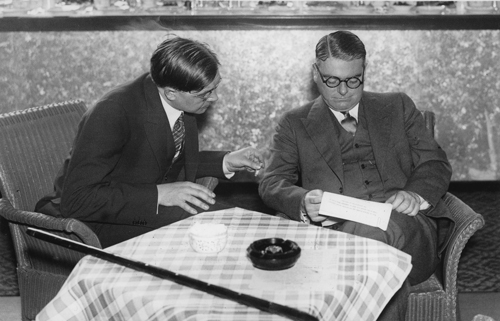
BIS Economic Adviser Per Jacobsson and BIS Vice-President Leon Fraser at the World Economic and Monetary Conference, London, 1933. © Basel University Archive
- When the BIS is set up in 1930, a Central Banking Department was opened to "study central bank policies and stimulate cooperation in this area". It was soon renamed the Monetary and Economic Department (MED). The BIS Annual Report became the primary venue for analysing the state of the world economy and financial system.
- The BIS is actively involved in the preparations of the League of Nations World Economic Conference, held in London in June-July 1933. Any hopes for a return to a renewed gold exchange standard - a move strongly supported by the BIS - are scuttled by the failure to reach a consensus.
- Throughout the Second World War, the BIS Annual Report grows considerably in size, as BIS economists collect and publish as much data and information as possible on the wartime economies. However, being cut off from developments in the Anglo-Saxon world, the BIS does not contribute to the new consensus on international monetary and financial affairs that emerges at the Bretton Woods Conference in July 1944.
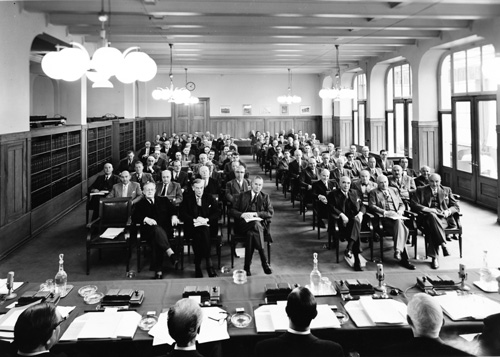
The BIS Annual General Meeting, June 1955. The AGM is traditionally the occasion to present the Bank's Annual Economic Report. © BIS Historical Archive
- During Europe's postwar recovery (1945-50), the BIS is called upon to analyse the economic and financial situation in a number of European countries, and to provide country-specific monetary policy advice.
- From 1959, the MED inaugurates a series of regular spring and autumn meetings of central bank economists. Typically, the spring meeting is devoted to a review of the state of the world economy, while the autumn meeting is dedicated to a particular topic of common interest.
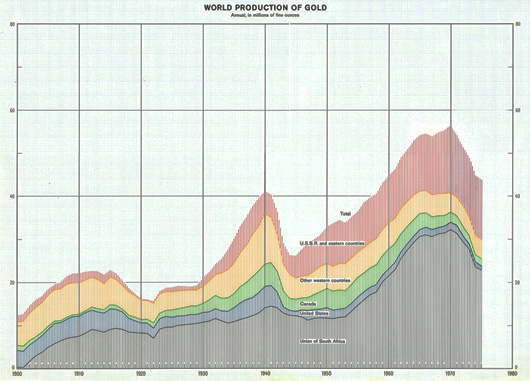
Gold played an important role in the Bretton Woods monetary system. Graph produced by the BIS Monetary and Economic Department charting the world production of gold between 1900 and 1975. © BIS Historical Archive
- In 1964, the Group of Ten countries invites the BIS to participate in a wide-ranging study on the functioning of the international monetary system and its future liquidity needs.
- In June 1964, the BIS Annual Report starts publication of eurocurrency market statistics, reflecting growing concerns among central banks over the rapid growth of these markets.
- From 1964, the newly created Gold and Foreign Exchange Committee regularly discusses developments on the international markets on the basis of statistics and reports compiled by the BIS.
- In 1971, to better monitor the development of the international eurocurrency markets, the Governors create a G10 Euro-currency Standing Committee, which meets regularly at the BIS. The MED provides secretariat services to the ECSC. It is renamed as the Committee on the Global Financial System in 1999.
- From December 1973, the BIS starts publishing quarterly eurocurrency market statistics (or locational banking statistics). From July 1983, the BIS starts publishing worldwide bank lending statistics on a consolidated basis.
- In January 1978, the BIS Data Bank is launched, an electronic repository for financial and economic time series shared between the BIS member central banks.
- In 1979, a BIS working group on international bank lending, chaired by Economic Adviser Alexandre Lamfalussy, discusses for the first time a possible macroprudential approach to financial stability issues.
- In November 1979, the BIS launches a new publications series with the publication of the first BIS Economic Paper. In April 1980, a working paper series is launched too.
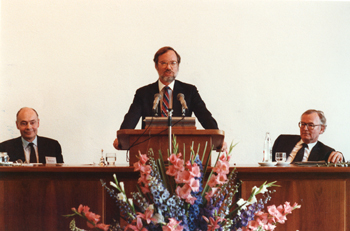
Per Jacobsson lecture in 1988 on The International Monetary System: the next Twenty-five Years. The BIS has a tradition of bringing together practitioners and researchers from both the private and public sectors. From left to right: Jeremy Morse (then Chairman of Lloyds Bank), C. Fred Bergsten (economist at the Institute for International Finance, Washington) and Christopher ("Kit") McMahon (former Deputy Governor of the Bank of England). © BIS Historical Archive
- In 1980, the G10 Governors, gathered in Basel, entrust the ECSC with the systematic monitoring of international banking developments.
- In the wake of the 1982-83 Latin American sovereign debt crisis, the BIS joins forces with the OECD (and later also with the IMF and World Bank) to publish statistics on external indebtedness (currently: joint external debt hub at www.jedh.org).
- In April 1989, the BIS conducts a first global survey of foreign exchange market activity.
- In March-April 1995, the BIS conducts its first triennial central bank survey of foreign exchange and derivatives markets activity.
- In August 1996, the BIS starts publishing its Quarterly Review of International Banking and Financial Market Developments.

Focus on global macro-financial stability, before and after the Great Financial Crisis. © BIS Historical Archive
- In August 2003, at the Jackson Hole conference for central bankers, BIS Economic Adviser William White and economist Claudio Borio present a paper articulating the BIS's emerging macroprudential perspective on financial stability issues and calling for the development of a macro-financial stability framework.
- From January 2006, the BIS hosts the Irving Fisher Committee on Central Bank Statistics (IFC), which was established in 1995 and is an affiliated member of the International Statistical Institute.
- In 2006, the MED launches a research programme focused on policy issues faced by the central banks and supervisory authorities in the Asia-Pacific region. This leads to the establishment of an Asian research network between the BIS and many Asian central banks.
- In the wake of the Great Financial Crisis (2007-09), the BIS steps up its research efforts, particularly in support of the post-crisis reform efforts coordinated through the Financial Stability Board, Basel Committee and Committee on Payments and Market Infrastructures.
- In March 2013, the BIS International Data Hub becomes operational. Its goal is to facilitate the secure storage and exchange of confidential bank data between supervisory agencies and central banks in participating jurisdictions.
- In September 2014, the first of a new series of BIS Research Network meetings takes place, bringing together researchers from academia and central banks to explore long-range research issues related to banking, monetary policy, regulation and financial stability.
- In 2016, the BIS inaugurates the Alexandre Lamfalussy Senior Research Fellowship for senior leading professionals in academia and in research institutions to promote joint research on policy-relevant topics.
- In 2020, in response to the Covid-19 crisis, the BIS Bulletin series is launched. These are short, topical notes by BIS economists that provide insights on current events in banking, markets and the larger economy.
Promoting sound financial standards and regulations
From the 1970s onwards, the BIS has become host to the main global standard setters for the financial system. The BIS member central banks and supervisory authorities, working through the Basel-based committees, have been the driving force behind this. The growing global outreach of the BIS over the last quarter century has been hugely beneficial to this process. However, the ultimate political responsibility for setting financial standards and regulations remains where it belongs: with domestic policymakers.
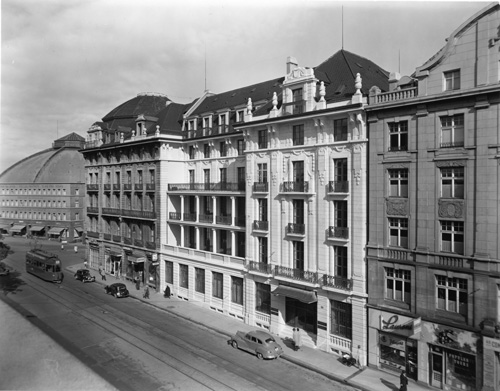
A 1950s view of the Savoy Hôtel de l'Univers in Basel, where the BIS was headquartered from 1930 to 1977. © BIS Historical Archive
- In many countries, banking supervision and regulations were first introduced or strengthened after the Great Depression of the 1930s. These efforts happened at the domestic level, and there was very little international cooperation.
- The BIS played a small role in facilitating the exchange of information on domestic regulations among its member central banks, for instance through the publication of a compendium of national financial market regulations in force.

The failure of West Germany's Bankhaus Herstatt in 1974 raised concerns regarding cross-border banking crises. © Keystone
- In 1971, the G10 Governors create the Euro-currency Standing Committee to consider policy problems arising out of the existence and operations of the eurocurrency market. The possibility of regulating the market is considered, but ultimately rejected.
- In 1974, the high-profile failures of Bankhaus Herstatt and Franklin National Bank raise the spectre of growing financial stability risks in the post-Bretton Woods world. In December 1974, the G10 Governors create the Committee on Banking Regulations and Supervisory Practices, which in 1990 becomes the Basel Committee on Banking Supervision.
- In September 1975, the BCBS issues the Basel Concordat, which sets out principles for sharing supervisory responsibility for banks' foreign branches, subsidiaries and joint ventures between host and parent (or home) supervisory authorities. In May 1983, the Basel Concordat is revised and reissued as the Principles for the supervision of banks' foreign establishments.
- In July 1988, the G10 Governors approve the Basel Capital Accord (Basel I) on the international convergence of capital measurement and capital standards. They agree to apply these standards to their own banking industry by the end of 1992 at the latest.

Stock exchanges across Asia were badly hit in the 1997-98 crisis. The Asia crisis prompted the establishment of the G20 and the Financial Stability Forum to better coordinate international efforts to strengthen financial stability. © Keystone
- In November 1990, the G10 Governors create the Committee on Payment and Settlements Systems to study policy and oversight issues related to cross-border and multicurrency interbank netting schemes. It is renamed as the Committee on Payments and Market Infrastructures in 2014 as its mandate evolves.
- In July 1992, the Basel Committee reformulates the principles for the supervision of international banking groups and their cross-border establishments as a set of minimum standards, which the G10 supervisory authorities expect each other to observe.
- In January 1996, the Joint Forum is established under the aegis of the Basel Committee, the International Organization of Securities Commissions and the International Association of Insurance Supervisors, bringing together senior bank, insurance and securities supervisors representing their supervisory constituencies.
- In September 1997, after a broad consultation with non-G10 supervisors, the Basel Committee issues its Core Principles for effective banking supervision.
- In June 2004, the central bank Governors and Heads of Supervision endorse the release of the International convergence of capital measurement and capital standards: a revised framework, better known as Basel II.
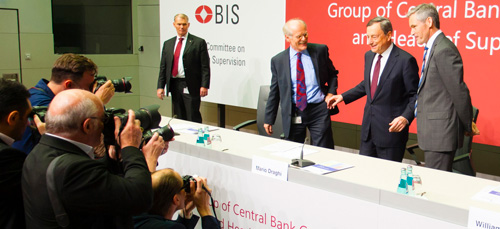
Press conference by the Basel Committee on Banking Supervision in 2017 presenting the Basel III reform package. On the right: Stefan Ingves (Governor Sveriges Riksbank and Chair BCBS), Mario Draghi (President ECB) and William Coen (Secretary General BCBS). © BIS Historical Archive
- In April 2009, the G20 sets up the Financial Stability Board (FSB) with a new macroprudential supervision mandate. The FSB is set up as a separate legal entity, with its secretariat based at the BIS in Basel.
- In the wake of the Great Financial Crisis (2007-09), the Basel Committee significantly increases its membership to 45 members from 28 jurisdictions, both from central banks and supervisory authorities. Likewise, the CPMI significantly increases its membership to comprise senior officials of 28 BIS member central banks.
- In November 2010, the G20 endorses the FSB policy framework for reducing the moral hazard posed by systemically important financial institutions.
- In June 2011, the Basel Committee releases Basel III: a global regulatory framework for more resilient banks and banking systems, introducing revised capital rules.
- In April 2012, the CPSS and IOSCO jointly release Principles for Financial Market Infrastructures, containing new international standards for payment, clearing and settlements systems.
- In 2017, the Basel Committee's oversight body, the Group of Central Bank Governors and Heads of Supervision, endorses the outstanding Basel III post-crisis regulatory reforms.
- In 2020, in view of the Covid-19 pandemic, the Basel Committee's oversight body, the GHOS, announces that the implementation date of the Basel III standards will be deferred by one year to 1 January 2023 to allow banks and supervisors to commit their full resources to the Covid-19 response.
Innovation
Innovation has always been part of the BIS's DNA. In a world of change, it is only through innovation that the BIS can remain useful and relevant to the global central bank community. Throughout the Bank's history, innovation has taken many forms.
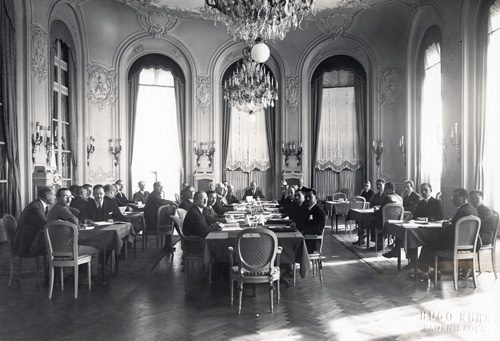
Meeting of central bank Governors and experts at the Hôtel Stéphanie in Baden-Baden, Germany, to draft the statutes and charter of the Bank for International Settlements, October-November 1929. © BIS Historical Archive
- The establishment of the BIS in 1930 is itself a significant innovation. The BIS is the first international financial organisation to be created by an international treaty. To give it the flexibility and necessary protection to perform its tasks as an international cooperation organisation and as an international bank, the BIS is given the status both of an international organisation (with the concomitant privileges and immunities) and of a shareholding company (in which all voting rights are exercised by the member central banks).
- In the late 1930s, at the request of the Universal Postal Union, the BIS develops a scheme for the multilateral settlement of surpluses and deficits arising from international postal traffic between participating countries. The scheme is based on the centralised management of gold sight accounts held on behalf of national postal administrations (through their central banks), thereby greatly reducing the need for physical gold shipments.
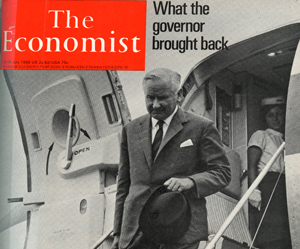
Cover page of -The Economist- in 1968. Bank of England Governor O'Brien, returning from a BIS meeting in Basel in which he had secured central bank support for sterling. © The Economist
- In 1950, the BIS is appointed agent to the European Payments Union (EPU), and develops an accounting method allowing countries to offset their bilateral trade deficits with certain countries against surpluses with others on a monthly basis, thereby allowing them to manage their scarce foreign exchange reserves more efficiently (multilateral clearing). The EPU achieves free trade and full current account convertibility among its members by 1958 and is subsequently wound up.
- In the 1960s, in order to support the Bretton Woods system of fixed but adjustable exchange rates, central bankers convening at the BIS devise several novel arrangements, some of which become established features of the international monetary system, including the central bank Gold Pool (1961-68), short- and long-term currency support arrangements (eg the Sterling Group Arrangements), multilateral surveillance and a central banks swap network.

Opening ceremony of the BIS's Representative Office for Asia and the Pacific in Hong Kong SAR, 1998. (From left to right: Ma Yuzhen (Commissioner of China's Foreign Ministry), Donald Tsang (Financial Secretary of the Hong Kong SAR), Alfons Verplaetse (President and Chairman of the BIS Board of Directors), Dai Xianglong (Governor of the People's Bank of China), Joseph Yam (First Chief Executive of the Hong Kong Monetary Authority), Andrew Crockett (General Manager of the BIS).) © BIS Historical Archive
- In 1988-89, the Committee of Governors of the central banks of the EU member states and its secretariat, based at the BIS, provide critical support to the work of the Committee for the Study of Economic and Monetary Union (Delors Committee) set up by the European Council. In its meetings in Basel, the Delors Committee develops the criteria that need to be met to achieve European Monetary Union. These criteria will be included in the Treaty on European Union (Maastricht Treaty) adopted in February 1992.
- In 1994, following the move of the newly created European Monetary Institute (the ECB's precursor) from Basel to Frankfurt, the BIS embarks on a globalisation strategy. Over the next quarter century, BIS membership nearly doubles from 33 central banks in the early 1990s to 63 in 2020, and the composition of the Board of Directors is radically overhauled to include the governors of the major emerging market economies.
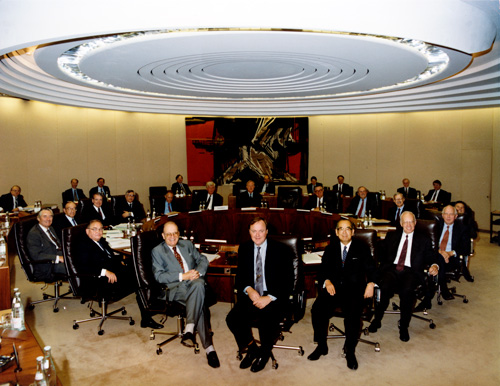
Meeting of the BIS Board of Directors in September 1994. It was the first board meeting in which the Governors of the central banks of Canada, Japan and the United States all participated. © BIS Historical Archive
- In 1977-79, in view of growing concerns about a sovereign debt build-up in emerging market economies, the Eurocurrency Standing Committee proposes the collection of country risk data directly with major financial institutions, as well as macroprudential measures to curb excessive lending. These proposals are not taken up at this point, but contribute to an emerging macroprudential approach at the BIS and beyond.
- The adoption by the G10 Governors of the Basel Capital Accord (Basel I) in 1988, and their informal commitment to implement it in their own jurisdictions provides an early and powerful example of soft law developed at the BIS. In the following decades, through the work of committees such as the Basel Committee and CPMI and of international bodies such as the FSB, soft law develops into a critical tool for international financial regulation.
- In 2000, in his capacity as chair of the G7 Financial Stability Forum, BIS General Manager Andrew Crockett launches an early call for a macroprudential approach to financial stability issues (and more specifically for countercyclical capital buffers).
- From 2000, innovative research is undertaken at the BIS and elsewhere on macroprudential policies, macro-financial stability frameworks and the financial cycle.

The Swiss National Bank (SNB) and the BIS sign the Operational Agreement on the BIS Innovation Hub Centre in Switzerland, 31 October 2019. © BIS Historical Archive
- Many themes of pre-crisis research are further developed at the BIS, in the broader central bank community and by academia immediately after the 2007-09 Great Financial Crisis. This feeds directly into the post-crisis, macroprudential reform efforts coordinated through the newly established G20 Financial Stability Board (which has its secretariat at the BIS).
- In November 2018, the BIS Board of Directors adopts Innovation BIS 2025, the Bank's new medium-term strategy. Its keystones are an increased focus on fintech and innovative ways of working.
- In 2018, the BIS joins the Network for Greening the Financial System (www.ngfs.net), set up by a group of central banks and supervisors to contribute to the development of environmental and climate risk management in the financial sector and to mobilise mainstream finance to support the transition toward a sustainable economy.
- In 2019, the BIS Innovation Hub is created to identify and develop in-depth insights into critical trends in financial technology of relevance to central banks, to explore the development of public goods to enhance the functioning of the global financial system, and to serve as a focal point for a network of central bank experts on innovation. In cooperation with the local central banks, BIS Innovation Hub centres are opened in Zurich, Hong Kong SAR and Singapore.
- In September 2019, the BIS Banking Department launches an open-ended fund for central bank investments in climate-friendly green bonds to help central banks to incorporate environmental sustainability objectives into the management of their reserves.
- In October 2020, seven central banks and the BIS publish a joint report on Central bank digital currencies: foundational principles and core features.
- In June 2021, the BIS with the Bank of France, the International Monetary Fund and the Network for Greening the Financial System (NGFS) organises a virtual Green Swan Conference on the theme "How in practice can the financial sector take immediate action against climate change-related risks?". A second Green Swan Conference takes place in May-June 2022, with the cooperation of the People's Bank of China, the ECB and the NGFS, on the theme of "Finance for the transition, a transition for Finance".
- In June 2021, the BIS establishes Innovation Hub Centres in London and Stockholm. The London Centre is set up in collaboration with the Bank of England, and its initial focus is on next generation financial market infrastructures and supervisory technology (suptech). The Nordic Centre in Stockholm is set up in collaboration with the central banks of Denmark, Iceland, Norway and Sweden. Its initial projects focus on central bank digital currencies (CBDC) and financial market infrastructures.