
Basel Committee on Banking Supervision

Basel Framework

The Basel Framework is the full set of standards of the Basel Committee on Banking Supervision (BCBS), which is the primary global standard setter for the prudential regulation of banks. The membership of the BCBS has agreed to fully implement these standards and apply them to the internationally active banks in their jurisdictions. The background page describes the framework's structure and how to navigate it.

Please provide first name.
Looks good!
Please provide first name.
Looks good!
View the framework as it was / will be on a specific date
RBC

Risk-based capital requirements

This standard describes the framework for risk-based capital requirements.

  • Effective as of: 01 Jan 2023
  • Next version 01 Jan 2027
  • Status Current

Chapters

Background to the Basel Framework

The Basel Framework is a consolidated version of the full set of standards of the Basel Committee on Banking Supervision (BCBS), which is the primary global standard setter for the prudential regulation of banks. The membership of the BCBS has agreed to fully implement these standards and apply them to the internationally active banks in their jurisdictions.

Structure

The framework comprises the 14 standards listed below. Each standard is divided into chapters, and many chapters have multiple versions, eg a chapter may have a version that is applicable now and one that will become applicable after the Basel III reforms have been implemented. The full breakdown of all chapters and versions is available here.

If you would like to explore the source material for the consolidated Basel Framework, there is a mapping table that links each of the paragraphs of the BCBS's original published standards to their locations within the first published version the framework.

Other features of the framework include:

  • Interactive cross-references to make it easier to navigate.
  • A "time traveller" feature, which lets you select a future date and see the framework as it is due to apply at that date.
  • Answers to frequently asked questions displayed directly underneath the paragraphs to which they relate.
  • A section to view all past and future planned changes to the Basel Framework.
  • An improved search function, which makes it easier to find specific content in each standard.

If you have any questions or suggestions regarding the consolidated Basel Framework, please let us know at baselcommittee@bis.org.

This standard describes the scope of application of the Basel Framework.

This standard describes the criteria that bank capital instruments must meet to be eligible to satisfy the Basel capital requirements, as well as necessary regulatory adjustments and transitional arrangements.

This standard describes the framework for risk-based capital requirements.

This standard describes how to calculate capital requirements for credit risk.

This standard describes how to calculate capital requirements for market risk and credit valuation adjustment risk.

This standard describes how to calculate capital requirements for operational risk.

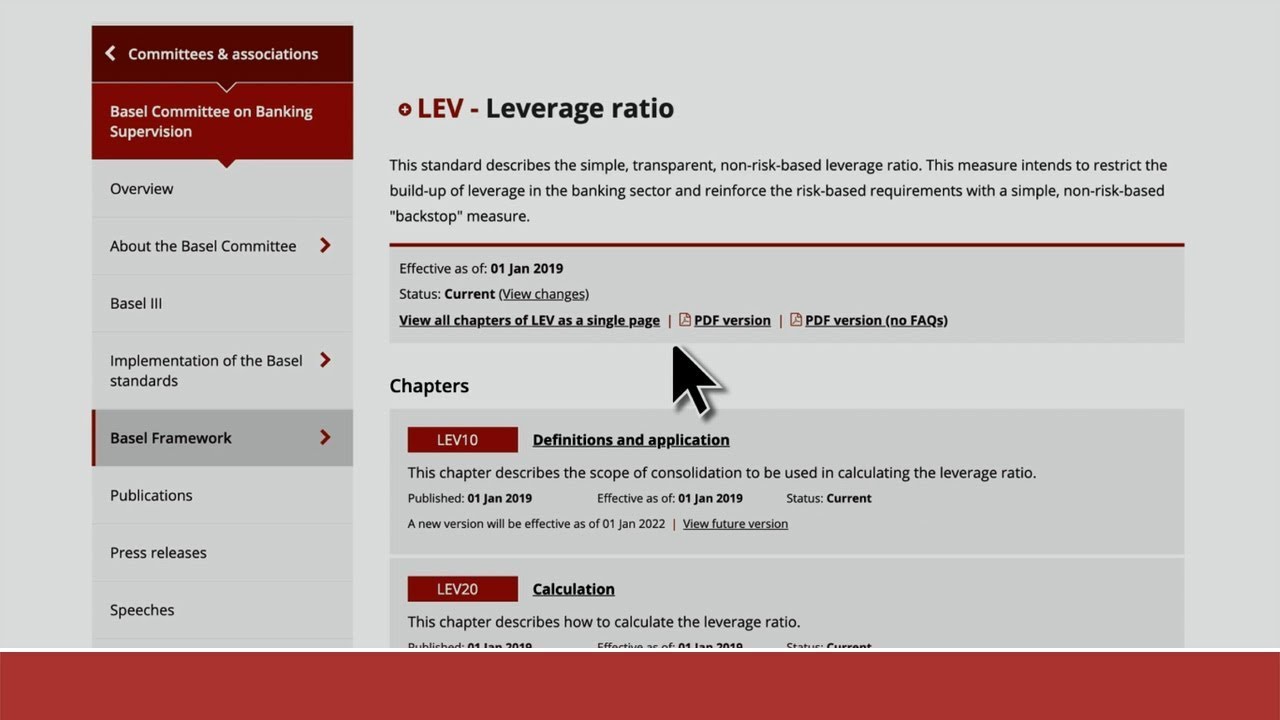
This standard describes the simple, transparent, non-risk-based leverage ratio. This measure intends to restrict the build-up of leverage in the banking sector and reinforce the risk-based requirements with a simple, non-risk-based "backstop" measure.

This standard describes the Liquidity Coverage Ratio, a measure which promotes the short-term resilience of a bank's liquidity risk profile.

The net stable funding ratio requires banks to maintain a stable funding profile in relation to the composition of their assets and off-balance-sheet activities.

Large exposures regulation limits the maximum loss that a bank could face in the event of a sudden counterparty failure to a level that does not endanger the bank's solvency. This standard requires banks to measure their exposures to a single counterparty or a group of connected counterparties and limit the size of large exposures in relation to their capital.

This standard establishes minimum standards for margin requirements for non-centrally cleared derivatives. Such requirements reduce systemic risk with respect to non-standardised derivatives by reducing contagion and spillover risks and promoting central clearing.

The Pillar 2 supervisory review process ensures that banks have adequate capital and liquidity to support all the risks in their business, especially with respect to risks not fully captured by the Pillar 1 process, and encourages good risk management.

This standard sets out disclosure requirements, which aim to encourage market discipline.

The Basel Core Principles provide a comprehensive standard for establishing a sound foundation for the regulation, supervision, governance and risk management of the banking sector.
The Basel Framework homepage lists all 14 standards together with a short description of their content. The "effective as of" date is the date by which the members of the BCBS have agreed to implement the standards. By default, this date is set to the launch date of the consolidated framework for standards that were already in force at the launch of the framework. For standards that have chapters that are due to change in the future, a "next version" date is shown.

Click on the name of any standard to get the list of chapters that it contains. By default, you will see the current versions of the standards that are in effect as of the day you are using the website. In cases where new chapter versions are due to come into effect in the future, the chapter can be accessed by clicking the "new future version" link shown at the bottom of the chapter description.

Video 9 April 2019
Navigating the Basel Framework
This tutorial explains the features of the Basel Committee's consolidated framework, bringing global standards for bank regulation and supervision together in one place.

You might also be interested in