Level 1: Self-assessments online tracker (information as of January 2026)
Jurisdictions are asked to self-assess their progress on adopting the legislation, regulations and policies that would allow them to implement the 24 Principles for FMIs and four of the five Responsibilities for authorities (A, B, C and E) within the regulatory framework that applies to FMIs.
The CPMI and IOSCO have put in place, for the Level 1 assessment programme, an online tracker that shows the jurisdictions' self-reported progress on the implementation of the PFMI for all FMI types.
This information is complemented through the Level 2 reports, which assess the completeness and consistency of the implementation measures taken by the jurisdictions against the PFMI.
Self-reported responses to the Principles
The table summarises self-reported responses for the Principles. Jurisdictions and ratings in blue have not achieved a rating of 4 (the link for each jurisdiction provides detailed information on the status of implementation and a link to relevant implementation measures).
| Jurisdiction1 | PS | CSD / SSS | CCP | TR |
|---|---|---|---|---|
| Argentina | 4 | 3/4 | 3 | 4 |
| Australia | 4 | 4 | 4 | 4 |
| Belgium | EUR2 | EU3 | EU | EU |
| Brazil | 4 | 4 | 4 | 4 |
| Canada | 4 | 4 | 4 | 4 |
| Chile | 4 | 4 | 4 | 4 |
| China | 4 | 4 | 4 | 4 |
| European Union (EU) / Eurosystem (EUR) | 4 | 4 | 4 | 4 |
| France | EUR | EU | EU | EU |
| Germany | EUR | EU | EU | EU |
| Hong Kong SAR | 4 | 4 | 4 | 4 |
| India | 4 | 4 | 4 | 4 |
| Indonesia | 4 | 4/4 | 4 | NA |
| Italy | EUR | EU | EU | EU |
| Japan | 4 | 4 | 4 | 4 |
| Korea | 4 | 4 | 4 | 4 |
| Mexico | 4 | 4 | 4 | 4 |
| Netherlands | EUR | EU | EU | EU |
| Russia | 4 | 4 | 4 | 4 |
| Saudi Arabia | 4 | 4 | 4 | 4 |
| Singapore | 4 | 4 | 4 | 4 |
| South Africa | 4 | 4 | 4 | 4 |
| Spain | EUR | EU | EU | EU |
| Sweden | 4 | EU | EU | EU |
| Switzerland | 4 | 4 | 4 | 4 |
| Turkey | 4 | 4 | 4 | 4 |
| United Kingdom | 4 | EU | EU | EU |
| United States | 4 | 4 | 4 | 1/4 |
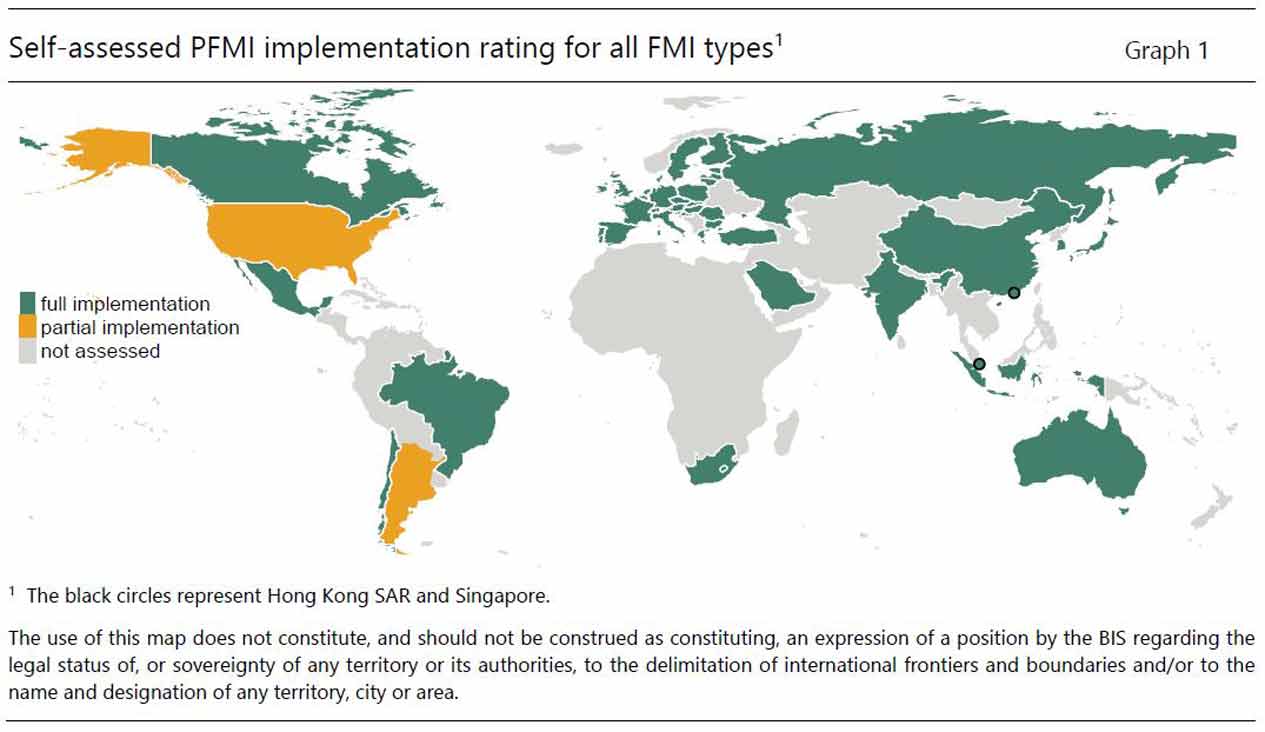
Map view of the self-assessed PFMI implementation rating for all FMI types (click to expand)
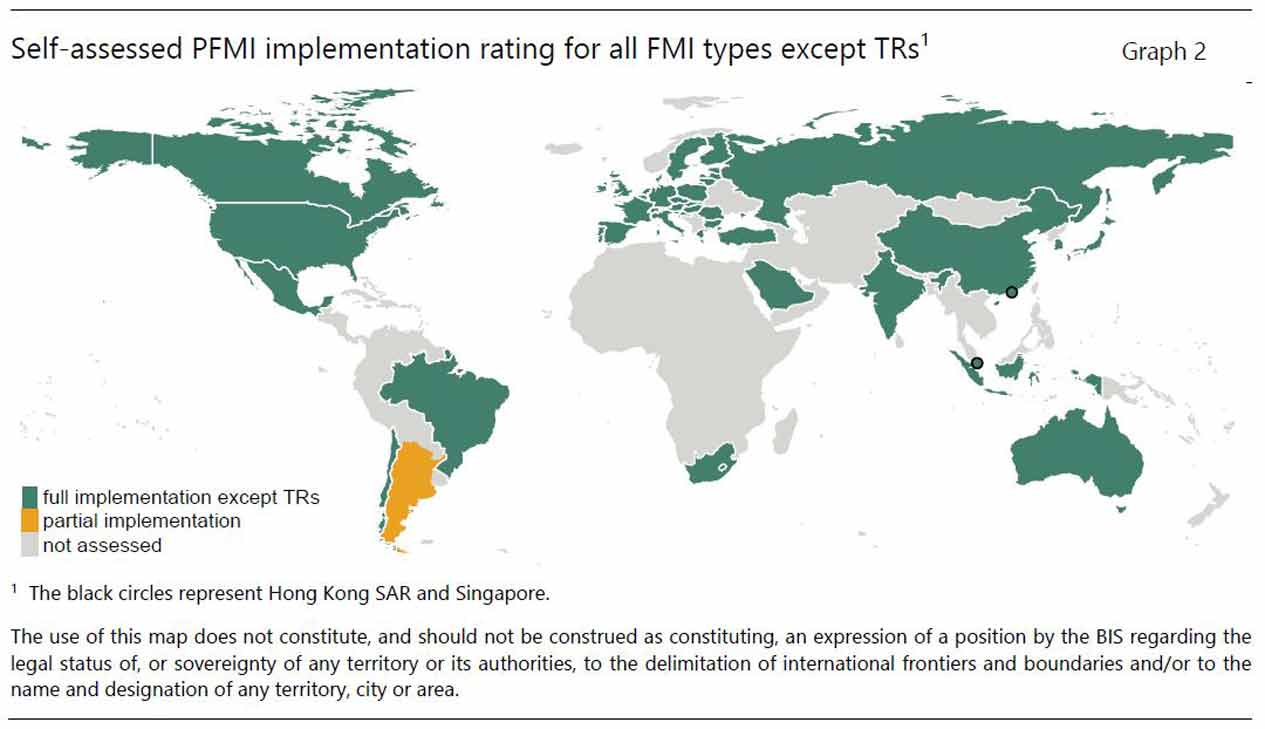
Map view of the self-assessed PFMI implementation rating for all FMI types except TRs (click to expand)
Notes
| PS | Payment systems |
|---|---|
| CSD / SSS | Central securities depositories / securities settlement systems |
| CCP | Central counterparties |
| TR | Trade repositories |
1 Rating is the same as for the Eurosystem.
2 Rating is the same as for the EU.
3 Member states of the European Union whose currency is the euro. EU rating is given to central counterparties and trade repositories, and EUR to payment systems and central securities depositories/securities settlement systems.
Self-reported responses to the Responsibilities
The table summarises self-reported responses for four Responsibilities (the link for each jurisdiction provides detailed information on the status of implementation and a link to relevant implementation measures).
| Jurisdiction1 | PS | CSD / SSS | CCP | TR |
|---|---|---|---|---|
| Argentina | 4 | 4 | 4 | 4 |
| Australia | 4 | 4 | 4 | 4 |
| Belgium | EUR1 | 4 | NA | EU2 |
| Brazil | 4 | 4 | 4 | 4 |
| Canada | 4 | 4 | 4 | 4 |
| Chile | 4 | 4 | 4 | 4 |
| China | 4 | 4 | 4 | 4 |
| European Union (EU) /Eurosystem (EUR) | 4 | NA | NA | 4 |
| France | EUR | 4 | 4 | EU |
| Germany | EUR | 4 | 4 | EU |
| Hong Kong SAR | 4 | 4 | 4 | 4 |
| India | 4 | 4 | 4 | 4 |
| Indonesia | 4 | 4 | 4 | NA |
| Italy | EUR | 4 | 4 | EU |
| Japan | 4 | 4 | 4 | 4 |
| Korea | 4 | 4 | 4 | 4 |
| Mexico | 4 | 4 | 4 | 4 |
| Netherlands | EUR | 4 | 4 | EU |
| Russia | 4 | 4 | 4 | 4 |
| Saudi Arabia | 4 | 4 | 4 | 4 |
| Singapore | 4 | 4 | 4 | 4 |
| South Africa | 4 | 4 | 4 | 4 |
| Spain | EUR | 4 | 4 | EU |
| Sweden | 4 | 4 | 4 | EU |
| Switzerland | 4 | 4 | 4 | 4 |
| Turkey | 4 | 4 | 4 | 4 |
| United Kingdom | 4 | 4 | 4 | EU |
| United States | 4 | 4 | 4 | 4 |
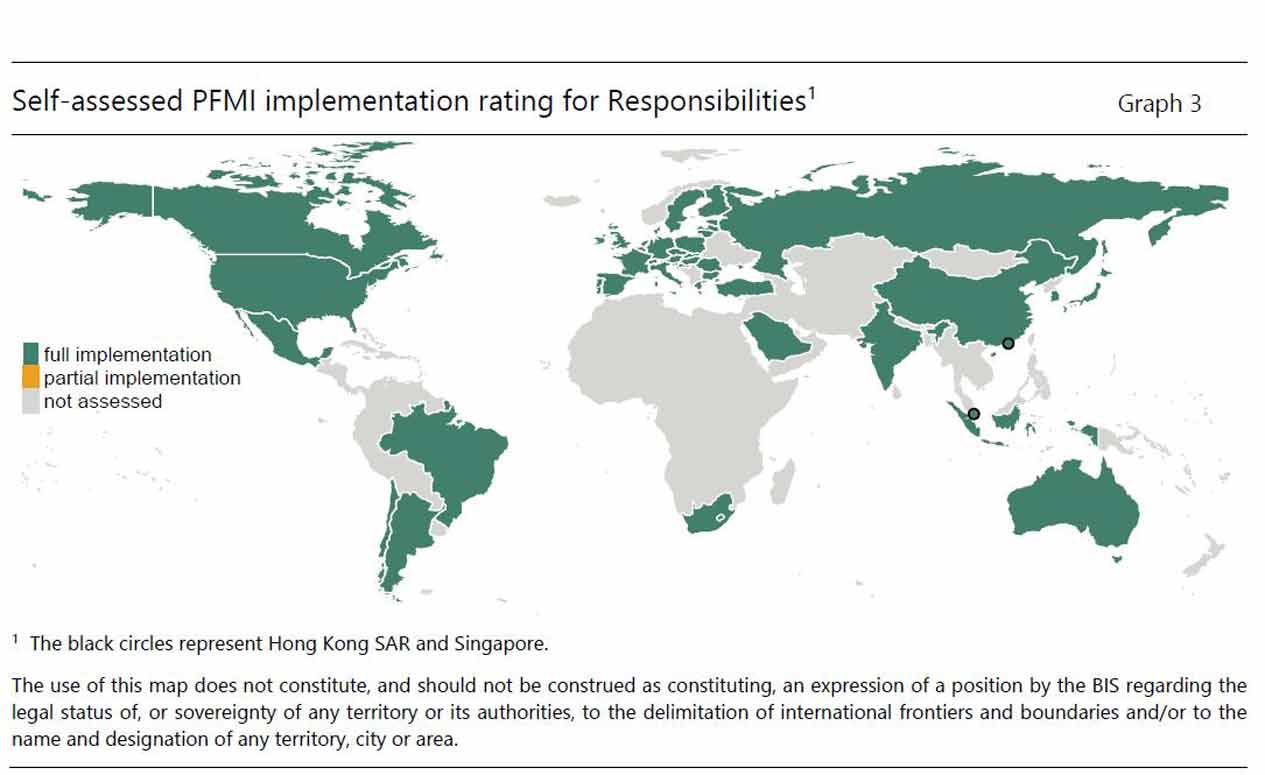
Map view of the self-assessed PFMI implementation rating for Responsibilities (click to expand)
Notes
| PS | Payment systems |
|---|---|
| CSD / SSS | Central securities depositories & securities settlement systems |
| CCP | Central counterparties |
| TR | Trade repositories |
1 FMIs within an FMI type which are under different authorities' jurisdictions and whose implementation status varies depending on the jurisdiction receive a split rating.
2 Rating is the same as for the Eurosystem.
3 Rating is the same as for the EU.
4 Member states of the European Union whose currency is the euro. EU rating is given to central counterparties and trade repositories, and EUR to payment systems and central securities depositories/securities settlement systems.
Ratings
Jurisdictions rate their level of implementation using a four-point scale:
This status corresponds to cases where some measure is needed but so far no draft has been made public to detail the planned content of the measure. This status includes cases where a jurisdiction has communicated high-level information about its implementation plans but such high-level information is not sufficient to achieve the necessary effect.
This status corresponds to cases where the draft implementation measures are already publicly available – for example, for public consultation or legislative deliberations.
This status corresponds to cases where the required implementation measures have been finalised and approved/adopted so that the relevant authorities have the necessary powers (a) to require relevant FMIs to observe the Principles (when implementation of the Principles is being addressed) or (b) to observe the Responsibilities (when implementation of the Responsibilities is being addressed). However, the FMIs are not yet required to observe the Principles or the authorities are not yet required to observe the Responsibilities.
Additional guidance to achieve a rating of “3” – The required measures to implement the PFMI are finalised and published, but:
- PFMI are not yet in effect; or
- there is a transition period until the Principles are in effect but the transition period is not specified; or
- the transition period is specified but applies to all Principles, not just a narrow subset.
This status corresponds to cases where, in addition to the required implementation measures having been finalised and approved/adopted, FMIs are expected to observe the Principles or authorities to observe the Responsibilities (depending on whether implementation of the Principles or Responsibilities is being addressed).
Where that is broadly the case but a further transitional period has been granted for FMIs in respect of full observance with a small number of aspects of the Principles that introduce significantly higher requirements than previously applied (because it is recognised that full observance of those aspects may take some time to achieve, eg for some aspects of operational risk), status “4” may also be granted provided that, in its response, the jurisdiction qualifies the status by clearly stating the relevant aspects and when the transitional period ends. In the description of status rating that is published, any such transitional arrangements are likely to be noted.
Additional guidance to achieve a rating of “4” – The required measures to implement the PFMI are finalised and published; and
- PFMI are in effect as of 1 January 2018; and
- if there is a transition period until the Principles are in effect, it is clearly articulated and only for a narrow subset of Principles; and
- links to public documents are provided for the final report
This status corresponds to cases where no relevant FMI exists that are within the scope of the PFMI. A rating of “NA” will be indicated only if no relevant regulatory measures are being taken and no such FMI is expected to develop within the jurisdiction.