Market risk
This chapter describes risks that supervisors should consider when evaluating banks' market risk practices under Pillar 2.
- Effective as of: 01 Jan 2023
- Last update: 27 Mar 2020
- Status Current
Policies and procedures for trading book eligibility
33.1
Clear policies and procedures used to determine the exposures that may be included in, and those that should be excluded from, the trading book for purposes of calculating regulatory capital are critical to ensure the consistency and integrity of a firm’s trading book. Such policies must conform to this framework. Supervisors should be satisfied that the policies and procedures clearly delineate the boundaries of the firm’s trading book, in compliance with the general principles set forth in this framework, and consistent with the bank’s risk management capabilities and practices. Supervisors should also be satisfied that transfers of positions between banking and trading books can only occur in a very limited set of circumstances. A supervisor will require a firm to modify its policies and procedures when they prove insufficient for preventing the booking in the trading book of positions that are not compliant with the general principles set forth in this framework, or not consistent with the bank’s risk management capabilities and practices.
33.2
Instruments held in the trading book must be subject to clearly defined policies and procedures, approved by senior management, that are aimed at ensuring active risk management. The application of the policies and procedures must be thoroughly documented. These policies and procedures should, at a minimum, address the following:
- The activities the bank considers to be trading or hedging of covered instruments;
- Trading strategies (including expected holding horizon and possible reactions if this limit is breached) for every covered instrument or portfolio;
- Standards regarding the extent to which a bank’s portfolio of covered instruments must be marked-to-market daily by reference to an active, liquid two-way market;
- For covered instruments that are marked-to-model, the standards for:
- Identifying the material risks of the covered instruments;
- Hedging the material risks of the covered instruments and the extent to which hedging instruments would have an active, liquid two-way market; and
- Reliably deriving estimates for the key assumptions and parameters used in the model.
- The extent to which the bank is required to generate valuations for the covered instruments that can be validated externally in a consistent manner;
- The extent to which instruments may have operational requirements that could impede the bank’s ability to effect an immediate liquidation of the covered instrument;
- The processes constituting active management of covered instruments, which must include:
- The setting of limits and ongoing monitoring for appropriateness;
- The requirement that each trading desk have a documented trading strategy and the process for monitoring covered instruments against the bank’s trading strategy, including that: (i)
for any given trading desk, bank senior management assume the responsibility that a given covered instrument or portfolio be managed with trading intent and in accordance with the trading strategy document.
(ii)The monitoring process includes evaluation of turnover and “stale positions” in order to determine compliance with specified holding periods.
- The degree of autonomy a trader has to enter into or manage covered instruments within agreed limits and according to the agreed strategy;
- The process for reporting to senior management as an integral part of the institution’s risk management process; and
- The active monitoring of instruments and risk positions with reference to market information sources, including: (i)
assessment of market liquidity and the ability to hedge instruments, risk positions or the portfolio risk profile;
(ii)analysis of changes in the market values of instruments and sensitivities due to changes in market risk factors; and
(iii)evaluation of the quality and availability of market inputs with respect to the valuation process, the level of market turnover, and the relative size of instruments traded in the market.
Policies and procedures for internal risk transfers from banking book to trading book
33.3
The bank must:
- document all internal risk transfer with its trading book, with respect to the banking book risk being hedged and the amount of such risk;
- document the details of any external third party matching hedge;
- submit a list to its supervisor of the procedures and strategies to manage the risks that the internal risk transfer desks undertake. This list must be approved by the bank’s senior management;
- ensure regular and consistent reporting of its internal risk transfer activities for risk management and control purposes. The bank must report this information to its supervisor on a regular basis.
33.4
The trading desks engaged in internal risk transfers must document all actions that have been implemented, along with contributory analysis and independent review in order to manage the risks they undertake.
33.5
The bank must have a consistent methodology for identifying and quantifying the banking book risk to be hedged through internal risk transfers. This methodology must be properly integrated in the bank’s risk management framework. The methodology must include all qualitative and quantitative regulatory requirements pertaining to trading book desks. Any material changes in the methodology must be approved by a specialised committee of the bank (eg the asset and liability management committee). The supervisor must be notified of such changes and approve of any material changes beforehand.
33.6
A bank must have a set of consistent risk management methods and internal controls in order to ensure and control the effectiveness of risk mitigation for its internal risk transfer transactions. These methods and controls must reflect the amount, types, and risks of the bank’s internal risk transfer activities and must be regularly reviewed by the bank’s risk management and control units.
Valuation
33.7
Prudent valuation policies and procedures form the foundation on which any robust assessment of market risk capital adequacy should be built. For a well diversified portfolio consisting of highly liquid cash instruments, and without market concentration, the valuation of the portfolio, combined with the minimum quantitative standards set out in this framework, may deliver sufficient capital to enable a bank, in adverse market conditions, to close out or hedge its exposures within the liquidity horizon period set out for that exposure in this framework. However, for less well diversified portfolios, for portfolios containing less liquid instruments, for portfolios with concentrations in relation to market turnover, and/or for portfolios which contain large numbers of positions that are marked to model this is less likely to be the case. In such circumstances, supervisors will consider whether a bank has sufficient capital. To the extent there is a shortfall the supervisor will react appropriately. This will usually require the bank to reduce its risks and/or hold an additional amount of capital.
Stress testing under the internal models approach
33.8
A bank must ensure that it has sufficient capital to meet the minimum capital requirements and to cover the results of its stress testing requirements specified in this framework. Supervisors will consider whether a bank has sufficient capital for these purposes, taking into account the nature and scale of the bank’s trading activities and any other relevant factors such as valuation adjustments made by the bank. To the extent that there is a shortfall, or if supervisors are not satisfied with the premise upon which the bank’s assessment of internal market risk capital adequacy is based, supervisors will take the appropriate measures. This will usually involve requiring the bank to reduce its risk exposures and/or to hold an additional amount of capital, so that its overall capital resources at least cover the Pillar 1 requirements plus the result of a stress test acceptable to the supervisor.
33.9
Where supervisors consider that limited liquidity or price transparency undermine the effectiveness of a bank’s model to capture risk, they will take appropriate measures, including requiring the exclusion of positions from the bank’s model. Supervisors should review the adequacy of the bank’s measure of the default risk charge; where the bank’s approach is inadequate, the use of the standardised charges will be required.
This standard describes the scope of application of the Basel Framework.
This standard describes the criteria that bank capital instruments must meet to be eligible to satisfy the Basel capital requirements, as well as necessary regulatory adjustments and transitional arrangements.
This standard describes the framework for risk-based capital requirements.
This standard describes how to calculate capital requirements for credit risk.
This standard describes how to calculate capital requirements for market risk and credit valuation adjustment risk.
This standard describes how to calculate capital requirements for operational risk.
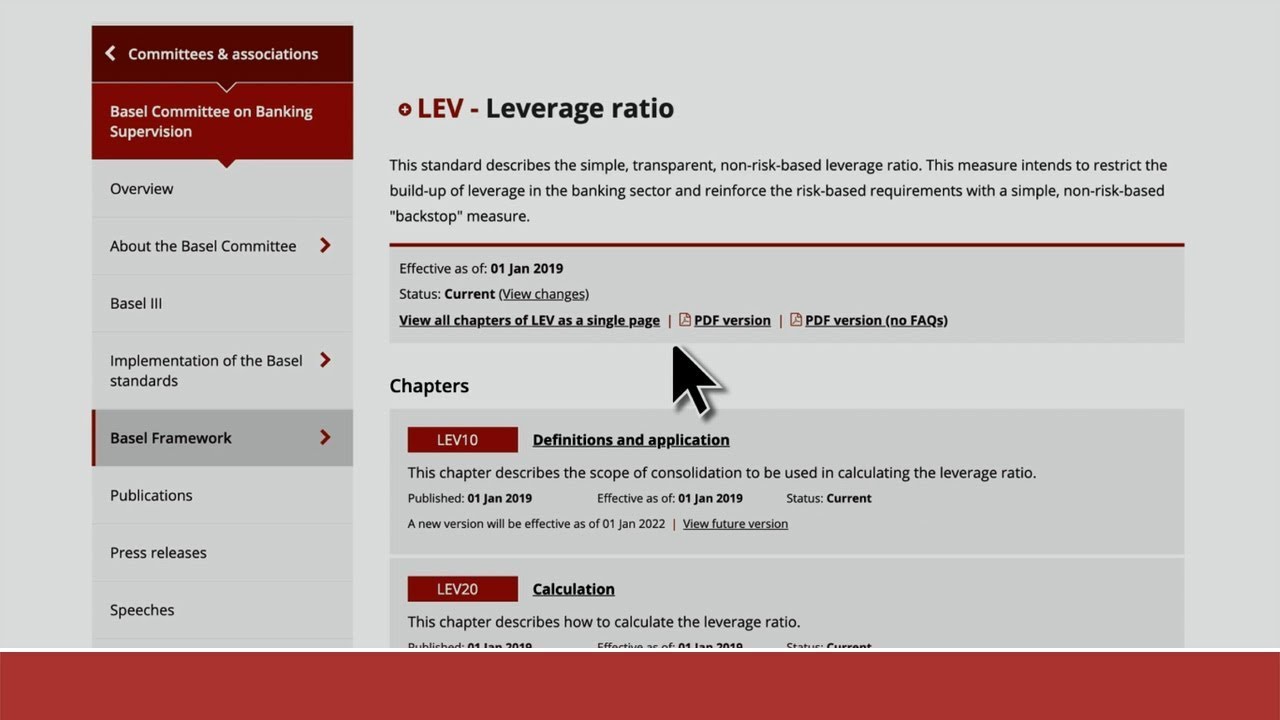
This standard describes the simple, transparent, non-risk-based leverage ratio. This measure intends to restrict the build-up of leverage in the banking sector and reinforce the risk-based requirements with a simple, non-risk-based "backstop" measure.
This standard describes the Liquidity Coverage Ratio, a measure which promotes the short-term resilience of a bank's liquidity risk profile.
The net stable funding ratio requires banks to maintain a stable funding profile in relation to the composition of their assets and off-balance-sheet activities.
Large exposures regulation limits the maximum loss that a bank could face in the event of a sudden counterparty failure to a level that does not endanger the bank's solvency. This standard requires banks to measure their exposures to a single counterparty or a group of connected counterparties and limit the size of large exposures in relation to their capital.
This standard establishes minimum standards for margin requirements for non-centrally cleared derivatives. Such requirements reduce systemic risk with respect to non-standardised derivatives by reducing contagion and spillover risks and promoting central clearing.
The Pillar 2 supervisory review process ensures that banks have adequate capital and liquidity to support all the risks in their business, especially with respect to risks not fully captured by the Pillar 1 process, and encourages good risk management.
This standard sets out disclosure requirements, which aim to encourage market discipline.
The Basel Core Principles provide a comprehensive standard for establishing a sound foundation for the regulation, supervision, governance and risk management of the banking sector.