Application guidance
This chapter summarises the components of high-quality liquid assets and the run-off factors applied to cash outflows and additional requirements under the Liquidity Coverage Ratio.
- Effective as of: 15 Dec 2019
- Last update: 15 Dec 2019
- Status Current
99.1
The table below summarises the Liquidity Coverage Ratio (LCR; percentages are factors to be multiplied by the total amount of each item).
| Item | Factor |
| Stock of high-quality liquid assets (HQLA) | |
|
|
| - Coins and bank notes - Qualifying marketable securities from sovereigns, central banks, public sector entities (PSEs) and multilateral development banks - Qualifying central bank reserves - Domestic sovereign or central bank debt for non-0% risk-weighted sovereigns | 100% |
|
|
| Level 2A assets: - Sovereign, central bank, multilateral development banks and PSE assets qualifying for 20% risk weighting - Qualifying corporate debt securities rated AA- or higher - Qualifying covered bonds rated AA- or higher | 85% |
| Level 2B assets (maximum of 15% of HQLA) |
|
| - Qualifying residential mortgage-backed securities (RMBS) | 75% |
| - Qualifying corporate debt securities rated between A+ and BBB- - Qualifying common equity shares - Sovereign, central bank and PSE debt securities rated BBB- or higher that do not qualify as a Level 1 or Level 2A asset. | 50% |
| Total value of stock of HQLA |
|
| Cash outflows | |
|
|
| Demand deposits and term deposits (less than 30 days maturity): |
|
| - Stable deposits (deposit insurance scheme meets additional criteria) | 3% |
| - Stable deposits | 5% |
| - Less stable retail deposits | 10% |
| Term deposits with residual maturity greater than 30 days | 0% |
|
|
| Demand deposits and term deposits (less than 30 days maturity) provided by small business customers: |
|
| - Stable deposits | 5% |
| - Less stable deposits | 10% |
| Operational deposits generated by clearing, custody and cash management activities | 25% |
| - Portion covered by deposit insurance | 5% |
| Cooperative banks in an institutional network (qualifying deposits with the centralised institution) | 25% |
| Non-financial corporates, sovereigns, central banks, multilateral development banks and PSEs | 40% |
| - If the entire amount fully covered by deposit insurance scheme | 20% |
| Other legal entity customers | 100% |
|
|
| - Secured funding transactions with a central bank counterparty or backed by Level 1 assets with any counterparty | 0% |
| - Secured funding transactions backed by Level 2A assets, with any counterparty | 15% |
| - Secured funding transactions backed by non-Level 1 or non-Level 2A assets, with domestic sovereigns, multilateral development banks, or domestic PSEs as a counterparty - Backed by RMBS eligible for inclusion in Level 2B | 25% |
| - Backed by other Level 2B assets | 50% |
| - All other secured funding transactions | 100% |
|
|
| Liquidity needs (eg collateral calls) related to financing transactions, derivatives and other contracts | 3 notch downgrade |
| Market valuation changes on derivatives transactions (largest absolute net 30-day collateral flows realised during the preceding 24 months) | Look-back approach |
| Valuation changes on non-Level 1 posted collateral securing derivatives | 20% |
| Excess collateral held by a bank related to derivative transactions that could contractually be called at any time by its counterparty | 100% |
| Liquidity needs related to collateral contractually due from the reporting bank on derivatives transactions | 100% |
| Increased liquidity needs related to derivative transactions that allow collateral substitution to non-HQLA assets | 100% |
| Asset-backed commercial paper (ABCP), structured investment vehicles (SIVs), conduits, special purpose entities (SPEs) etc: - Liabilities from maturing ABCP, SIVs, SPEs etc (applied to maturing amounts and returnable assets) - Asset-backed securities (including covered bonds) applied to maturing amounts | 100% |
| Currently undrawn committed credit and liquidity facilities provided to: |
|
| - Retail and small business clients | 5% |
| - Non-financial corporates, sovereigns and central banks, multilateral development banks and PSEs | 10% for credit 30% for liquidity |
| - Banks subject to prudential supervision | 40% |
| - Other financial institutions (include securities firms, insurance companies) | 40% for credit 100% for liquidity |
| - Other legal entity customers, credit and liquidity facilities | 100% |
| Other contingent funding liabilities (such as guarantees, letters of credit, revocable credit and liquidity facilities etc) | National discretion |
| - Trade finance | 0-5% |
| - Customer short positions covered by other customers’ collateral | 50% |
| Any additional contractual outflows | 100% |
| Net derivative cash outflows | 100% |
| Any other contractual cash outflows | 100% |
| Total cash outflows |
|
| Cash inflows | |
| Maturing secured lending transactions backed by the following collateral: |
|
| Level 1 assets | 0% |
| Level 2A assets | 15% |
| Level 2B assets |
|
| - Eligible RMBS | 25% |
| - Other assets | 50% |
| Margin lending backed by all other collateral | 50% |
| All other assets | 100% |
| Credit or liquidity facilities provided to the reporting bank | 0% |
| Operational deposits held at other financial institutions (include deposits held at centralised institution of network of co-operative banks) | 0% |
| Other inflows by counterparty: |
|
| - Amounts to be received from retail counterparties | 50% |
| - Amounts to be received from non-financial wholesale counterparties, from transactions other than those listed in above inflow categories | 50%
|
| - Amounts to be received from financial institutions and central banks, from transactions other than those listed in above inflow categories. | 100%
|
| Net derivative cash inflows | 100% |
| Other contractual cash inflows | National discretion |
| Total cash inflows |
|
| Total net cash outflows = Total cash outflows minus min [total cash inflows, 75% of gross outflows] |
|
| LCR = Stock of HQLA / Total net cash outflows |
|
This standard describes the scope of application of the Basel Framework.
This standard describes the criteria that bank capital instruments must meet to be eligible to satisfy the Basel capital requirements, as well as necessary regulatory adjustments and transitional arrangements.
This standard describes the framework for risk-based capital requirements.
This standard describes how to calculate capital requirements for credit risk.
This standard describes how to calculate capital requirements for market risk and credit valuation adjustment risk.
This standard describes how to calculate capital requirements for operational risk.
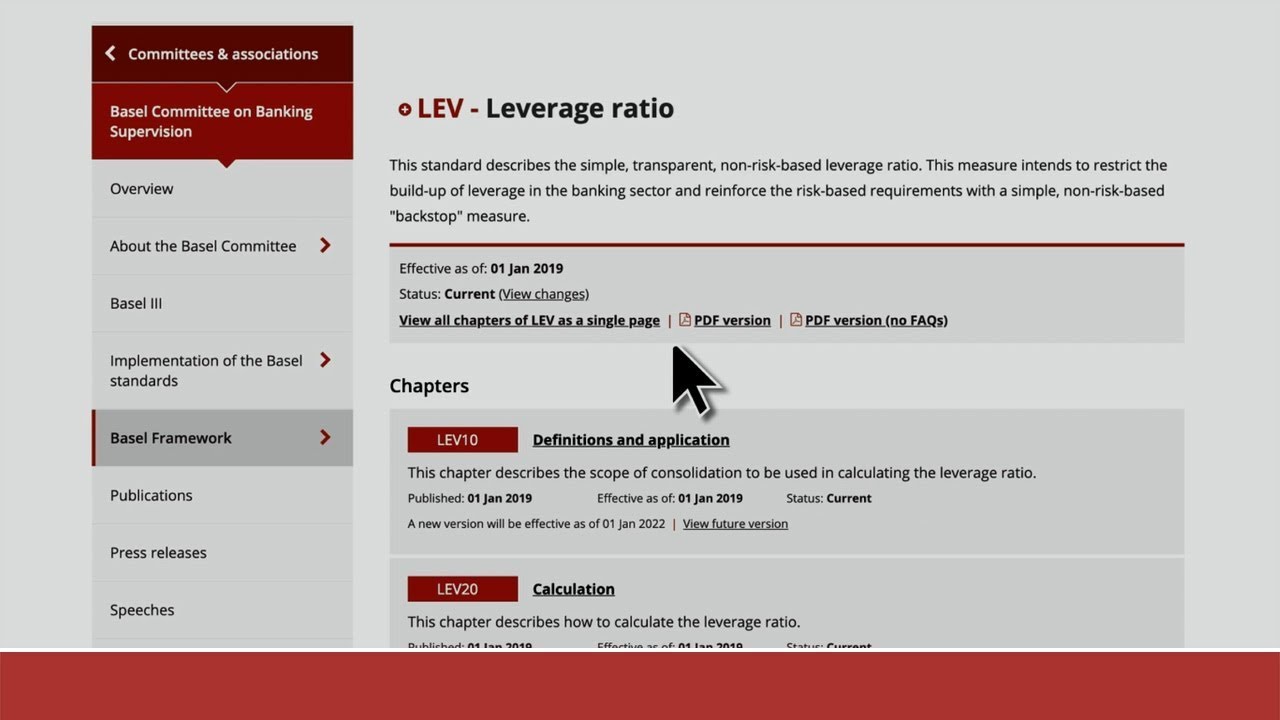
This standard describes the simple, transparent, non-risk-based leverage ratio. This measure intends to restrict the build-up of leverage in the banking sector and reinforce the risk-based requirements with a simple, non-risk-based "backstop" measure.
This standard describes the Liquidity Coverage Ratio, a measure which promotes the short-term resilience of a bank's liquidity risk profile.
The net stable funding ratio requires banks to maintain a stable funding profile in relation to the composition of their assets and off-balance-sheet activities.
Large exposures regulation limits the maximum loss that a bank could face in the event of a sudden counterparty failure to a level that does not endanger the bank's solvency. This standard requires banks to measure their exposures to a single counterparty or a group of connected counterparties and limit the size of large exposures in relation to their capital.
This standard establishes minimum standards for margin requirements for non-centrally cleared derivatives. Such requirements reduce systemic risk with respect to non-standardised derivatives by reducing contagion and spillover risks and promoting central clearing.
The Pillar 2 supervisory review process ensures that banks have adequate capital and liquidity to support all the risks in their business, especially with respect to risks not fully captured by the Pillar 1 process, and encourages good risk management.
This standard sets out disclosure requirements, which aim to encourage market discipline.
The Basel Core Principles provide a comprehensive standard for establishing a sound foundation for the regulation, supervision, governance and risk management of the banking sector.