Transition
This chapter describes transitional arrangements that apply to the leverage ratio buffer requirement for global systemically important banks.
- Effective as of: 01 Jan 2023
- Last update: 27 Mar 2020
- Status Current
90.1
The leverage ratio buffer requirement on 1 January 2023 shall be based on the Financial Stability Board's 2021 list of global systemically important banks (G-SIBs), based on end-2020 data. For banks that are subsequently identified as G-SIBs or which are no longer identified as G-SIBs, the same transitional arrangements will apply as in the higher loss-absorbency requirement framework.
90.2
The leverage ratio buffer requirement will be updated annually to reflect the annual updated list of G-SIB requirements. G-SIBs subject to a revised higher loss-absorbency requirement would also be subject to a revised leverage ratio buffer requirement, calibrated at 50% of the former requirement. Both requirements would follow the same implementation arrangements. Jurisdictions may impose a higher leverage ratio buffer requirement.
This standard describes the scope of application of the Basel Framework.
This standard describes the criteria that bank capital instruments must meet to be eligible to satisfy the Basel capital requirements, as well as necessary regulatory adjustments and transitional arrangements.
This standard describes the framework for risk-based capital requirements.
This standard describes how to calculate capital requirements for credit risk.
This standard describes how to calculate capital requirements for market risk and credit valuation adjustment risk.
This standard describes how to calculate capital requirements for operational risk.
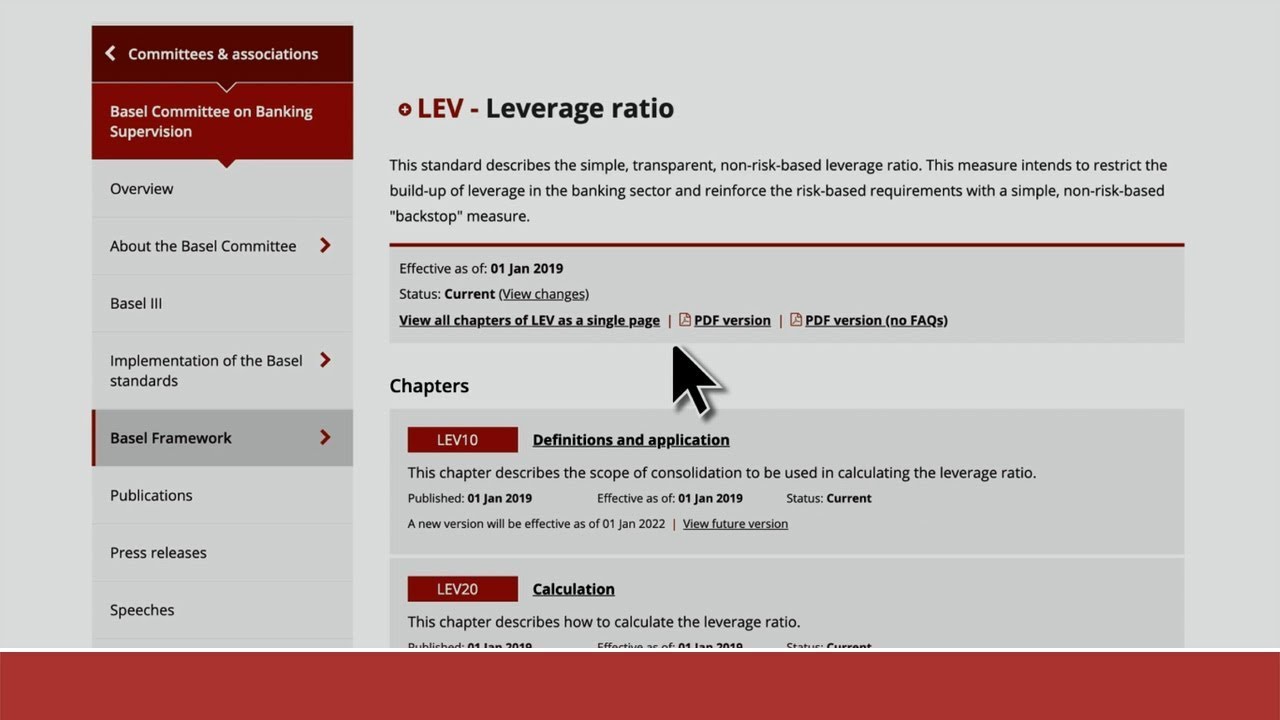
This standard describes the simple, transparent, non-risk-based leverage ratio. This measure intends to restrict the build-up of leverage in the banking sector and reinforce the risk-based requirements with a simple, non-risk-based "backstop" measure.
This standard describes the Liquidity Coverage Ratio, a measure which promotes the short-term resilience of a bank's liquidity risk profile.
The net stable funding ratio requires banks to maintain a stable funding profile in relation to the composition of their assets and off-balance-sheet activities.
Large exposures regulation limits the maximum loss that a bank could face in the event of a sudden counterparty failure to a level that does not endanger the bank's solvency. This standard requires banks to measure their exposures to a single counterparty or a group of connected counterparties and limit the size of large exposures in relation to their capital.
This standard establishes minimum standards for margin requirements for non-centrally cleared derivatives. Such requirements reduce systemic risk with respect to non-standardised derivatives by reducing contagion and spillover risks and promoting central clearing.
The Pillar 2 supervisory review process ensures that banks have adequate capital and liquidity to support all the risks in their business, especially with respect to risks not fully captured by the Pillar 1 process, and encourages good risk management.
This standard sets out disclosure requirements, which aim to encourage market discipline.
The Basel Core Principles provide a comprehensive standard for establishing a sound foundation for the regulation, supervision, governance and risk management of the banking sector.