Update on Committee standards, guidelines and sound practices
This chapter lists Committee standards, guidelines and sound practices that have been published since the last substantive review of the Core Principles.
- Effective as of: 25 Apr 2024
- Last update: 25 Apr 2024
- Status Current
98.1
Supervision and supervisory practices are not static. The Committee frequently issues new (and revises existing) standards, guidelines and sound practices. These are designed to strengthen regulatory and supervisory regimes, particularly for internationally active banks in Committee member jurisdictions. Supervisors are encouraged to move towards the adoption of updated and new international supervisory standards as they are issued.
98.2
Any standards that are consolidated in the Basel Framework are automatically incorporated into the Basel Core Principles when "Basel Framework" is referred to in the text. Similarly, when the Basel Core Principles refer to "applicable standards", this refers to the most recent BCBS standard or guideline that is effective.
98.3
The Committee has included this annex as a resource on supervisory practices and emerging risks that have evolved since the last review of the Basel Core Principles. When the next review of the Basel Core Principles is conducted, it will consider whether and how to embed any specific requirements or learnings from these publications within the text of the Core Principles.
98.4
This list is updated biennially.
|
Standards |
Table 1 |
|
Guidelines |
Table 2 |
|
Sound practices |
Table 3 |
|
Other standard-setting bodies' publications |
Table 4 |
This standard describes the scope of application of the Basel Framework.
This standard describes the criteria that bank capital instruments must meet to be eligible to satisfy the Basel capital requirements, as well as necessary regulatory adjustments and transitional arrangements.
This standard describes the framework for risk-based capital requirements.
This standard describes how to calculate capital requirements for credit risk.
This standard describes how to calculate capital requirements for market risk and credit valuation adjustment risk.
This standard describes how to calculate capital requirements for operational risk.
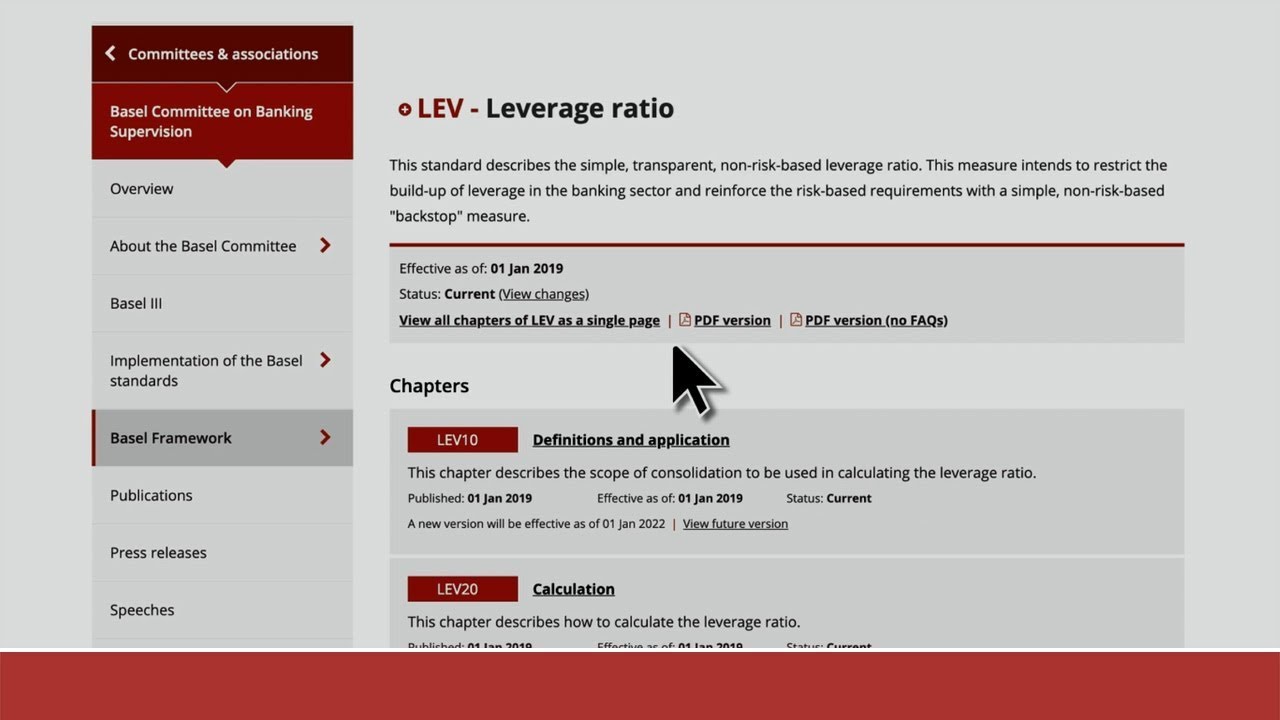
This standard describes the simple, transparent, non-risk-based leverage ratio. This measure intends to restrict the build-up of leverage in the banking sector and reinforce the risk-based requirements with a simple, non-risk-based "backstop" measure.
This standard describes the Liquidity Coverage Ratio, a measure which promotes the short-term resilience of a bank's liquidity risk profile.
The net stable funding ratio requires banks to maintain a stable funding profile in relation to the composition of their assets and off-balance-sheet activities.
Large exposures regulation limits the maximum loss that a bank could face in the event of a sudden counterparty failure to a level that does not endanger the bank's solvency. This standard requires banks to measure their exposures to a single counterparty or a group of connected counterparties and limit the size of large exposures in relation to their capital.
This standard establishes minimum standards for margin requirements for non-centrally cleared derivatives. Such requirements reduce systemic risk with respect to non-standardised derivatives by reducing contagion and spillover risks and promoting central clearing.
The Pillar 2 supervisory review process ensures that banks have adequate capital and liquidity to support all the risks in their business, especially with respect to risks not fully captured by the Pillar 1 process, and encourages good risk management.
This standard sets out disclosure requirements, which aim to encourage market discipline.
The Basel Core Principles provide a comprehensive standard for establishing a sound foundation for the regulation, supervision, governance and risk management of the banking sector.