Credit valuation adjustment risk
This chapter describes disclosure requirements for CVA risk.
- Effective as of: 01 Jan 2023
- Last update: 27 Mar 2020
- Status Current
Table CVAA: General qualitative disclosure requirements related to CVA
Template CVA1: The reduced basic approach for CVA (BA-CVA)
Template CVA2: The full basic approach for CVA (BA-CVA)
Table CVAB: Qualitative disclosures for banks using the SA-CVA
Template CVA3: The standardised approach for CVA (SA-CVA)
Template CVA4: RWA flow statements of CVA risk exposures under SA-CVA
Introduction
51.1
The disclosure requirements under this section are:
General information about CVA risk:
- Table CVAA - General qualitative disclosure requirements related to CVA
- Template CVA1 - The reduced basic approach for CVA (BA-CVA)
- Template CVA2 - The full basic approach for CVA (BA-CVA)
- Table CVAB - Qualitative disclosures for banks using the SA-CVA
- Template CVA3 - The standardised approach for CVA (SA-CVA)
- Template CVA4 - RWA flow statements of CVA risk exposures under SA-CVA
CVA risk under the basic approach (BA-CVA):
CVA risk under the standardised approach (SA-CVA):
Table CVAA: General qualitative disclosure requirements related to CVA
TABLE.1
|
Purpose: To provide a description of the risk management objectives and policies for CVA risk. |
|
|
Scope of application: The table is mandatory for all banks that are subject to CVA capital requirements, including banks which are qualified and have elected to set its capital requirement for CVA at 100% of its counterparty credit risk charge. |
|
|
Content: Qualitative information. |
|
|
Frequency: Annual. |
|
|
Format: Flexible. |
|
|
Banks must describe their risk management objectives and policies for CVA risk as follows: |
|
|
(a) |
An explanation and/or a description of the bank's processes implemented to identify, measure, monitor and control the bank's CVA risks, including policies for hedging CVA risk and the processes for monitoring the continuing effectiveness of hedges. |
|
(b) |
Whether the bank is eligible and has chosen to set its capital requirement for CVA at 100% of the bank's capital requirement for counterparty credit risk as applicable under MAR40. |
Template CVA1: The reduced basic approach for CVA (BA-CVA)
TABLE.2
|
Purpose: To provide the components used for the computation of RWA under the reduced BA-CVA for CVA risk. |
||||
|
Scope of application: The template is mandatory for banks having part or all of their RWA for CVA risk measured according to the reduced BA-CVA. The template should be completed with only the amounts obtained from the netting sets which are under the reduced BA-CVA. |
||||
|
Content: RWA. |
||||
|
Frequency: Semiannual. |
||||
|
Format: Fixed. |
||||
|
Accompanying narrative: Banks must describe the types of hedge they use even if they are not taken into account under the reduced BA-CVA. |
||||
|
a |
b |
|||
|
|
Components |
BA-CVA RWA |
||
|
1 |
Aggregation of systematic components of CVA risk |
|||
|
2 |
Aggregation of idiosyncratic components of CVA risk |
|||
|
3 |
Total |
|||
|
Definitions and instructions |
||||
|
Row number |
Explanation |
|||
|
1 |
Aggregation of systematic components of CVA risk: RWA under perfect correlation assumption (∑cSCVAc) as per MAR50.14. |
|||
|
2 |
Aggregation of idiosyncratic components of CVA risk: RWA under zero correlation assumption (sqrt(∑cSCVAc2)) as per MAR50.14. |
|||
|
3 |
Total: Kreduced as per MAR50.14 multiplied by 12.5. |
|||
|
Linkages across templates [CVA1:3/b] is equal to [OV1:10/a] if the bank only uses the reduced BA-CVA for all CVA risk exposures. |
||||
Template CVA2: The full basic approach for CVA (BA-CVA)
TABLE.3
|
Purpose: To provide the components used for the computation of RWA under the full BA-CVA for CVA risk. |
|||
|
Scope of application: The template is mandatory for banks having part or all of their RWA for CVA risk measured according to the full version of the BA-CVA. The template should be fulfilled with only the amounts obtained from the netting sets which are under the full BA-CVA. |
|||
|
Content: RWA. |
|||
|
Frequency: Semiannual. |
|||
|
Format: Fixed. Additional rows can be inserted for the breakdown of other risks. |
|||
|
a |
|||
|
|
BA-CVA RWA |
||
|
1 |
K Reduced |
||
|
2 |
K Hedged |
||
|
3 |
Total |
||
|
Definitions and instructions |
|||
|
Row number |
Explanation |
||
|
1 |
K Reduced: Kreduced as per MAR50.14. |
||
|
2 |
K Hedged: Khedged as per MAR50.21. |
||
|
3 |
Total: Kfull as per MAR50.20 multiplied by 12.5. |
||
|
Linkages across templates [CVA2:3/a] is equal to [OV1:10/a] if the bank only uses the full BA-CVA for all CVA risk exposures. |
|||
Table CVAB: Qualitative disclosures for banks using the SA-CVA
TABLE.4
|
Purpose: To provide the main characteristics of the bank's CVA risk management framework. |
||
|
Scope of application: The table is mandatory for all banks using the SA-CVA to calculate their RWA for CVA risk. |
||
|
Content: Qualitative information. |
||
|
Frequency: Annual. |
||
|
Format: Flexible. |
||
|
Banks must provide the following information on their CVA risk management framework: |
||
|
(a) |
A description of the bank's CVA risk management framework. |
|
|
(b) |
A description of how senior management is involved in the CVA risk management framework. |
|
|
(c) |
An overview of the governance of the CVA risk management framework (eg documentation, independent control unit, independent review, independence of the data acquisition from the lines of business). |
|
Template CVA3: The standardised approach for CVA (SA-CVA)
TABLE.5
|
Purpose: To provide the components used for the computation of RWA under the SA-CVA for CVA risk. |
|||
|
Scope of application: The template is mandatory for banks having part or all of their RWA for CVA risk measured according to the SA-CVA. |
|||
|
Content: RWA. |
|||
|
Frequency: Semiannual. |
|||
|
Format: Fixed. Additional rows can be inserted for the breakdown of other risks. |
|||
|
a |
b |
||
|
|
SA-CVA RWA |
Number of counterparties |
|
|
1 |
Interest rate risk |
||
|
2 |
Foreign exchange risk |
||
|
3 |
Reference credit spread risk |
||
|
4 |
Equity risk |
||
|
5 |
Commodity risk |
||
|
6 |
Counterparty credit spread risk |
||
|
7 |
Total (sum of rows 1 to 6) |
||
|
Linkages across templates [CVA3:7/a] is equal to [OV1:10/a] if the bank only uses the SA-CVA for all CVA risk exposures. |
|||
Template CVA4: RWA flow statements of CVA risk exposures under SA-CVA
TABLE.6
|
Purpose: Flow statement explaining variations in RWA for CVA risk determined under the SA-CVA. |
|||
|
Scope of application: The template is mandatory for banks using the SA-CVA. |
|||
|
Content: RWA for CVA risk. Changes in RWA amounts over the reporting period for each of the key drivers should be based on a bank's reasonable estimation of the figure. |
|||
|
Frequency: Quarterly. |
|||
|
Format: Fixed. |
|||
|
Accompanying narrative: Banks are expected to supplement the template with a narrative commentary to explain any significant changes over the reporting period and the key drivers of such changes. Factors behind changes could include movements in risk levels, scope changes (eg movement of netting sets between SA-CVA and BA-CVA), acquisition and disposal of business/product lines or entities or foreign currency translation movements. |
|||
|
a |
|||
|
1 |
Total RWA for CVA at previous quarter-end |
||
|
2 |
Total RWA for CVA at end of reporting period |
||
|
Linkages across templates [CVA4:1/a] is equal to [OV1:10/b] [CVA4:2/a] is equal to [OV1:10/a] |
|||
This standard describes the scope of application of the Basel Framework.
This standard describes the criteria that bank capital instruments must meet to be eligible to satisfy the Basel capital requirements, as well as necessary regulatory adjustments and transitional arrangements.
This standard describes the framework for risk-based capital requirements.
This standard describes how to calculate capital requirements for credit risk.
This standard describes how to calculate capital requirements for market risk and credit valuation adjustment risk.
This standard describes how to calculate capital requirements for operational risk.
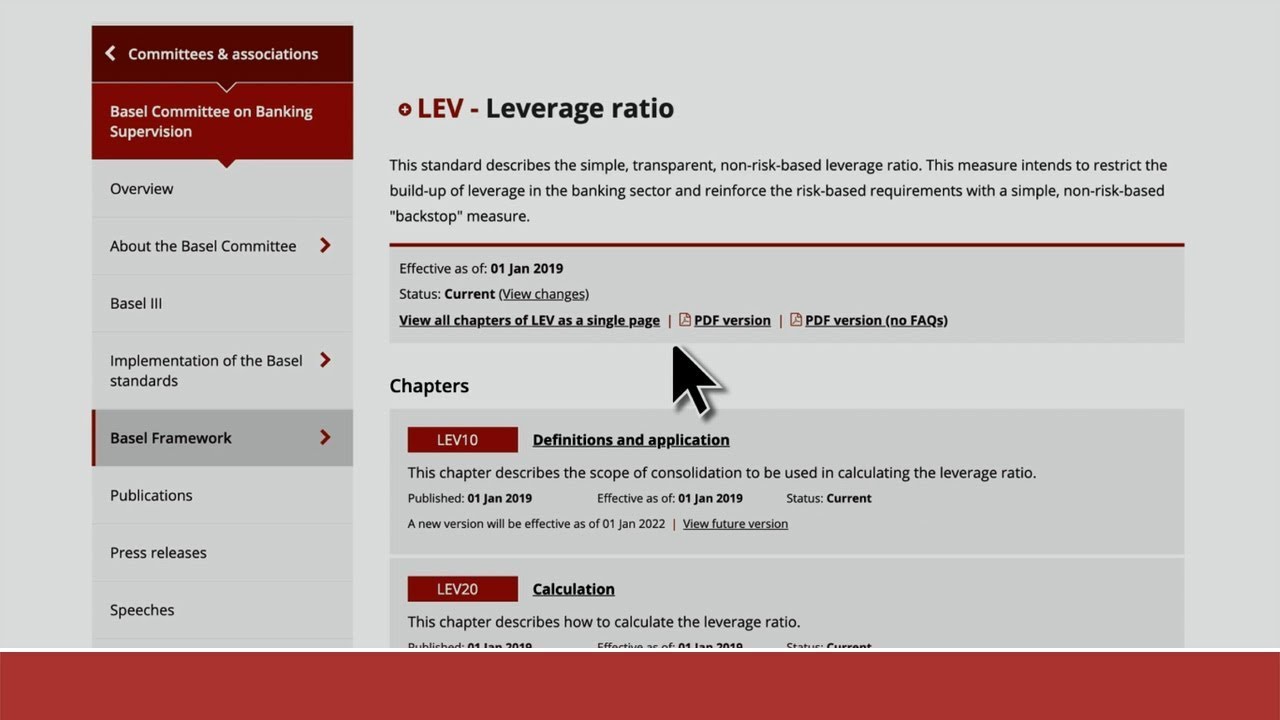
This standard describes the simple, transparent, non-risk-based leverage ratio. This measure intends to restrict the build-up of leverage in the banking sector and reinforce the risk-based requirements with a simple, non-risk-based "backstop" measure.
This standard describes the Liquidity Coverage Ratio, a measure which promotes the short-term resilience of a bank's liquidity risk profile.
The net stable funding ratio requires banks to maintain a stable funding profile in relation to the composition of their assets and off-balance-sheet activities.
Large exposures regulation limits the maximum loss that a bank could face in the event of a sudden counterparty failure to a level that does not endanger the bank's solvency. This standard requires banks to measure their exposures to a single counterparty or a group of connected counterparties and limit the size of large exposures in relation to their capital.
This standard establishes minimum standards for margin requirements for non-centrally cleared derivatives. Such requirements reduce systemic risk with respect to non-standardised derivatives by reducing contagion and spillover risks and promoting central clearing.
The Pillar 2 supervisory review process ensures that banks have adequate capital and liquidity to support all the risks in their business, especially with respect to risks not fully captured by the Pillar 1 process, and encourages good risk management.
This standard sets out disclosure requirements, which aim to encourage market discipline.
The Basel Core Principles provide a comprehensive standard for establishing a sound foundation for the regulation, supervision, governance and risk management of the banking sector.