Organisation and governance
The Global Economy Meeting (GEM) is the governing body of the CPMI. The CPMI reports to the GEM and, through the Economic Consultative Committee (ECC), seeks the GEM's endorsement for major decisions.
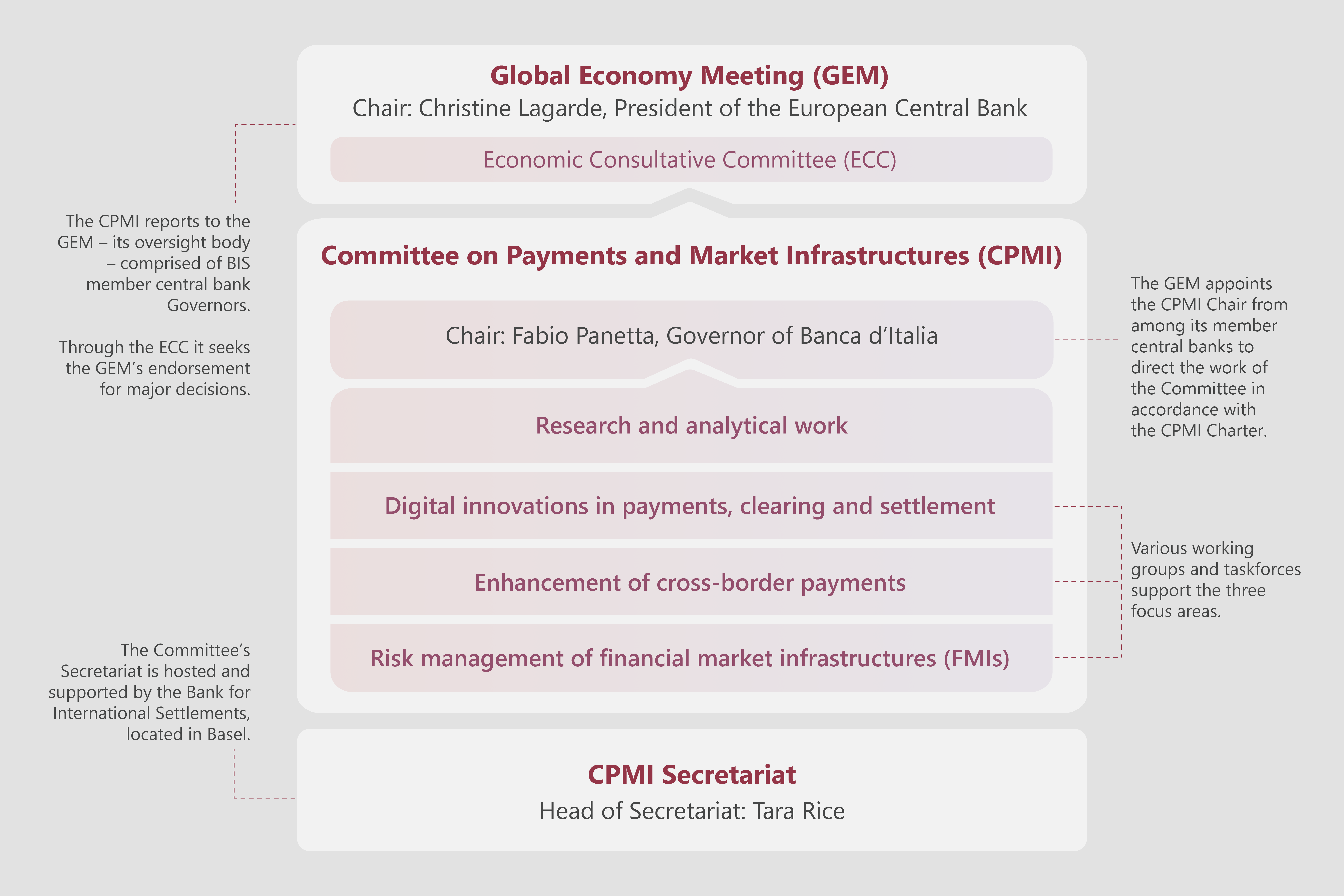
CPMI membership
The Committee comprises senior officials from 28 central banks and meets about three times per year. Decisions are reached by way of consensus among members. The Committee may establish working groups to perform specifically assigned tasks or functions. The Committee expanded its membership most recently in 2018.
| Argentina | Central Bank of Argentina |
| Australia | Reserve Bank of Australia |
| Belgium | National Bank of Belgium |
| Brazil | Central Bank of Brazil |
| Canada | Bank of Canada |
| China | People's Bank of China |
| European Union | European Central Bank |
| France | Bank of France |
| Germany | Deutsche Bundesbank |
| Hong Kong SAR | Hong Kong Monetary Authority |
| India | Reserve Bank of India |
| Indonesia | Bank Indonesia |
| Italy | Bank of Italy |
| Japan | Bank of Japan |
| Korea | Bank of Korea |
| Mexico | Bank of Mexico |
| Netherlands | De Nederlandsche Bank |
| Russia* | Central Bank of the Russian Federation |
| Saudi Arabia | Saudi Central Bank |
| Singapore | Monetary Authority of Singapore |
| South Africa | South African Reserve Bank |
| Spain | Bank of Spain |
| Sweden | Sveriges Riksbank |
| Switzerland | Swiss National Bank |
| Türkiye | Central Bank of the Republic of Türkiye |
| United Kingdom | Bank of England |
| United States | Board of Governors of the Federal Reserve System Federal Reserve Bank of New York |
* The access of the Central Bank of the Russian Federation to all BIS services, meetings and other BIS activities has been suspended.
The CPMI Chair
The Chairperson directs the work of the CPMI in accordance with its mandate, and is appointed by the GEM, following a proposal by the ECC, for a term of three years that can be renewed once. The Chairperson's main responsibilities are to:
- convene and chair Committee meetings. If the Chairperson is unable to attend a Committee meeting, he/she may designate a substitute to chair the meeting on his/her behalf;
- monitor the progress of the CPMI work programme and provide guidance between meetings to carry out the decisions and directions of the Committee;
- report to the GEM; and
- represent the CPMI externally and be the principal spokesperson for the CPMI.
| Jon Cunliffe Deputy Governor, Bank of England | 2020 - 2023 |
| Benoît Cœuré Executive Board Member, European Central Bank | 2013 - 2019 |
| Paul Tucker Deputy Governor, Financial Stability of the Bank of England | 2012 - 2013 |
| William C Dudley President and CEO, Federal Reserve Bank of New York | 2009 - 2012 |
| Timothy Geithner President and CEO, Federal Reserve Bank of New York | 2005 - 2009 |
| Tommaso Padoa-Schioppa Executive Board Member, European Central Bank | 2000 - 2005 |
| Wendelin Hartmann Board Member, Deutsche Bundesbank | 1998 - 2000 |
| William McDonough President and CEO, Federal Reserve Bank of New York | 1994 - 1998 |
| Wayne Angell Board of Governors Member, Federal Reserve System | 1990 - 1994 |

The CPMI Secretariat
The Secretariat is provided by the BIS and Members of Secretariat support the work of the Committee, the Chair and the groups around which the Committee organises its work.
The Head of Secretariat directs the work of the Secretariat and reports to the Chairperson. He/she also assists the Chairperson in representing the CPMI externally.
| Morten Bech | 2016 - 2020 |
| Klaus Löber | 2012 - 2016 |
| Daniel Heller | 2009 - 2012 |
| Denis Beau | 2007 - 2008 |
| Marc Hollanders | 2002 - 2007 |
| Gregor Heinrich | 1998 - 2002 |
| Paul Van den Bergh | 1989 - 1998 |

Cooperation with other standard-setting bodies
The CPMI cooperates with other standard setters (in particular the International Organization of Securities Commissions (IOSCO) and the Basel Committee on Banking Supervision (BCBS)), other central bank bodies (such as the Committee on the Global Financial System (CGFS) and the Markets Committee (MC)), international financial institutions and public sector bodies on matters falling within its mandate to enhance coordination of policy development and implementation.
The CPMI is a member of the Financial Stability Board (FSB) and participates in the FSB's work to coordinate and promote the implementation of effective regulatory, supervisory and other financial sector policies. In the context of its activities the CPMI maintains contact with many global payment system providers, industry associations and regulatory authorities.

Outreach activities
The CPMI has developed relationships with central banks worldwide. Through its Community of Practice on Payment Systems (CoPS), the CPMI provides a platform for cooperation and regular exchanges with around 50 central banks, as well as regional and international organisations across the globe.
If so requested and whenever possible, the CPMI provides expertise on payment system issues and organisational support to regional central banking and international organisations by providing speakers and/or co-organising seminars and workshops. For instance, it works with the Arab Monetary Fund (AMF), the Association of African Central Banks (AACB), the Center for Latin American Monetary Studies (CEMLA), the South African Development Community (SADC), and the South East Asian Central Banks Research and Training Centre (SEACEN) as well as the International Monetary Fund and the World Bank.