Remuneration
The disclosures described in this chapter provide information on a bank's remuneration policy, the fixed and variable remuneration awarded during the financial year, details of any special payments made, and information on a bank's total outstanding deferred and retained remuneration.
- Effective as of: 15 Dec 2019
- Last update: 15 Dec 2019
- Status Current
Introduction
35.1
The disclosure requirements under this section are:
- Table REMA – Remuneration policy
- Template REM1 – Remuneration awarded during financial year
- Template REM2 – Special payments
- Template REM3 – Deferred remuneration
35.2
Table REMA provides information on a bank’s remuneration policy as well as key features of the remuneration system.
35.3
Templates REM1, REM2 and REM3 provide information on a bank’s fixed and variable remuneration awarded during the financial year, details of any special payments made, and information on a bank’s total outstanding deferred and retained remuneration, respectively.
35.4
The disclosure requirements should be published annually. When it is not possible for the remuneration disclosures to be made at the same time as the publication of a bank’s annual report, the disclosures should be made as soon as possible thereafter.
Table REMA: Remuneration policy
TABLE.1
|
Purpose: Describe the bank's remuneration policy as well as key features of the remuneration system to allow meaningful assessments by users of Pillar 3 data of banks' compensation practices. |
|
|
Scope of application: The table is mandatory for all banks. |
|
|
Content: Qualitative information. |
|
|
Frequency: Annual |
|
|
Format: Flexible. |
|
|
Banks must describe the main elements of their remuneration system and how they develop this system. In particular, the following elements, where relevant, should be described: |
|
|
Qualitative disclosures |
|
|
(a) |
Information relating to the bodies that oversee remuneration. Disclosures should include:
|
|
(b) |
Information relating to the design and structure of remuneration processes. Disclosures should include:
|
|
(c) |
Description of the ways in which current and future risks are taken into account in the remuneration processes. Disclosures should include an overview of the key risks, their measurement and how these measures affect remuneration. |
|
(d) |
Description of the ways in which the bank seeks to link performance during a performance measurement period with levels of remuneration. Disclosures should include:
|
|
(e) |
Description of the ways in which the bank seeks to adjust remuneration to take account of longer-term performance. Disclosures should include:
|
|
(f) |
Description of the different forms of variable remuneration that the bank utilises and the rationale for using these different forms. Disclosures should include:
|
Table REM1: Remuneration awarded during the financial year
TABLE.2
|
Purpose: Provide quantitative information on remuneration for the financial year. |
||||
|
Scope of application: The template is mandatory for all banks. |
||||
|
Content: Quantitative information. |
||||
|
Frequency: Annual |
||||
|
Format: Flexible. |
||||
|
Accompanying narrative: Banks may supplement the template with a narrative commentary to explain any significant movements over the reporting period and the key drivers of such movements. |
||||
|
a |
b |
|||
|
Remuneration amount |
Senior management |
Other material risk-takers |
||
|
1 |
Fixed remuneration |
Number of employees |
||
|
2 |
Total fixed remuneration (rows 3 + 5 + 7) |
|||
|
3 |
Of which: cash-based |
|||
|
4 |
Of which: deferred |
|||
|
5 |
Of which: shares or other |
|||
|
6 |
Of which: deferred |
|||
|
7 |
Of which: other forms |
|||
|
8 |
Of which: deferred |
|||
|
9 |
Variable remuneration |
Number of employees |
||
|
10 |
Total variable remuneration (rows 11 + 13 + 15) |
|||
|
11 |
Of which: cash-based |
|||
|
12 |
Of which: deferred |
|||
|
13 |
Of which: shares or other |
|||
|
14 |
Of which: deferred |
|||
|
15 |
Of which: other forms |
|||
|
16 |
Of which: deferred |
|||
|
17 |
Total remuneration (rows 2 + 10) |
|||
|
Definitions and instructions Senior management and other material risk-takers categories in columns (a) and (b) must correspond to the type of employees described in Table REMA. Other forms of remuneration in rows 7 and 15 must be described in Table REMA and, if needed, in the accompanying narrative. |
||||
Table REM2: Special payments
TABLE.3
|
Purpose: Provide quantitative information on special payments for the financial year. |
||||||
|
Scope of application: The template is mandatory for all banks. |
||||||
|
Content: Quantitative information. |
||||||
|
Frequency: Annual. |
||||||
|
Format: Flexible. |
||||||
|
Accompanying narrative: Banks may supplement the template with a narrative commentary to explain any significant movements over the reporting period and the key drivers of such movements. |
||||||
|
Special payments |
Guaranteed bonuses |
Sign-on awards |
Severance payments |
|||
|
Number of employees |
Total amount |
Number of employees |
Total amount |
Number of employees |
Total amount |
|
|
Senior management |
||||||
|
Other material risk-takers |
||||||
|
Definitions and instructions Senior management and other material risk-takers categories in rows 1 and 2 must correspond to the type of employees described in Table REMA. Guaranteed bonuses are payments of guaranteed bonuses during the financial year. Sign-on awards are payments allocated to employees upon recruitment during the financial year. Severance payments are payments allocated to employees dismissed during the financial year. |
||||||
Template REM3: Deferred remuneration
TABLE.4
Template REM3: Deferred remuneration
|
Purpose: Provide quantitative information on deferred and retained remuneration. |
|||||
|
Scope of application: The template is mandatory for all banks. |
|||||
|
Content: Quantitative information. |
|||||
|
Frequency: Annual. |
|||||
|
Format: Flexible. |
|||||
|
Accompanying narrative: Banks may supplement the template with a narrative commentary to explain any significant movements over the reporting period and the key drivers of such movements. |
|||||
|
a |
b |
c |
d |
e |
|
|
Deferred and retained remuneration |
Total amount of outstanding deferred remuneration |
Of which: |
Total amount of amendment during the year due to ex post explicit adjustments |
Total amount of amendment during the year due to ex post implicit adjustments |
Total amount of deferred remuneration paid out in the financial year |
|
Senior management |
|||||
|
Cash |
|||||
|
Shares |
|||||
|
Cash-linked instruments |
|||||
|
Other |
|||||
|
Other material risk-takers |
|||||
|
Cash |
|||||
|
Shares |
|||||
|
Cash-linked instruments |
|||||
|
Other |
|||||
|
Total |
|||||
|
Definitions Outstanding exposed to ex post explicit adjustment: Part of the deferred and retained remuneration that is subject to direct adjustment clauses (for instance, subject to malus, clawbacks or similar reversal or downward revaluations of awards). Outstanding exposed to ex post implicit adjustment: Part of the deferred and retained remuneration that is subject to adjustment clauses that could change the remuneration, due to the fact that they are linked to the performance of other indicators (for instance, fluctuation in the value of shares performance or performance units). In columns (a) and (b), the amounts at reporting date (cumulated over the last years) are expected. In columns (c)-(e), movements during the financial year are expected. While columns (c) and (d) show the movements specifically related to column (b), column (e) shows payments that have affected column (a). |
|||||
This standard describes the scope of application of the Basel Framework.
This standard describes the criteria that bank capital instruments must meet to be eligible to satisfy the Basel capital requirements, as well as necessary regulatory adjustments and transitional arrangements.
This standard describes the framework for risk-based capital requirements.
This standard describes how to calculate capital requirements for credit risk.
This standard describes how to calculate capital requirements for market risk and credit valuation adjustment risk.
This standard describes how to calculate capital requirements for operational risk.
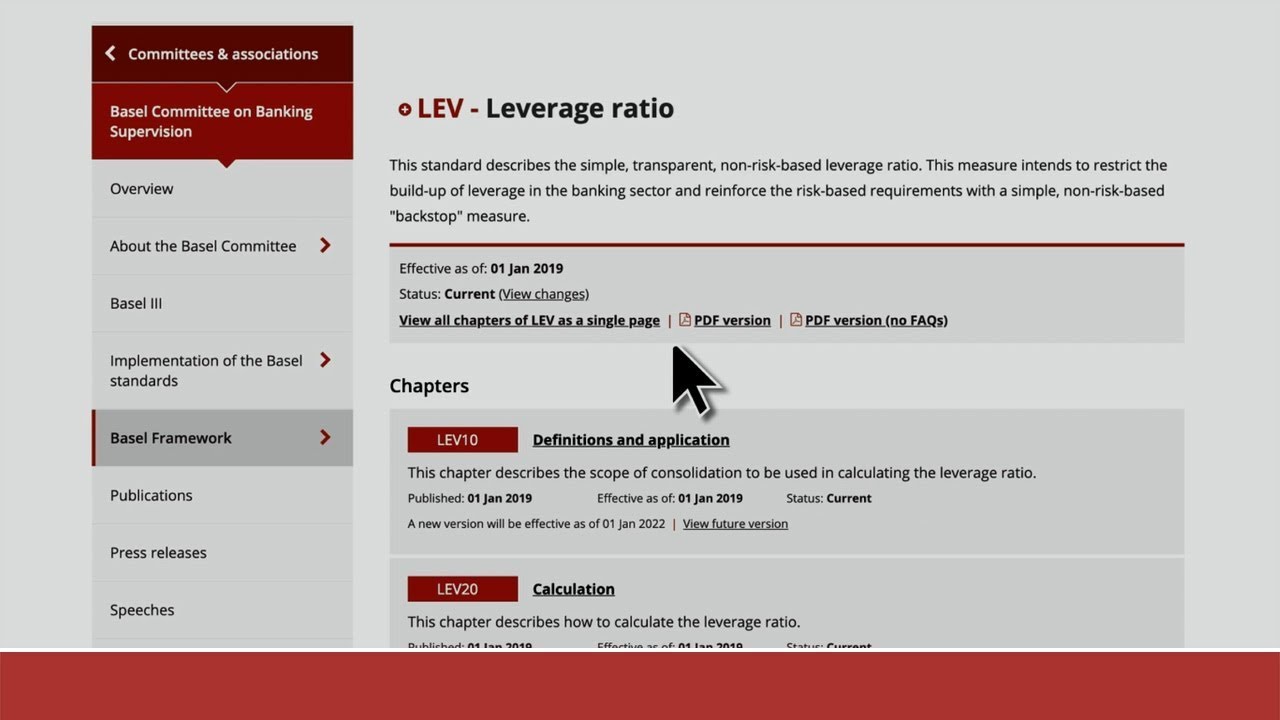
This standard describes the simple, transparent, non-risk-based leverage ratio. This measure intends to restrict the build-up of leverage in the banking sector and reinforce the risk-based requirements with a simple, non-risk-based "backstop" measure.
This standard describes the Liquidity Coverage Ratio, a measure which promotes the short-term resilience of a bank's liquidity risk profile.
The net stable funding ratio requires banks to maintain a stable funding profile in relation to the composition of their assets and off-balance-sheet activities.
Large exposures regulation limits the maximum loss that a bank could face in the event of a sudden counterparty failure to a level that does not endanger the bank's solvency. This standard requires banks to measure their exposures to a single counterparty or a group of connected counterparties and limit the size of large exposures in relation to their capital.
This standard establishes minimum standards for margin requirements for non-centrally cleared derivatives. Such requirements reduce systemic risk with respect to non-standardised derivatives by reducing contagion and spillover risks and promoting central clearing.
The Pillar 2 supervisory review process ensures that banks have adequate capital and liquidity to support all the risks in their business, especially with respect to risks not fully captured by the Pillar 1 process, and encourages good risk management.
This standard sets out disclosure requirements, which aim to encourage market discipline.
The Basel Core Principles provide a comprehensive standard for establishing a sound foundation for the regulation, supervision, governance and risk management of the banking sector.