Interest rate risk in the banking book
This chapter describes disclosure requirements for interest rate risk in the banking book.
- Effective as of: 15 Dec 2019
- Last update: 15 Dec 2019
- Status Current
Introduction
70.1
The disclosure requirements set out in this chapter are:
- Table IRRBBA – Interest rate risk in the banking book (IRRBB) risk management objective and policies
- Template IRRBB1 – Quantitative information on IRRBB
70.2
Table IRRBBA provides information on a bank’s IRRBB risk management objective and policy. Template IRRBB1 provides quantitative IRRBB information, including the impact of interest rate shocks on their change in economic value of equity and net interest income, computed based on a set of prescribed interest rate shock scenarios.
70.3
Banks must disclose the measured changes in economic value of equity (∆EVE) and changes in net interest income (∆NII) under the prescribed interest rate shock scenarios set out in SRP31. In disclosing Table IRRBBA and Template IRRBB1, banks should use their own internal measurement system (IMS) to calculate the IRRBB exposure values, unless instructed by their national supervisor. SRP31 provides a standardised framework that banks may adopt as their IMS. In addition to quantitative disclosure, banks should provide sufficient qualitative information and supporting detail to enable the market and wider public to:
- Monitor the sensitivity of the bank’s economic value and earnings to changes in interest rates;
- Understand the primary assumptions underlying the measurement produced by the bank’s IMS; and
- Have an insight into the bank’s overall IRRBB objective and IRRBB management.
70.4
For the disclosure of ∆EVE:
- Banks should exclude their own equity from the computation of the exposure level;
- Banks should include all cash flows from all interest rate-sensitive assets, liabilities and off-balance sheet items in the banking book in the computation of their exposure.1 Banks should disclose whether they have excluded or included commercial margins and other spread components in their cash flows;
- Cash flows should be discounted using either a risk-free rate or a risk-free rate including commercial margins and other spread components (only if the bank has included commercial margins and other spread components in its cash flows).2 Banks should disclose whether they have discounted their cash flows using a risk-free rate or a risk-free rate including commercial margins and other spread components; and
- ΔEVE should be computed with the assumption of a run-off balance sheet, where existing banking book positions amortise and are not replaced by any new business.
2 Footnotes
| 1 | Interest rate-sensitive assets are assets which are not deducted from Common Equity Tier 1 capital and which exclude (i) fixed assets such as real estate or intangible assets as well as (ii) equity exposures in the banking book. |
| 2 | The discounting factors must be representative of a risk-free zero coupon rate. An example of an acceptable yield curve is a secured interest rate swap curve. |
70.5
For the disclosure of ∆NII:
- Banks should include expected cash flows (including commercial margins and other spread components) arising from all interest rate-sensitive assets, liabilities and off-balance sheet items in the banking book;
- ΔNII should be computed assuming a constant balance sheet, where maturing or repricing cash flows are replaced by new cash flows with identical features with regard to the amount, repricing period and spread components.
- ΔNII should be disclosed as the difference in future interest income over a rolling 12-month period.
70.6
In addition to the required disclosures in Table IRRBBA and Template IRRBB1, banks are encouraged to make voluntary disclosures of information on internal measures of IRRBB that would assist the market in interpreting the mandatory disclosure numbers.
Table IRRBBA - IRRBB risk management objectives and policies
TABLE.1
|
Purpose: Provide a description of the risk management objectives and policies concerning IRRBB. |
|
|
Scope of application: Mandatory for all banks within the scope of application set out in SRP31. |
|
|
Content: Qualitative and quantitative information. Quantitative information is based on the daily or monthly average of the year or on the data as at the reporting date. |
|
|
Frequency: Annual. |
|
|
Format: Flexible. |
|
|
Qualitative disclosure |
|
|
a |
A description of how the bank defines IRRBB for purposes of risk control and measurement. |
|
b |
A description of the bank's overall IRRBB management and mitigation strategies. Examples are: monitoring of economic value of equity (EVE) and net interest income (NII) in relation to established limits, hedging practices, conduct of stress testing, outcome analysis, the role of independent audit, the role and practices of the asset and liability management committee, the bank's practices to ensure appropriate model validation, and timely updates in response to changing market conditions. |
|
c |
The periodicity of the calculation of the bank's IRRBB measures, and a description of the specific measures that the bank uses to gauge its sensitivity to IRRBB. |
|
d |
A description of the interest rate shock and stress scenarios that the bank uses to estimate changes in the economic value and in earnings. |
|
e |
Where significant modelling assumptions used in the bank's internal measurement systems (IMS) (ie the EVE metric generated by the bank for purposes other than disclosure, eg for internal assessment of capital adequacy) are different from the modelling assumptions prescribed for the disclosure in Template IRRBB1, the bank should provide a description of those assumptions and their directional implications and explain its rationale for making those assumptions (eg historical data, published research, management judgment and analysis). |
|
f |
A high-level description of how the bank hedges its IRRBB, as well as the associated accounting treatment. |
|
g |
A high-level description of key modelling and parametric assumptions used in calculating ∆EVE and ∆NII in Template IRRBB1, which includes:
|
|
h |
(Optional) Any other information which the bank wishes to disclose regarding its interpretation of the significance and sensitivity of the IRRBB measures disclosed and/or an explanation of any significant variations in the level of the reported IRRBB since previous disclosures. |
|
Quantitative disclosures |
|
|
1 |
Average repricing maturity assigned to non-maturity deposits (NMDs). |
|
2 |
Longest repricing maturity assigned to NMDs. |
Template IRRBB1 - Quantitative information on IRRBB
TABLE.2
|
Purpose: Provide information on the bank's changes in economic value of equity and net interest income under each of the prescribed interest rate shock scenarios. |
|||||||||||||||||||||||||||||||||||||||||||||||||||||||||||||||
|
Scope of application: Mandatory for all banks within the scope of application set out in SRP31. |
|||||||||||||||||||||||||||||||||||||||||||||||||||||||||||||||
|
Content: Quantitative information. |
|||||||||||||||||||||||||||||||||||||||||||||||||||||||||||||||
|
Frequency: Annual |
|||||||||||||||||||||||||||||||||||||||||||||||||||||||||||||||
|
Format: Fixed. |
|||||||||||||||||||||||||||||||||||||||||||||||||||||||||||||||
|
Accompanying narrative: Commentary on the significance of the reported values and an explanation of any material changes since the previous reporting period. |
|||||||||||||||||||||||||||||||||||||||||||||||||||||||||||||||
|
|||||||||||||||||||||||||||||||||||||||||||||||||||||||||||||||
|
Definitions For each of the supervisory prescribed interest rate shock scenarios, the bank must report for the current period and for the previous period: (i)the change in the economic value of equity based on its IMS, using a run-off balance sheet and an instantaneous shock or based on the result of the standardised framework SRP31 if the bank has chosen to adopt the framework or has been mandated by its supervisor to follow the framework; and (ii)the change in projected NII over a forward-looking rolling 12-month period compared with the bank's own best estimate 12-month projections, using a constant balance sheet assumption and an instantaneous shock. |
|||||||||||||||||||||||||||||||||||||||||||||||||||||||||||||||
This standard describes the scope of application of the Basel Framework.
This standard describes the criteria that bank capital instruments must meet to be eligible to satisfy the Basel capital requirements, as well as necessary regulatory adjustments and transitional arrangements.
This standard describes the framework for risk-based capital requirements.
This standard describes how to calculate capital requirements for credit risk.
This standard describes how to calculate capital requirements for market risk and credit valuation adjustment risk.
This standard describes how to calculate capital requirements for operational risk.
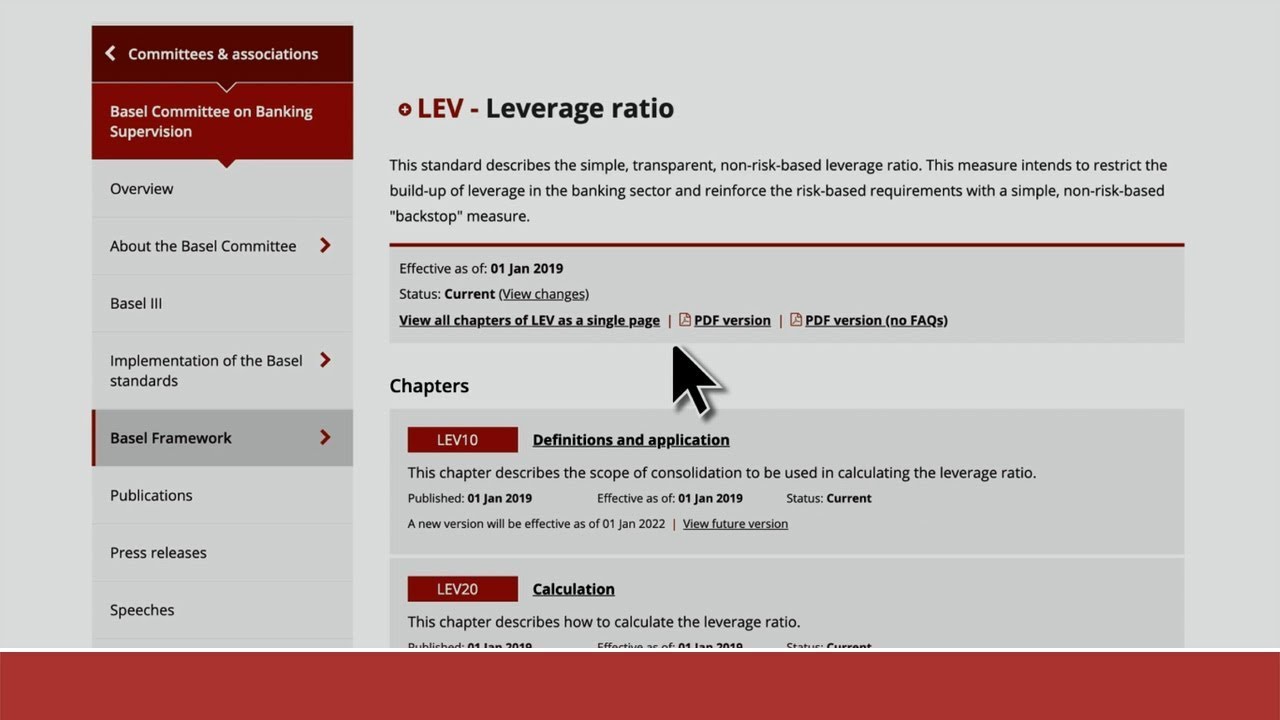
This standard describes the simple, transparent, non-risk-based leverage ratio. This measure intends to restrict the build-up of leverage in the banking sector and reinforce the risk-based requirements with a simple, non-risk-based "backstop" measure.
This standard describes the Liquidity Coverage Ratio, a measure which promotes the short-term resilience of a bank's liquidity risk profile.
The net stable funding ratio requires banks to maintain a stable funding profile in relation to the composition of their assets and off-balance-sheet activities.
Large exposures regulation limits the maximum loss that a bank could face in the event of a sudden counterparty failure to a level that does not endanger the bank's solvency. This standard requires banks to measure their exposures to a single counterparty or a group of connected counterparties and limit the size of large exposures in relation to their capital.
This standard establishes minimum standards for margin requirements for non-centrally cleared derivatives. Such requirements reduce systemic risk with respect to non-standardised derivatives by reducing contagion and spillover risks and promoting central clearing.
The Pillar 2 supervisory review process ensures that banks have adequate capital and liquidity to support all the risks in their business, especially with respect to risks not fully captured by the Pillar 1 process, and encourages good risk management.
This standard sets out disclosure requirements, which aim to encourage market discipline.
The Basel Core Principles provide a comprehensive standard for establishing a sound foundation for the regulation, supervision, governance and risk management of the banking sector.