Available and required stable funding
This chapter describes how to calculate the amount of available stable funding provided by a bank's liabilities and equity and how to calculate the amount of required stable funding for a bank's assets and off-balance-sheet activities.
- Effective as of: 15 Dec 2019
- Last update: 30 Mar 2023
- Status Removed on 05 Jul 2024
Introduction
30.1
The amounts of available stable funding (ASF) and required stable funding (RSF) specified in the standard are calibrated to reflect the presumed degree of stability of liabilities and liquidity of assets.
30.2
The calibration reflects the stability of liabilities across two dimensions:
- Funding tenor: the net stable funding ratio (NSFR) is generally calibrated such that longer-term liabilities are assumed to be more stable than short-term liabilities.
- Funding type and counterparty: the NSFR is calibrated under the assumption that short-term (maturing in less than one year) deposits provided by retail customers and funding provided by small business customers are behaviourally more stable than wholesale funding of the same maturity from other counterparties.
30.3
In determining the appropriate amounts of required stable funding for various assets, the following criteria were taken into consideration, recognising the potential trade-offs between these criteria:
- Resilient credit creation: the NSFR requires stable funding for some proportion of lending to the real economy in order to ensure the continuity of this type of intermediation.
- Bank behaviour: the NSFR is calibrated under the assumption that banks may seek to roll over a significant proportion of maturing loans to preserve customer relationships.
- Asset tenor: the NSFR assumes that some short-dated assets (maturing in less than one year) require a smaller proportion of stable funding because banks would be able to allow some proportion of those assets to mature instead of rolling them over.
- Asset quality and liquidity value: the NSFR assumes that unencumbered, high-quality assets that can be securitised or traded, and thus can be readily used as collateral to secure additional funding or sold in the market, do not need to be wholly financed with stable funding.
30.4
Additional stable funding sources are also required to support at least a small portion of the potential calls on liquidity arising from off-balance sheet commitments and contingent funding obligations.
Definition of available stable funding
30.5
The amount of ASF is measured based on the broad characteristics of the relative stability of an institution’s funding sources, including the contractual maturity of its liabilities and the differences in the propensity of different types of funding providers to withdraw their funding.
30.6
The amount of ASF must be calculated by first assigning the carrying value of an institution’s capital and liabilities to one of five categories as presented below. The amount assigned to each category is then multiplied by an ASF factor, and the total ASF is the sum of the weighted amounts. Carrying value represents the amount at which a liability or equity instrument is recorded before the application of any regulatory deductions, filters or other adjustments. As noted in NSF10.2, definitions mirror those outlined in the LCR standard, unless otherwise specified.
30.7
When determining the maturity of an equity or liability instrument, the bank must assume investors redeem call options at the earliest possible date. For funding with options exercisable at the bank’s discretion, supervisors should take into account reputational factors that may limit a bank’s ability not to exercise the option.1 In particular, where the market expects certain liabilities to be redeemed before their legal final maturity date, banks and supervisors should assume such behaviour for the purpose of the NSFR and include these liabilities in the corresponding ASF category. Along the same lines, when calculating the NSFR, options by a bank to extend funding maturity of its obligations (eg soft-bullet structures) should generally be assumed not to be exercised when there may be reputational concerns. For long-dated liabilities, only the portion of cash flows falling at or beyond the six-month and one-year time horizons should be treated as having an effective residual maturity of six months or more and one year or more, respectively.
1 Footnote
| 1 | This could reflect a case where a bank may imply that it would be subject to funding risk if it did not exercise an option on its own funding. |
30.8
Derivative liabilities are calculated first based on the replacement cost for derivative contracts (obtained by marking to market) where the contract has a negative value. When an eligible bilateral netting contract is in place that meets the conditions as specified in CRE52.7, the replacement cost for the set of derivative exposures covered by the contract must be the net replacement cost.
30.9
In calculating NSFR derivative liabilities, collateral posted in the form of variation margin in connection with derivative contracts, regardless of the asset type, must be deducted from the negative replacement cost amount.2
FAQ11 Footnote, 1 FAQ
| 2 | NSFR derivative liabilities = (derivative liabilities) – (total collateral posted as variation margin on derivative liabilities). To the extent that the bank’s accounting framework reflects on balance sheet, in connection with a derivative contract, an asset associated with collateral posted as variation margin that is deducted from the replacement cost amount for purposes of the NSFR, that asset should not be included in the calculation of a bank’s RSF to avoid any double-counting. |
| FAQ1 | Does the deduction of variation margin from replacement cost in connection with a derivative or bilateral netting contract include the portion of variation margin that is in excess of the replacement cost amount of that derivative or bilateral netting contract? Or do national supervisors only allow a variation margin deduction up to the amount of the derivative asset or liability? While national discretion exists on this matter, the amount of variation margin in connection with a derivative or bilateral netting contract that is in excess of the replacement cost of that derivative or bilateral netting contract must be adequately captured. This can be done by considering the full amount of variation margin in the calculation of the bank’s net derivative asset or liability, or by excluding any amount of variation margin that is posted or received in excess of the replacement cost of the corresponding derivative or bilateral netting contract and treating them according to the corresponding balance-sheet treatment (ie, typically a loan), the period of encumbrance and, where applicable, the type of counterparty. The Committee intends to monitor the impact of this national discretion. |
30.10
Liabilities and capital instruments receiving a 100% ASF factor comprise:
- the total amount of regulatory capital, before the application of capital deductions, as defined in CAP10,3 excluding the proportion of Tier 2 instruments with residual maturity of less than one year;
- the total amount of any capital instrument not included in NSF30.10(1) that has an effective residual maturity of one year or more, but excluding any instruments with explicit or embedded options that, if exercised, would reduce the expected maturity to less than one year;
- the total amount of secured and unsecured borrowings and liabilities (including term deposits) with effective residual maturities of one year or more. Cash flows falling below the one-year horizon but arising from liabilities with a final maturity greater than one year do not qualify for the 100% ASF factor; and
- retail term deposits maturing over one year that cannot be withdrawn early without significant penalty.
1 Footnote, 1 FAQ
| 3 | Capital instruments reported here should meet all requirements outlined in CAP10, and should only include amounts after transitional arrangements in CAP90 have expired under fully implemented Basel III standards (ie as in 2022). |
| FAQ1 | What is the treatment in the NSFR of unsecured precious metals liabilities (such as deposits in precious metals received by a bank)? Are the ASF factors for retail deposits and unsecured wholesale funding according to NSF30.10 to NSF30.14 applicable? Yes, on-balance sheet precious metals liabilities should receive the same ASF factors as other on-balance sheet (cash) funding. There is no difference between cash settlement and physical delivery in terms of application of ASF factors. |
30.11
Liabilities receiving a 95% ASF factor comprise “stable” (as defined in LCR40.7 to LCR40.12) non-maturity (demand) deposits and/or term deposits with residual maturities of less than one year,and/or term deposits with residual maturities greater than one year that can be withdrawn early without a significant penalty, provided by retail and small business customers.4
30.12
Liabilities receiving a 90% ASF factor comprise “less stable” (as defined in LCR40.13 to LCR40.15) non-maturity (demand) deposits and/or term deposits with residual maturities of less than one year, and/or term deposits with residual maturities greater than one year that can be withdrawn early without a significant penalty, provided by retail and small business customers.5
1 Footnote
| 5 | The treatment of retail and small business deposits follows the definitions provided in the LCR standard and not the run-off rates applied to them in a particular jurisdiction. Thus, retail and small business deposits that are subject to higher (than 5% and 10%) outflow assumptions than those for stable and less stable deposits in the LCR could be treated as stable and less stable, unless a given jurisdiction chooses to apply a more conservative treatment (lower ASF). |
30.13
Liabilities receiving a 50% ASF factor comprise:
- funding (secured and unsecured) with a residual maturity of less than one year provided by non-financial corporate customers;
- operational deposits (as defined in LCR40.26 to LCR40.36);
- funding with residual maturity of less than one year from sovereigns, public sector entities (PSEs), and multilateral and national development banks;6 and
- other funding (secured and unsecured) not included in the categories above with residual maturity between six months to less than one year, including funding from central banks and financial institutions.
1 Footnote
| 6 | Banks should refer to guidance from their supervisors to determine if any national development banks in their jurisdictions or abroad can qualify for this treatment. These entities would likely include banks that provide financing for development projects. Contrary to multilateral development banks, whose membership and operation involve several countries, national development banks typically belong to or are controlled by the state in which they are incorporated. |
30.14
Liabilities receiving a 0% ASF factor comprise:
- all other liabilities and equity categories not included in the above categories, including other funding with residual maturity of less than six months from central banks and financial institutions;7
- other liabilities without a stated maturity. This category must include short positions and open maturity positions that are not otherwise captured under NSF30.10 to NSF30.13. Two exceptions may be recognised for liabilities without a stated maturity, which would then be assigned either a 100% ASF factor if the effective maturity is one year or greater, or 50%, if the effective maturity is between six months and less than one year:
- first, deferred tax liabilities, which should be treated according to the nearest possible date on which such liabilities could be realised; and
- second, minority interest, which should be treated according to the term of the instrument, usually in perpetuity.
- NSFR derivative liabilities as calculated according to NSF30.8 and NSF30.9 net of NSFR derivative assets as calculated according to NSF30.23 and NSF30.24, if NSFR derivative liabilities are greater than NSFR derivative assets;8 and
- “trade date” payables arising from purchases of financial instruments, foreign currencies and commodities that
- are expected to settle within the standard settlement cycle or period that is customary for the relevant exchange or type of transaction, or
- have failed to, but are still expected to, settle.
2 Footnotes
| 7 | At the discretion of national supervisors, deposits between banks within the same cooperative network maybe excluded from liabilities receiving a 0% ASF provided they are either (a) required by law in some jurisdictions to be placed at the central organisation and are legally constrained within the cooperative bank network as minimum deposit requirements, or (b) in the context of common task sharing and legal, statutory or contractual arrangements, so long as the bank that has received the monies and the bank that has deposited participate in the same institutional network’s mutual protection scheme against illiquidity and insolvency of its members. Such deposits maybe assigned an ASF up to the RSF factor assigned by regulation for the same deposits to the depositing bank, not to exceed 85%. |
| 8 | ASF = 0% x MAX ((NSFR derivative liabilities – NSFR derivative assets), 0). |
Definition of required stable funding for assets and off-balance sheet exposures
30.15
The amount of RSF is measured based on the broad characteristics of the liquidity risk profile of an institution’s assets and off-balance-sheet exposures. The amount of RSF is calculated by first assigning the carrying value of an institution’s assets to the categories listed below. The carrying value of an asset item should generally be recorded by following its accounting value, ie net of specific provisions, in line with CRE20.1 and the requirements for on-balance sheet, non-derivative assets in LEV30. The amount assigned to each category is then multiplied by its associated RSF factor, and the total RSF is the sum of the weighted amounts added to the amount of off-balance-sheet activity (or potential liquidity exposure) multiplied by its associated RSF factor. As noted in NSF10.2, definitions mirror those outlined in the LCR standard, unless otherwise specified.9 Regardless of whether a bank uses the internal ratings-based (IRB) approach, the standardised approach risk weights in CRE20 must be used to determine the NSFR treatment.
1 Footnote
| 9 | For the purposes of calculating the NSFR, high-quality liquid assets (HQLA) are defined as all HQLA without regard to Liquidity Coverage Ratio (LCR) operational requirements and LCR caps on Level 2 and Level 2B assets that may otherwise limit the ability of some HQLA to be included as eligible HQLA in calculation of the LCR. HQLA are defined in LCR30. Operational requirements are specified in LCR30.13 to LCR30.28. |
30.16
Unless explicitly stated otherwise in the NSFR standard, assets must be allocated to maturity buckets according to their contractual residual maturity. However, this should take into account embedded optionality, such as put or call options, which may affect the actual maturity date as described in NSF30.7 and NSF30.17. The RSF factors assigned to various types of assets are intended to approximate the amount of a particular asset that would have to be funded, either because it will be rolled over, or because it could not be monetised through sale or used as collateral in a secured borrowing transaction over the course of one year without significant expense. Under the standard, such amounts must be supported by stable funding.
30.17
Assets must be allocated to the appropriate RSF factor based on their residual maturity or liquidity value. When determining the maturity of an instrument, the bank must assume investors exercise any option to extend maturity. For assets with options to extend exercisable at the bank’s discretion, supervisors should take into account reputational factors that may limit a bank’s ability not to exercise the option.10 In particular, where the market expects certain assets to be extended in their maturity, banks and supervisors should assume such behaviour for the purpose of the NSFR and include these assets in the corresponding RSF category. For amortising loans (or other principal repayment claims), the portion that comes due within the one-year horizon may be treated in the less-than-one-year residual maturity category. Unencumbered loans without a stated final maturity, even where the borrower may repay the loan in full and without penalty charges at the next rate reset date, are deemed to have an effective residual maturity period of more than one year and must be given either a 65% or 85% RSF factor depending on their risk weights under the standardised approach for credit risk. If there is a contractual provision with a review date at which the bank may determine whether a given facility or loan is renewed or not, supervisors may authorise, on a case by case basis, banks to use the next review date as the maturity date. In doing so, supervisors must consider the incentives created and the actual likelihood that such facilities/loans will not be renewed. In particular, options by a bank not to renew a given facility should generally be assumed not to be exercised when there may be reputational concerns.
1 Footnote
| 10 | This could reflect a case where a bank may imply that it would be subject to funding risk if it did not exercise an option on its own assets. |
30.18
In the case of exceptional central bank liquidity absorbing operations, claims on central banks may receive a reduced RSF factor. For those operations with a residual maturity equal to or greater than six months, the RSF factor must not be lower than 5%. When applying a reduced RSF factor, supervisors need to closely monitor the ongoing impact on banks’ stable funding positions arising from the reduced requirement and take appropriate measures as needed. Also, as further specified in NSF30.20, assets that are provided as collateral for exceptional central bank liquidity providing operations may receive a reduced RSF factor which must not be lower than the RSF factor applied to the equivalent asset that is unencumbered. In both cases, supervisors should discuss and agree on the appropriate RSF factor with the relevant central bank.
30.19
For purposes of determining its required stable funding, an institution must include financial instruments, foreign currencies and commodities for which a purchase order has been executed, and exclude financial instruments, foreign currencies and commodities for which a sales order has been executed, even if such transactions have not been reflected in the balance sheet under a settlement-date accounting model, provided that:
- such transactions are not reflected as derivatives or secured financing transactions in the institution’s balance sheet, and
- the effects of such transactions will be reflected in the institution’s balance sheet when settled.
30.20
Assets on the balance sheet that are encumbered11 for one year or more must receive a 100% RSF factor. Assets encumbered for a period of between six months and less than one year that would, if unencumbered, receive an RSF factor lower than or equal to 50% must receive a 50% RSF factor. Assets encumbered for between six months and less than one year that would, if unencumbered, receive an RSF factor higher than 50% must retain that higher RSF factor. Where assets have less than six months remaining in the encumbrance period, those assets may receive the same RSF factor as an equivalent asset that is unencumbered. In addition, for the purposes of calculating the NSFR, assets that are encumbered for exceptional12 central bank liquidity operations may receive a reduced RSF factor. Supervisors should discuss and agree on the appropriate RSF factor with the relevant central bank, which must not be lower than the RSF factor applied to the equivalent asset that is unencumbered.
FAQ1, FAQ2, FAQ32 Footnotes, 3 FAQs
| 11 | Encumbered assets include but are not limited to assets backing securities or covered bonds and assets pledged in securities financing transactions or collateral swaps. “Unencumbered” is defined in LCR30.16. |
| 12 | In general, exceptional central bank liquidity operations are considered to be non-standard, temporary operations conducted by the central bank in order to achieve its mandate in a period of market-wide financial stress and/or exceptional macroeconomic challenges. |
| FAQ1 | How should the encumbrance treatment be applied to secured lending (eg reverse repo) transactions where the collateral received does not appear on the bank’s balance sheet, and it has been rehypothecated or sold thereby creating a short position? The encumbrance treatment should be applied to the on-balance sheet receivable to the extent that the transaction cannot mature without the bank returning the collateral received to the counterparty. As per LCR30.16, for a transaction to be “unencumbered”, it must be “free of legal, regulatory, contractual or other restrictions on the ability of the bank to liquidate, sell, transfer or assign the asset”. Since the liquidation of the cash receivable is contingent on the return of collateral that is no longer held by the bank, the receivable should be considered as encumbered. When the collateral received from a secured funding transaction has been rehypothecated, the receivable should be considered encumbered for the term of the rehypothecation of the collateral. When the collateral received from a secured funding transaction has been sold outright, thereby creating a short position, the receivable related to the original secured funding transaction should be considered encumbered for the term of the residual maturity of this receivable. Thus, the on-balance-sheet receivable should: -be treated according to the answer to FAQ2 under NSF30.21 if the remaining period of encumbrance is less than six months (ie it is considered as being unencumbered in the NSFR); -be assigned a 50% or higher RSF factor if the remaining period of encumbrance is between six months and less than one year according to NSF30.20; and -be assigned a 100% RSF factor if the remaining period of encumbrance is greater than one year according to NSF30.20. |
| FAQ2 | How should the encumbrance treatment be applied to secured lending (eg reverse repo) transactions where the collateral appears on the bank’s balance sheet, and it has been rehypothecated or sold, thereby creating a short position? Collateral received that appears on a bank’s balance sheet and has been rehypothecated (eg encumbered to a repo) should be treated as encumbered according to NSF30.20. Consequently, the collateral received should: -be treated as being unencumbered if the remaining period of encumbrance is less than six months according to NSF30.20, and receive the same RSF factor as an equivalent asset that is unencumbered; -be assigned a 50% or higher RSF factor if the remaining period of encumbrance is between six months and less than one year according to NSF30.20; and -be assigned a 100% RSF factor if the remaining period of encumbrance is greater than one year according to NSF30.20. If the collateral has been sold outright, thereby creating a short position, the corresponding on-balance-sheet receivable should be considered encumbered for the term of the residual maturity of this receivable, and receive an RSF factor according to the answer to NSF30.20 FAQ1 above. |
| FAQ3 | Would excess over-collateralisation (OC) (OC in an amount higher than the legal OC requirement) in a covered bond collateral pool constitute encumbered assets for the purpose of the NSFR? For example, should the OC requirements to maintain a particular rating imposed by rating agencies be taken into account for determining excess OC? The treatment of excess OC will depend on the ability of the bank to issue additional covered bonds against the collateral or pool of collateral, which may depend on the specific characteristics of the covered bond issuance programme. Where collateral is posted for the specific issuance of covered bonds and it is thus an intrinsic characteristic of a particular issuance, then the excess collateral committed for the issuance cannot be used to raise additional funding or be taken out of the collateral pool without affecting the characteristics of the issuance, and must be considered encumbered for as long as it remains in the collateral pool. If, however, the covered bonds are issued against a collateral pool that allows for multiple issuance, subject to supervisory discretion, the excess collateral (which would actually represent excess issuance capacity) may be treated as unencumbered for the purpose of the NSFR, provided it can be withdrawn at the issuer’s discretion without any contractual, regulatory, reputational or relevant operational impediment (such as a negative impact on the bank’s targeted rating) and it can be used to issue more covered bonds or mobilise such collateral in any other way (eg by selling outright or securitising). A type of operational impediment that should be taken into account includes those cases where rating agencies set an objective and measureable threshold for OC (ie explicit OC requirements to maintain a minimum rating imposed by rating agencies), and to the extent that not meeting such requirements could materially impact the bank’s targeted rating of the covered bonds, thus impairing the future ability of the institution to issue new covered bonds. In such cases, supervisors may, taking national specificities and other factors into account, specify an OC level below which excess collateral is considered encumbered. |
30.21
For secured funding arrangements, use of balance sheet and accounting treatments should generally result in banks excluding, from their assets, securities which they have borrowed in securities financing transactions (such as reverse repos and collateral swaps) where they do not have beneficial ownership. In contrast, banks must include securities they have lent in securities financing transactions where they retain beneficial ownership. Banks should also not include any securities they have received through collateral swaps if those securities do not appear on their balance sheets. Where banks have encumbered securities in repos or other securities financing transactions, but have retained beneficial ownership and those assets remain on the bank’s balance sheet, the bank must allocate such securities to the appropriate RSF category.
FAQ1, FAQ2, FAQ33 FAQs
| FAQ1 | What is the treatment in terms of encumbrance for collateral pledged in a repo operation with remaining maturity of one year or greater but where the collateral pledged matures in less than one year? In this case, for the purpose of computing the NSFR, the collateral should be considered encumbered for the term of the repo or secured transaction, even if the actual maturity of the collateral is shorter than one year. This follows because the collateral would have to be replaced once it matures. Thus, the collateral pledged under a transaction maturing beyond one year must be subject to a RSF factor of 100%, regardless of its maturity. |
| FAQ2 | What is the applicable RSF factor for the amount receivable by a bank under a reverse repo transaction? With the exception of loans (reverse repos) to financial institutions with residual maturity of less than six months secured by Level 1 assets (which receive a 10% RSF factor as per NSF30.27) or by other assets (which receive a 15% RSF factor as per NSF30.28), the treatment for the amount receivable is the same as with any other loan, which will depend on the counterparty and term of the operation. |
| FAQ3 | What is the treatment for the collateral received? According to NSF30.21, the NSFR treatment of collateral received in a reverse repo is determined by the collateral’s balance sheet and accounting treatments, which should generally result in banks excluding from their assets, securities that they have borrowed in securities financing transactions (such as reverse repos and collateral swaps) which are kept off-balance sheet. In this case, there is no NSFR treatment for the collateral. If, however, the collateral received is kept on-balance sheet, such collateral must receive an RSF factor according to its characteristics (whether it is HQLA, its term, issuer, etc). |
30.22
Amounts receivable and payable under these securities financing transactions should generally be reported on a gross basis, meaning that the gross amount of such receivables and payables should be reported on the RSF side and ASF side, respectively. The only exception is that securities financing transactions with a single counterparty may be measured on a net basis when calculating the NSFR, provided that the netting conditions for securities financing transactions set out in LEV30 are met.
30.23
Derivative assets are calculated first based on the replacement cost for derivative contracts (obtained by marking to market) where the contract has a positive value. When an eligible bilateral netting contract is in place that meets the conditions as specified in CRE52.7, the replacement cost for the set of derivative exposures covered by the contract must be the net replacement cost.
30.24
In calculating NSFR derivative assets, collateral received in connection with derivative contracts must not offset the positive replacement cost amount, regardless of whether or not netting is permitted under the bank's operative accounting or risk-based framework, unless it is received in the form of cash variation margin and meets the conditions as specified in LEV30 for the cash portion of variation margin exchanged between counterparties to be viewed as a form of pre-settlement payment.13 Any remaining balance sheet liability associated with variation margin received that does not meet the criteria above or initial margin received may not offset derivative assets and should be assigned a 0% ASF factor.
FAQ1, FAQ2, FAQ3, FAQ41 Footnote, 4 FAQs
| 13 | NSFR derivative assets = (derivative assets) – (cash collateral received as variation margin on derivative assets) |
| FAQ1 | Does the existence of minimum thresholds of transfer amounts for exchange of collateral in derivative contracts automatically preclude such contracts from being considered for the condition of NSF30.24 to allow an offsetting of collateral received (in particular regarding the daily calculation and exchange of variation margins)? No. NSF30.24 refers to LEV30 which states that “variation margin exchanged is the full amount that would be necessary to fully extinguish the mark-to-market exposure of the derivative subject to the threshold and minimum transfer amounts applicable to the counterparty”. The requirement on frequency of calculation and exchange of margins states that “Variation margin is calculated and exchanged on a daily basis based on mark-to-market valuation of derivatives positions”. |
| FAQ2 | What is the appropriate treatment of initial margin and variation margin if they are not separate? For over-the-counter transactions, any fixed independent amount a bank was contractually required to post at the inception of the derivatives transaction should be considered as initial margin, regardless of whether any of this margin was returned to the bank in the form of variation margin payments. If the initial margin is formulaically defined at a portfolio level, the amount considered as initial margin should reflect this calculated amount as of the NSFR measurement date, even if, for example, the total amount of margin physically posted to the bank’s counterparty is lower because of variation margin payments received. For centrally cleared transactions, the amount of initial margin should reflect the total amount of margin posted (initial margin and variation margin) less any mark-to-market losses on the applicable portfolio of cleared transactions. |
| FAQ3 | If an on-balance sheet asset is associated with collateral posted as initial margin for purposes of the NSFR, should it be treated as encumbered? To the extent that the bank’s accounting framework reflects on balance sheet, in connection with a derivative contract, an asset associated with collateral posted as initial margin for purposes of the NSFR, that asset should not be counted as an encumbered asset in the calculation of a bank’s RSF to avoid any double-counting. |
| FAQ4 | Does the deduction of variation margin from replacement cost in connection with a derivative or bilateral netting contract include the portion of variation margin that is in excess of the replacement cost amount of that derivative or bilateral netting contract? Or do national supervisors only allow a variation margin deduction up to the amount of the derivative asset or liability? While national discretion exists on this matter, the amount of variation margin in connection with a derivative or bilateral netting contract that is in excess of the replacement cost of that derivative or bilateral netting contract must be adequately captured. This can be done by considering the full amount of variation margin in the calculation of the bank’s net derivative asset or liability, or by excluding any amount of variation margin that is posted or received in excess of the replacement cost of the corresponding derivative or bilateral netting contract and treating them according to the corresponding balance-sheet treatment (ie, typically a loan), the period of encumbrance and, where applicable, the type of counterparty. The Committee intends to monitor the impact of this national discretion. |
30.25
Assets assigned a 0% RSF factor comprise:
- coins and banknotes immediately available to meet obligations;
- all central bank reserves (including required reserves and excess reserves);14
- all claims15 on central banks with residual maturities of less than six months; and
- "trade date" receivables arising from sales of financial instruments, foreign currencies and commodities that
- are expected to settle within the standard settlement cycle or period that is customary for the relevant exchange or type of transaction, or
- have failed to, but are still expected to, settle.
2 Footnotes, 1 FAQ
| 14 | Supervisors may discuss and agree with the relevant central bank on the RSF factor to be assigned to required reserves, based in particular on consideration of whether or not the reserve requirement must be satisfied at all times and thus the extent to which reserve requirements in that jurisdiction exist on a longer-term horizon and therefore require associated stable funding. |
| 15 | The term “claims” is broader than loans. The term “claims”, for example, also includes central bank bills and the asset account created on banks’ balance sheets by entering into repo transactions with central banks. |
| FAQ1 | What is the treatment in the NSFR of unsecured loans in precious metals extended by a bank or deposits in precious metals placed by a bank? Is the treatment according to NSF30.25 to NSF30.32 applicable? Yes, on-balance sheet unsecured loans in precious metals extended by a bank or deposits in precious metals placed by a bank that are settled by cash payment should receive the same RSF factors as other (cash) deposits and loans depending on the relevant characteristics such as counterparty type, maturity and encumbrance. Where physical delivery is assumed, loans extended in precious metals and deposits placed in precious metals should be treated like physically traded commodities and are subject to 85% RSF unless the loan (or deposit) is (i) extended to (or placed with) a financial counterparty and has a residual maturity of one year or greater or (ii) encumbered for a period of one year or more or (iii) non-performing, in which cases 100% RSF should be applied. The assumed type of settlement should be determined in accordance with the approach to determine inflows applied in the LCR, and, should jurisdictions opt for the alternative treatment of classification between cash settlement and physical delivery in line with LCR40.86 FAQ1, supervisors in such jurisdictions must publicly disclose these treatments. |
30.26
Assets assigned a 5% RSF factor comprise unencumbered Level 1 assets as defined in LCR30.41, excluding assets receiving a 0% RSF as specified above, and including:
- marketable securities representing claims on or guaranteed by sovereigns, central banks, PSEs, the Bank for International Settlements, the International Monetary Fund, the European Central Bank and the European Community, or multilateral development banks that are assigned a 0% risk weight under CRE20; and
- certain non-0% risk-weighted sovereign or central bank debt securities (excluding claims on central banks with maturities of less than six months, which must receive a 0% RSF) as specified in the LCR standard.
1 FAQ
| FAQ1 | Should sovereign bonds issued in foreign currencies that are excluded from HQLA according to LCR30.41 get the treatment of HQLA in the NSFR? (This question applies to those sovereign or central bank debt securities issued in foreign currencies which are not computable given that their amount exceeds the bank’s stressed net cash outflows in that currency and country.) Yes, the total amount of these securities can be treated as Level 1 and assigned to the corresponding bucket. |
30.27
Assets assigned a 10% RSF factor comprise unencumbered loans to financial institutions with residual maturities of less than six months, where the loan is secured against Level 1 assets as defined in LCR30.41, and where the bank has the ability to freely rehypothecate the received collateral for the life of the loan.
30.28
Assets assigned a 15% RSF factor comprise:
- unencumbered Level 2A assets as defined in LCR30.43, including:
- marketable securities representing claims on or guaranteed by sovereigns, central banks, PSEs or multilateral development banks that are assigned a 20% risk weight under CRE20; and
- corporate debt securities (including commercial paper) and covered bonds with a credit rating equal or equivalent to at least AA–;
- all other unencumbered loans to financial institutions with residual maturities of less than six months not included in NSF30.27.
30.29
Assets assigned a 50% RSF factor comprise:
- unencumbered Level 2B assets as defined and subject to the conditions set forth in LCR30.45, including:
- residential mortgage-backed securities with a credit rating of at least AA;
- corporate debt securities (including commercial paper) with a credit rating of between A+ and BBB–; and
- exchange-traded common equity shares not issued by financial institutions or their affiliates;
- any HQLA as defined in the LCR that are encumbered for a period of between six months and less than one year;
- all loans to financial institutions and central banks with residual maturity of between six months and less than one year;
- deposits held at other financial institutions for operational purposes, as outlined in LCR40.26 to LCR40.36, that are subject to the 50% ASF factor in NSF30.13(2); and
- all other non-HQLA not included in the above categories that have a residual maturity of less than one year, for example, loans to non-financial corporate clients, loans to retail customers (ie natural persons) and small business customers, and loans to sovereigns, national development banks and PSEs.
1 FAQ
| FAQ1 | Corporates, PSEs and covered bonds with a credit rating equal or equivalent to at least AA– have an RSF of 15%. However, only corporates with a credit rating of between A+ and BBB– have an RSF of 50%, while this is not applicable for PSEs and covered bonds. Is this correct? Sovereign and PSEs bonds rated between A+ and BBB– are also eligible as Level 2B assets and, as such, would be subject to an RSF of 50%. This is also the case for corporate securities that would qualify as Level 2A assets but whose price has declined more than 10% within a 30-day period, but not over 20%. With respect to covered bonds, only those whose rating is above AA– are eligible as Level 2A assets, and the LCR does not contemplate including covered bonds as Level 2B assets. Those assets that do not qualify as HQLA should be classified according to their maturity. |
30.30
Assets assigned a 65% RSF factor comprise:
- unencumbered residential mortgages with a residual maturity of one year or more that would qualify for a 35% or lower risk weight under CRE20; and
- other unencumbered loans, including loans to sovereigns, multilateral development banks, PSEs and national development banks, not included in the above categories, excluding loans to financial institutions, with a residual maturity of one year or more that would qualify for a 35% or lower risk weight under CRE20.
30.31
Assets assigned an 85% RSF factor comprise:
- cash, securities or other assets posted as initial margin for derivative contracts16 and cash or other assets provided to contribute to the default fund of a central counterparty (CCP), in both cases regardless of whether recorded on or off the balance sheet. Where securities or other assets posted as initial margin for derivative contracts would otherwise receive a higher RSF factor, they should retain that higher factor.
- other unencumbered performing loans17 that do not qualify for the 35% or lower risk weight under CRE20 and have residual maturities of one year or more, excluding loans to financial institutions;
- unencumbered securities with a remaining maturity of one year or more and exchange-traded equities, that are not in default and do not qualify as HQLA according to the LCR standard; and
- physical traded commodities, including gold.
2 Footnotes
| 16 | Initial margin posted on behalf of a customer, where the bank provided a customer access to a third party (eg a CCP) for the purpose of clearing derivatives, where the transactions are executed in the name of the customer and the bank does not guarantee performance of the third party (eg the CCP), may be exempt from this requirement. |
| 17 | Performing loans are considered to be those that are not past due for more than 90 days or otherwise classified as a defaulted exposure under CRE20. |
30.32
Assets assigned a 100% RSF factor comprise:
- all assets that are encumbered for a period of one year or more;
- NSFR derivative assets as calculated according to NSF30.23 and NSF30.24 net of NSFR derivative liabilities as calculated according to NSF30.8 and NSF30.9, if NSFR derivative assets are greater than NSFR derivative liabilities;18
- assets without a stated maturity not included in NSF30.32(1) and NSF30.32(2) (including non-maturity reverse repos unless banks can demonstrate to supervisors that the non-maturity reverse repo would effectively mature in less than one year);
- all other assets not included in the above categories, including non-performing loans, loans to financial institutions with a residual maturity of one year or more, non-exchange-traded equities, fixed assets, items deducted from regulatory capital, retained interest, insurance assets, subsidiary interests and defaulted securities; and
- 5% to 20% (depending on national discretion) of all derivative liabilities (ie negative replacement cost amounts) as calculated according to NSF30.8 to NSF30.9 (before deducting variation margin posted).
1 Footnote, 2 FAQs
| 18 | RSF = 100% x MAX ((NSFR derivative assets – NSFR derivative liabilities), 0). |
| FAQ1 | NSF30 Footnote 18 states that NSFR derivative liabilities = (derivative liabilities) – (total collateral posted as variation margin on derivative liabilities). In contrast, NSF30.32(5) requires a 100% RSF factor to be applied to 5% to 20% (depending on national discretion) of derivative liabilities calculated before deducting variation margin posted. Should derivative liabilities be calculated before or after deducting collateral posted as variation margin on the derivative contracts? Additionally, would the 100% RSF factor be applied to the 5% to 20% (depending on national discretion) of derivatives liabilities even in cases when a bank is in a net derivative asset position (ie the net derivative asset is already subject to a 100% RSF factor)? NSFR derivative liabilities, as defined in NSF30.9, should be calculated after deducting collateral posted as variation margin on the derivative contracts. However, for the purpose of NSF30.32(5), the 5% to 20% RSF factor applies to the gross amount of derivative liabilities as defined in NSF30.8, ie before deducting the collateral posted. There are no exceptions to this treatment: thus, the 100% RSF factor is applied to 5% of the gross amount of derivatives liabilities in all cases, and is not dependent on a bank’s net derivative position as described in NSF30.32(2). |
| FAQ2 | How should derivatives structured as "settled-to-market" be captured? Derivatives structured as "settled-to-market" should be included in the calculation of the 5% to 20% of derivative liabilities specified in NSF30.32(5). The replacement cost amount of these derivatives should be calculated as if no settlement payments and receipts had been made to account for the changes in the value of a derivative transaction or a portfolio of derivative transactions. |
30.33
Many potential off-balance sheet liquidity exposures require little direct or immediate funding but can lead to significant liquidity drains over a longer time horizon. The NSFR assigns an RSF factor to various off-balance sheet activities in order to ensure that institutions hold stable funding for the portion of off-balance sheet exposures that may be expected to require funding within a one-year horizon.
30.34
Consistent with the LCR, the NSFR identifies off-balance-sheet exposure categories based broadly on whether the commitment is a credit or liquidity facility or some other contingent funding obligation. Table 1 identifies the specific types of off-balance-sheet exposures to be assigned to each off-balance sheet category and their associated RSF factor.
| Off-balance sheet categories and associated RSF factors | Table 1 | |
| RSF factor | RSF category | |
| 5% of the currently undrawn portion | Irrevocable and conditionally revocable credit and liquidity facilities to any client | |
| National supervisors may specify the RSF factors based on their national circumstances | Other contingent funding obligations, including products and instruments such as unconditionally revocable credit and liquidity facilities; trade finance-related obligations (including guarantees and letters of credit); guarantees and letters of credit unrelated to trade finance obligations; and non-contractual obligations (such as potential requests for debt repurchases of the bank’s own debt or that of related conduits, securities investment vehicles and other such financing facilities, structured products where customers anticipate ready marketability, such as adjustable rate notes and variable rate demand notes or managed funds that are marketed with the objective of maintaining a stable value). | |
Interdependent assets and liabilities
30.35
National supervisors have discretion in limited circumstances to determine whether certain asset and liability items, on the basis of contractual arrangements, are interdependent such that the liability cannot fall due while the asset remains on the balance sheet, the principal payment flows from the asset cannot be used for something other than repaying the liability, and the liability cannot be used to fund other assets. For interdependent items, supervisors may adjust RSF and ASF factors so that they are both 0%, subject to the following criteria:
- The individual interdependent asset and liability items must be clearly identifiable.
- The maturity and principal amount of both the liability and its interdependent asset must be the same.
- The bank is acting solely as a pass-through unit to channel the funding received (the interdependent liability) into the corresponding interdependent asset.
- The counterparties for each pair of interdependent liabilities and assets must not be the same.
1 FAQ
| FAQ1 | Do derivative transactions qualify for the treatment of interdependent assets and liabilities? No. National supervisors have discretion in limited circumstances to determine whether certain asset and liability items, on the basis of contractual arrangements, are interdependent. The strict conditions of NSF30.35 must all be fulfilled to allow this treatment to apply. This treatment, therefore, is not intended to be applied to derivative transactions, since it is rarely the case that derivatives would meet all conditions. Furthermore, the fulfilment of the conditions provided for by NSF30.35 would not automatically lead to the application of the treatment of interdependent assets, as supervisors are still required to consider whether perverse incentives or unintended consequences are being created by approving this treatment for certain operations, before exercising such discretion. |
30.36
Before exercising this discretion, supervisors should consider whether perverse incentives or unintended consequences are being created.
30.37
The instances where supervisors will exercise the discretion to apply this exceptional treatment should be transparent, explicit and clearly outlined in the regulations of each jurisdiction, to provide clarity both within the jurisdiction and internationally.
This standard describes the scope of application of the Basel Framework.
This standard describes the criteria that bank capital instruments must meet to be eligible to satisfy the Basel capital requirements, as well as necessary regulatory adjustments and transitional arrangements.
This standard describes the framework for risk-based capital requirements.
This standard describes how to calculate capital requirements for credit risk.
This standard describes how to calculate capital requirements for market risk and credit valuation adjustment risk.
This standard describes how to calculate capital requirements for operational risk.
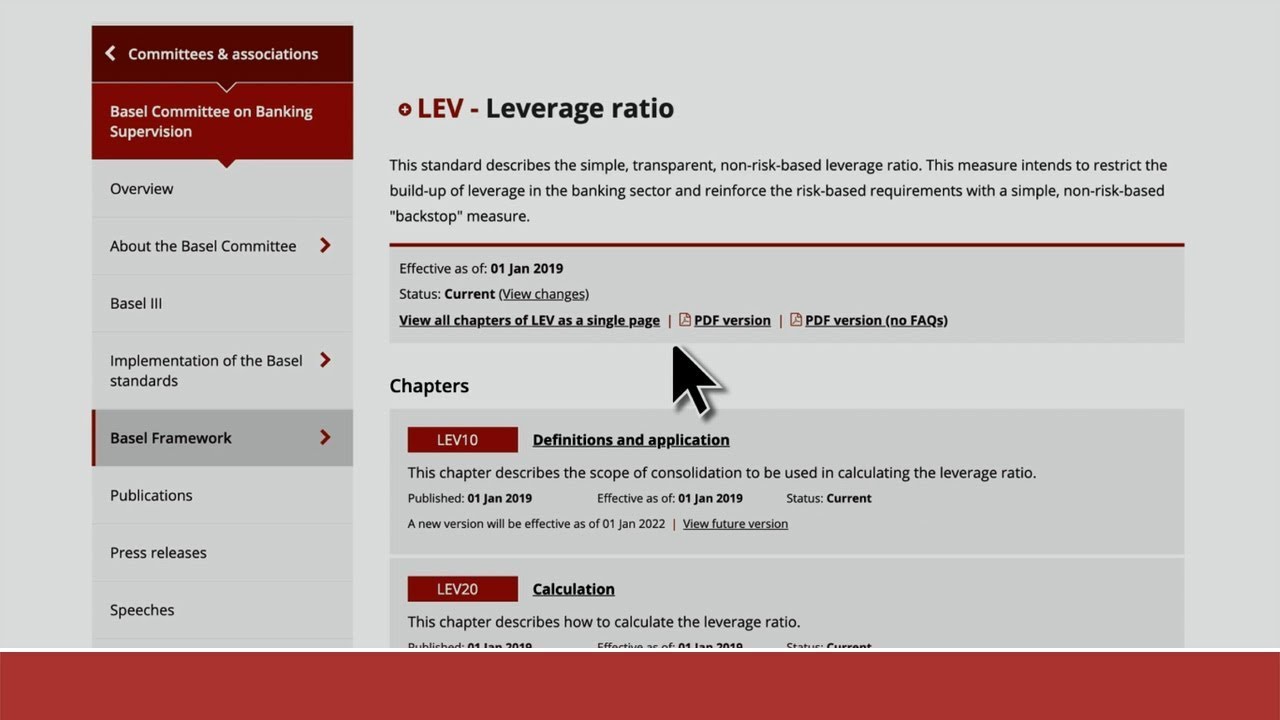
This standard describes the simple, transparent, non-risk-based leverage ratio. This measure intends to restrict the build-up of leverage in the banking sector and reinforce the risk-based requirements with a simple, non-risk-based "backstop" measure.
This standard describes the Liquidity Coverage Ratio, a measure which promotes the short-term resilience of a bank's liquidity risk profile.
The net stable funding ratio requires banks to maintain a stable funding profile in relation to the composition of their assets and off-balance-sheet activities.
Large exposures regulation limits the maximum loss that a bank could face in the event of a sudden counterparty failure to a level that does not endanger the bank's solvency. This standard requires banks to measure their exposures to a single counterparty or a group of connected counterparties and limit the size of large exposures in relation to their capital.
This standard establishes minimum standards for margin requirements for non-centrally cleared derivatives. Such requirements reduce systemic risk with respect to non-standardised derivatives by reducing contagion and spillover risks and promoting central clearing.
The Pillar 2 supervisory review process ensures that banks have adequate capital and liquidity to support all the risks in their business, especially with respect to risks not fully captured by the Pillar 1 process, and encourages good risk management.
This standard sets out disclosure requirements, which aim to encourage market discipline.
The Basel Core Principles provide a comprehensive standard for establishing a sound foundation for the regulation, supervision, governance and risk management of the banking sector.