Transitional arrangements
This chapter describes transitional arrangements applying to certain capital instruments, as well as transitional arrangements that may be used by jurisdictions applying expected credit loss accounting.
- Effective as of: 15 Dec 2019
- Last update: 15 Dec 2019
- Status Current
Transitional arrangements for certain capital instruments
90.1
Capital instruments that no longer qualify as non-common equity Tier 1 or Tier 2 capital are phased out beginning 1 January 2013. Fixing the base at the nominal amount of such instruments outstanding on 1 January 2013, their recognition is capped at 90% from 1 January 2013, with the cap reducing by 10 percentage points in each subsequent year.
90.2
This cap is applied to Additional Tier 1 and Tier 2 separately and refers to the total amount of instruments outstanding that no longer meet the relevant entry criteria. To the extent an instrument is redeemed, or its recognition in capital is amortised, after 1 January 2013, the nominal amount serving as the base is not reduced.
FAQ1, FAQ2, FAQ3, FAQ4, FAQ5, FAQ66 FAQs
| FAQ1 | If a Tier 2 instrument eligible for transitional arrangements begins its final five-year amortisation period prior to 1 January 2013, does it carry on amortising at a rate of 20% per annum after 1 January 2013? Individual instruments continue to be amortised at a rate of 20% per year while the aggregate cap is reduced at a rate of 10% per year. |
| FAQ2 | Can ineligible Tier 1 instruments be “cascaded” into Tier 2 and, if so, can a firm elect to do this at 1 January 2013 or a later date? CAP90.1 states that, “Capital instruments that no longer qualify as non-common equity Tier 1 capital or Tier 2 capital are phased out beginning 1 January 2013. Fixing the base at the nominal amount of such instruments outstanding on 1 January 2013, their recognition is capped at 90% from 1 January 2013, with the cap reducing by 10 percentage points in each subsequent year.” This rule does not prohibit instruments, in whole or in part, that exceed the cap on recognition in Additional Tier 1 being reallocated to Tier 2 if they meet all of the criteria for inclusion in Tier 2 that apply from 1 January 2013. Any reallocation will have no effect on the calculation of the cap itself. This means that instruments that are phased out of Additional Tier 1 and do not meet the point-of-non-viability requirements in CAP10.11(16) will not be permitted to be “cascaded” into Tier 2, as Tier 2 is required to meet the point-of-non-viability requirements in CAP10.16(10). |
| FAQ3 | Some Tier 1 and Tier 2 instruments were not eligible to be recognised as such under Basel II because they exceeded the relevant limits for recognition (eg 15% innovative limit or Tier 2 limit). Can amounts that exceeded these limits be included in the base for the transitional arrangements established in CAP90.1 and CAP90.2? No. The base for the transitional arrangements should reflect the outstanding amount that is eligible to be included in the relevant tier of capital under the national rules applied on 31 December 2012. |
| FAQ4 | If a Tier 2 instrument eligible for grandfathering begins its final five-year amortisation period prior to 1 January 2013, is the full nominal amount or the amortised amount used in fixing the base for transitional arrangements? For Tier 2 instruments that have begun to amortise before 1 January 2013, the base for transitional arrangements should take into account the amortised amount, not the full nominal amount. |
| FAQ5 | What happens to share premium (stock surplus) associated with instruments eligible for the transitional arrangements? Share premium (stock surplus) only meets the entry criteria if it is related to an instrument that meets the entry criteria. The share premium of instruments that do not meet the entry criteria, but which are eligible for the transitional arrangements, should instead be included in the base for the transitional arrangements. |
| FAQ6 | How do the transitional arrangements apply to instruments denominated in a foreign currency along with any potential hedges of the nominal amount of those instruments? The total amount of such instruments that no longer meet the criteria for inclusion in the relevant tier of capital are included in the base and limited by the cap from 1 January 2013 onwards. To calculate the base, instruments denominated in foreign currency that no longer qualify for inclusion in the relevant tier of capital should be included using their value in the reporting currency of the bank as at 1 January 2013. The base will therefore be fixed in the reporting currency of the bank throughout the transitional period. During the transitional period instruments denominated in a foreign currency should be valued as they are reported on the balance sheet of the bank at the relevant reporting date (adjusting for any amortisation in the case of Tier 2 instruments) and, along with all other instruments that no longer meet the criteria for inclusion in the relevant tier of capital, are subject to the cap. |
90.3
In addition, instruments with an incentive to be redeemed are treated as follows:
- For an instrument that has a call and a step-up prior to 1 January 2013 (or another incentive to be redeemed), if the instrument is not called at its effective maturity date and on a forward-looking basis meets the new criteria for inclusion in Tier 1 or Tier 2, it continues to be recognised in that tier of capital.
- For an instrument that has a call and a step-up on or after 1 January 2013 (or another incentive to be redeemed), if the instrument is not called at its effective maturity date and on a forward-looking basis meets the new criteria for inclusion in Tier 1 or Tier 2, it continues to be recognised in that tier of capital. After the call date, the full amount of a Tier 1 instrument, or the applicable amortised amount of a Tier 2 instrument, is recognised. Prior to the effective maturity date, the instrument would be considered an “instrument that no longer qualifies as Additional Tier 1 or Tier 2” and therefore is phased out from 1 January 2013.
- For an instrument that has a call and a step-up between 12 September 2010 and 1 January 2013 (or another incentive to be redeemed), if the instrument is not called at its effective maturity date and on a forward-looking basis does not meet the new criteria for inclusion in Tier 1 or Tier 2, it is fully derecognised in that tier of regulatory capital from 1 January 2013 and not included in the base for the transitional arrangements.
- For an instrument that has a call and a step-up on or after 1 January 2013 (or another incentive to be redeemed), if the instrument is not called at its effective maturity date and on a forward looking basis does not meet the new criteria for inclusion in Tier 1 or Tier 2, it is derecognised in that tier of regulatory capital from the effective maturity date. Prior to the effective maturity date, the instrument would be considered an “instrument that no longer qualifies as Additional Tier 1 or Tier 2” and therefore is phased out from 1 January 2013.
- For an instrument that had a call and a step-up on or prior to 12 September 2010 (or another incentive to be redeemed), if the instrument was not called at its effective maturity date and on a forward looking basis does not meet the new criteria for inclusion in Tier 1 or Tier 2, it is considered an “instrument that no longer qualifies as Additional Tier 1 or Tier 2” and therefore is phased out from 1 January 2013.
4 FAQs
| FAQ1 | Does this mean that if there was a Tier 1 security that met all the requirements to qualify for Additional Tier 1 capital on a forward-looking basis after its call date and it is callable on 31 December 2014, on 1 January 2014, the security would count at 80% of notional but on 1 January 2015, if not called, it would count as 100% of Tier 1 capital? Yes. However, it should be noted that the base that sets a cap on the instruments that may be included applies to all outstanding instruments that no longer qualify as non-common equity Tier 1. This means, for example, that if other non-qualifying Tier 1 instruments are repaid during 2014 it is possible for the instrument to receive recognition in excess of 80% during 2014. |
| FAQ2 | If an instrument issued before 12 September 2010 has an incentive to redeem and does not fulfil the non-viability requirement in CAP10.11(16) or CAP10.16(10), but is otherwise compliant on a forward-looking basis, is it eligible for transitional arrangements? If an instrument has an effective maturity date that occurs before 1 January 2013 and is not called, and complies with the entry criteria except for the non-viability requirement on 1 January 2013, then it is eligible for transitional arrangements. If the instrument has an effective maturity date that occurs after 1 January 2013, and therefore it does not comply with the entry criteria (including the non-viability requirement) as on 1 January 2013, it should be phased out until its effective maturity date and derecognised after that date. |
| FAQ3 | Assume that on 1 January 2013 a bank has $100m of non-compliant Tier 1 securities outstanding. By 1 January 2017, the capital recognition has been reduced to 50% (10% per year starting at 90% on 1 January 2013). Now assume that $50m of the Tier 1 securities have been called between 2013 and the end of 2016 – leaving $50m outstanding. Does the transitional arrangement mean the bank can fully recognise the remaining $50m of capital on 1 January 2017? Yes. |
| FAQ4 | For instruments with an incentive to redeem after 1 January 2013, CAP90.3 permits them to be included in capital after their call/step-up date if they meet the CAP10 criteria on a forward-looking basis. Does this forward looking basis mean that they need to meet the loss absorbency criteria set out in CAP10.11(16) and CAP10.16(10)? Yes, they need to meet all CAP10 criteria on a forward looking basis or they will be derecognised from capital after their call/step-up date. |
90.4
Capital instruments that do not meet the criteria for inclusion in Common Equity Tier 1 are excluded from Common Equity Tier 1 as of 1 January 2013. However, instruments meeting the following three conditions are phased out over the same horizon described in CAP90.1:
- they are issued by a non-joint stock company;1
- they are treated as equity under the prevailing accounting standards; and
- they receive unlimited recognition as part of Tier 1 capital under current national banking law.
1 Footnote
| 1 | Non-joint stock companies were not addressed in the Basel Committee’s 1998 agreement on instruments eligible for inclusion as they do not issue voting common shares. |
90.5
The following instruments qualify for the above transition arrangements:
- instruments issued before 12 September 2010; and
- instruments issued prior to 1 January 2013 that meet all of the entry criteria for Additional Tier 1 or Tier 2 apart from the non-viability criteria in CAP10.11(16) and CAP10.16(10).
1 FAQ
| FAQ1 | If the contractual terms of an instrument issued before 12 September 2010 are amended to remove features that make it ineligible for grandfathering (eg deletion of call options or other incentives to redeem) but without making the instrument fully compliant with the Basel III definition of capital, can the instrument be counted as eligible grandfathered regulatory capital (subject to the limits in CAP90.1)? A material change in the terms and conditions of a pre-existing instrument shall be considered in the same way as the issuance of a new instrument. This means that the instrument may only be included in regulatory capital if the revised terms and conditions meet the Basel III eligibility criteria in full. Revisions to terms and conditions cannot be used to extend grandfathering arrangements. This reasoning holds true for all types of capital instruments. |
Transitional arrangements for expected credit loss accounting
90.7
The Committee has determined that it may be appropriate for a jurisdiction to introduce a transitional arrangement for the impact on regulatory capital from the application of expected credit loss (ECL) accounting. Jurisdictions applying a transitional arrangement must implement such an arrangement as follows.
90.8
The transitional arrangement must apply only to provisions that are “new” under an ECL accounting model. “New” provisions are provisions which do not exist under accounting approaches applied prior to the adoption of an ECL accounting model.
90.9
The transitional arrangement must adjust Common Equity Tier 1 capital. Where there is a reduction in Common Equity Tier 1 capital due to new provisions, net of tax effect, upon adoption of an ECL accounting model, the decline in Common Equity Tier 1 capital (the “transitional adjustment amount”) must be partially included (ie added back) to Common Equity Tier 1 capital over a number of years (the “transition period”) commencing on the effective date of the transition to ECL accounting.
90.10
Jurisdictions must choose whether banks under their supervision determine the transitional adjustment amount throughout the transition period by either:
- calculating it just once, at the effective date of the transition to ECL accounting (ie static approach); or
- recalculating it periodically to reflect the evolution of a bank’s ECL provisions within the transition period (ie dynamic approach).
90.11
The transitional adjustment amount may be calculated based on the impact on Common Equity Tier 1 capital upon adoption of an ECL accounting model or from accounting provisions disclosed before and after the adoption of an ECL accounting model.
90.12
For internal ratings-based (IRB) portfolios, the calculation of transitional adjustment amounts must take account of the shortfall of the stock of provisions to expected losses, as set out in CAP30.13. In some circumstances, an increase in provisions will not be fully reflected in IRB Common Equity Tier 1 capital.
90.13
The transition period commences from the date upon which a bank adopts ECL accounting in a jurisdiction that requires or permits the implementation of an ECL accounting framework. The transition period must be no more than five years.
90.14
During the transition period, the transitional adjustment amount will be partially included in (ie added back to) Common Equity Tier 1 capital. A fraction of the transitional adjustment amount (based on the number of years in the transition period) will be included in Common Equity Tier 1 capital during the first year of the transition period, with the proportion included in Common Equity Tier 1 capital phased out each year thereafter during the course of the transition period on a straight line basis. The impact of ECL provisions on Common Equity Tier 1 capital must not be fully neutralised during the transition period.
90.15
The transitional adjustment amount included in Common Equity Tier 1 capital each year during the transition period must be taken through to other measures of capital as appropriate (eg Tier 1 capital and total capital), and hence to the calculation of the leverage ratio and of large exposures limits.
90.16
Jurisdictions must choose between applying the consequential adjustments listed below or a simpler approach to ensure that banks do not receive inappropriate capital relief. (An example of a simpler approach that would not provide inappropriate capital relief would be amortising the transitional arrangement more rapidly than otherwise.)
- Account should be taken of tax effects in calculating the impact of ECL accounting on Common Equity Tier 1 capital.
- Any deferred tax asset (DTA) arising from a temporary difference associated with a non-deducted provision amount must be disregarded for regulatory purposes during the transitional period. This means that such DTA amount must not be considered for Common Equity Tier 1 capital, and in return must not be subject to deduction from Common Equity Tier 1 capital and must not be subject to risk weighting, as applicable.
- An accounting provision amount not deducted from Common Equity Tier 1 capital should not:
- be included in Tier 2 capital, even if the provision meets the definition of “general” or “excess” provisions;
- reduce exposure amounts in the standardised approach even if it meets the definition of a “specific” provision; or
- reduce the total exposure measure in the leverage ratio.
90.17
Jurisdictions must publish details of any transitional arrangement applied, the rationale for it, and its implications for supervision of banks (eg whether supervisory decisions will be based solely on regulatory metrics which incorporate the effect of the transitional arrangement). Jurisdictions that choose to implement a transitional arrangement must require their banks to disclose, as set out in DIS20:2
- whether a transitional arrangement is applied; and
- the impact on the bank’s regulatory capital and leverage ratios compared to the bank’s “fully loaded” capital and leverage ratios had the transitional arrangements not been applied.
1 Footnote
| 2 | In addition to the required disclosures under Pillar 3, banks may also provide this information prominently on their website. |
This standard describes the scope of application of the Basel Framework.
This standard describes the criteria that bank capital instruments must meet to be eligible to satisfy the Basel capital requirements, as well as necessary regulatory adjustments and transitional arrangements.
This standard describes the framework for risk-based capital requirements.
This standard describes how to calculate capital requirements for credit risk.
This standard describes how to calculate capital requirements for market risk and credit valuation adjustment risk.
This standard describes how to calculate capital requirements for operational risk.
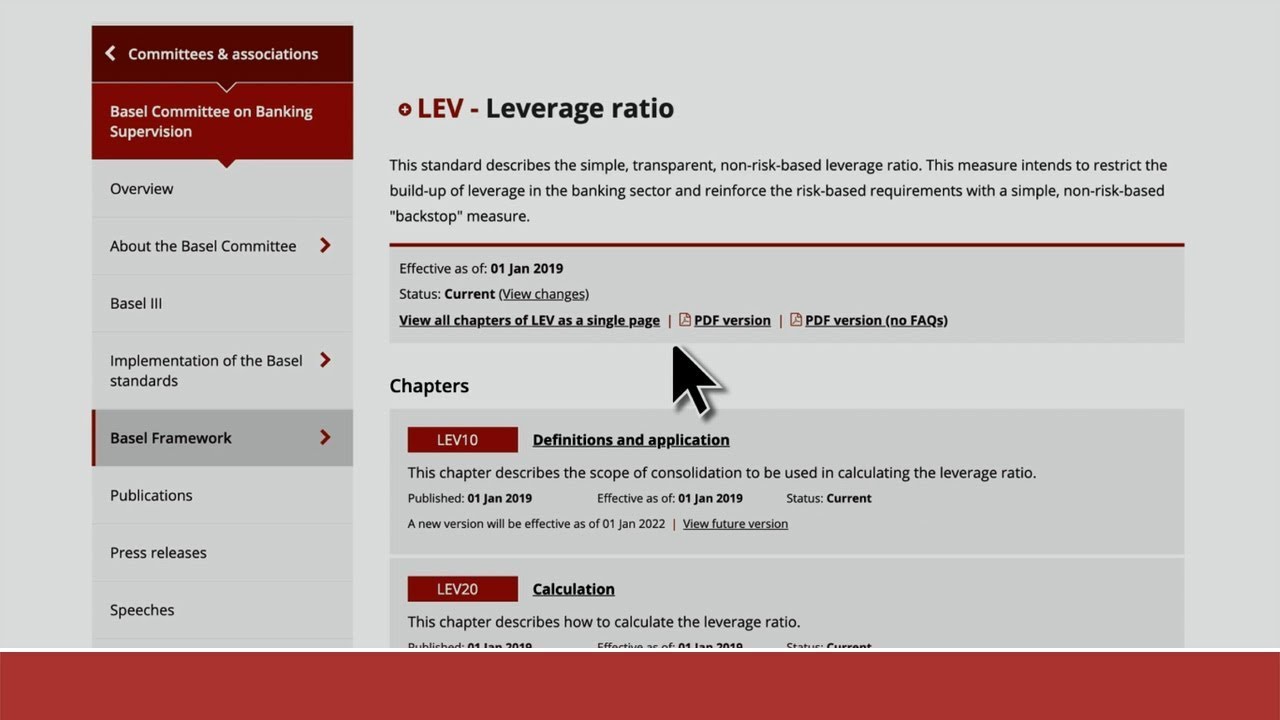
This standard describes the simple, transparent, non-risk-based leverage ratio. This measure intends to restrict the build-up of leverage in the banking sector and reinforce the risk-based requirements with a simple, non-risk-based "backstop" measure.
This standard describes the Liquidity Coverage Ratio, a measure which promotes the short-term resilience of a bank's liquidity risk profile.
The net stable funding ratio requires banks to maintain a stable funding profile in relation to the composition of their assets and off-balance-sheet activities.
Large exposures regulation limits the maximum loss that a bank could face in the event of a sudden counterparty failure to a level that does not endanger the bank's solvency. This standard requires banks to measure their exposures to a single counterparty or a group of connected counterparties and limit the size of large exposures in relation to their capital.
This standard establishes minimum standards for margin requirements for non-centrally cleared derivatives. Such requirements reduce systemic risk with respect to non-standardised derivatives by reducing contagion and spillover risks and promoting central clearing.
The Pillar 2 supervisory review process ensures that banks have adequate capital and liquidity to support all the risks in their business, especially with respect to risks not fully captured by the Pillar 1 process, and encourages good risk management.
This standard sets out disclosure requirements, which aim to encourage market discipline.
The Basel Core Principles provide a comprehensive standard for establishing a sound foundation for the regulation, supervision, governance and risk management of the banking sector.