Calculation
This chapter explains how to calculate the Liquidity Coverage Ratio, the minimum requirement and banks' reporting obligations.
- Effective as of: 15 Dec 2019
- Last update: 15 Dec 2019
- Status Removed on 08 Dec 2022
20.1
The Committee has developed the Liquidity Coverage Ratio (LCR) to promote the short-term resilience of the liquidity risk profile of banks by ensuring that they have sufficient high-quality liquid assets (HQLA) to survive a significant stress scenario lasting 30 calendar days.
20.2
The scenario for this standard entails a combined idiosyncratic and market-wide shock that would result in:
- the run-off of a proportion of retail deposits;
- a partial loss of unsecured wholesale funding;
- a partial loss of secured, short-term financing with certain collateral and counterparties;
- additional contractual outflows that would arise from a downgrade in the bank’s public credit rating by up to and including three notches, including collateral posting requirements;
- increases in market volatilities that impact the quality of collateral or potential future exposure of derivative positions and thus require larger collateral haircuts or additional collateral, or lead to other liquidity needs;
- unscheduled draws on committed but unused credit and liquidity facilities that the bank has provided to its clients; and
- the potential need for the bank to buy back debt or honour non-contractual obligations in the interest of mitigating reputational risk.
20.3
This stress test should be viewed as a minimum supervisory requirement for banks. Banks are expected to conduct their own stress tests to assess the level of liquidity they should hold beyond this minimum, and construct their own scenarios that could cause difficulties for their specific business activities. Such internal stress tests should incorporate longer time horizons than the one mandated by this standard. Banks should share the results of these additional stress tests with supervisors.

20.5
The LCR builds on traditional liquidity "coverage ratio" methodologies used internally by banks to assess exposure to contingent liquidity events. The total net cash outflows for the scenario are to be calculated for 30 calendar days into the future. The standard requires that, absent a situation of financial stress, the value of the ratio be no lower than 100% (ie the stock of HQLA should at least equal total net cash outflows) on an ongoing basis because the stock of unencumbered HQLA is intended to serve as a defence against the potential onset of liquidity stress. During periods of stress, however, it would be entirely appropriate for banks to use their stock of HQLA, thereby falling below the minimum. Supervisors will subsequently assess this situation and will give guidance on usability according to the circumstances.
20.6
In particular, supervisory decisions regarding a bank’s use of its HQLA should be guided by consideration of the core objective and definition of the LCR. Supervisors should exercise judgement in their assessment and account not only for prevailing macrofinancial conditions, but also consider forward-looking assessments of macroeconomic and financial conditions. In determining a response, supervisors should be aware that some actions could be procyclical if applied in circumstances of market-wide stress. Supervisors should seek to take these considerations into account on a consistent basis across jurisdictions.
- Supervisors should assess conditions at an early stage, and take actions if deemed necessary, to address potential liquidity risk.
- Supervisors should allow for differentiated responses to a reported LCR below 100%. Any potential supervisory response should be proportionate with the drivers, magnitude, duration and frequency of the reported shortfall.
- Supervisors should assess a number of firm- and market-specific factors in determining the appropriate response, as well as other considerations related to both domestic and global frameworks and conditions. Potential considerations include, but are not limited to:
- the reason(s) that the LCR fell below 100%. This includes use of the stock of HQLA, an inability to roll over funding or large unexpected draws on contingent obligations. In addition, the reasons may relate to overall credit, funding and market conditions, including liquidity in credit, asset and funding markets, affecting individual banks or all institutions, regardless of their own condition;
- the extent to which the reported decline in the LCR is due to a firm-specific or market-wide shock;
- a bank’s overall health and risk profile, including activities, positions with respect to other supervisory requirements, internal risk systems, controls and other management processes, among others;
- the magnitude, duration and frequency of the reported decline of HQLA;
- the potential for contagion to the financial system and additional restricted flow of credit or reduced market liquidity due to actions to maintain an LCR of 100%; and
- the availability of other sources of contingent funding such as central bank funding,1 or other actions by prudential authorities.
- Supervisors should have a range of tools at their disposal to address a reported LCR below 100%. Banks may use their stock of HQLA in both idiosyncratic and systemic stress events, although the supervisory response may differ between the two.
- At a minimum, a bank should present an assessment of its liquidity position, including the factors that contributed to its LCR falling below 100%, the measures that have been and will be taken and the expectations on the potential length of the situation. Enhanced reporting to supervisors should be commensurate with the duration of the shortfall.
- If appropriate, supervisors could also require actions by a bank to reduce its exposure to liquidity risk, strengthen its overall liquidity risk management, or improve its contingency funding plan.
- However, in a situation of sufficiently severe system-wide stress, effects on the entire financial system should be considered. Potential measures to restore liquidity levels should be discussed, and should be executed over a period of time considered appropriate to prevent additional stress on the bank and on the financial system as a whole.
- Supervisors’ responses should be consistent with the overall approach to the prudential framework.
1 Footnote
| 1 | The Sound Principles require that a bank develop a contingency funding plan (CFP) that clearly sets out strategies for addressing liquidity shortfalls, in both firm-specific and market-wide situations of stress. A CFP should, among other things, “reflect central bank lending programmes and collateral requirements, including facilities that form part of normal liquidity management operations (eg the availability of seasonal credit).” |
20.7
The LCR should be used on an ongoing basis to help monitor and control liquidity risk. The LCR must be reported to supervisors at least monthly, with the operational capacity to increase the frequency to weekly or even daily in stressed situations at the discretion of the supervisors. The time lag in reporting should be as short as feasible and ideally should not surpass two weeks.
20.8
Banks are expected to inform supervisors of their LCR and their liquidity profile on an ongoing basis. Banks must also notify supervisors immediately if their LCR has fallen, or is expected to fall, below 100%.
This standard describes the scope of application of the Basel Framework.
This standard describes the criteria that bank capital instruments must meet to be eligible to satisfy the Basel capital requirements, as well as necessary regulatory adjustments and transitional arrangements.
This standard describes the framework for risk-based capital requirements.
This standard describes how to calculate capital requirements for credit risk.
This standard describes how to calculate capital requirements for market risk and credit valuation adjustment risk.
This standard describes how to calculate capital requirements for operational risk.
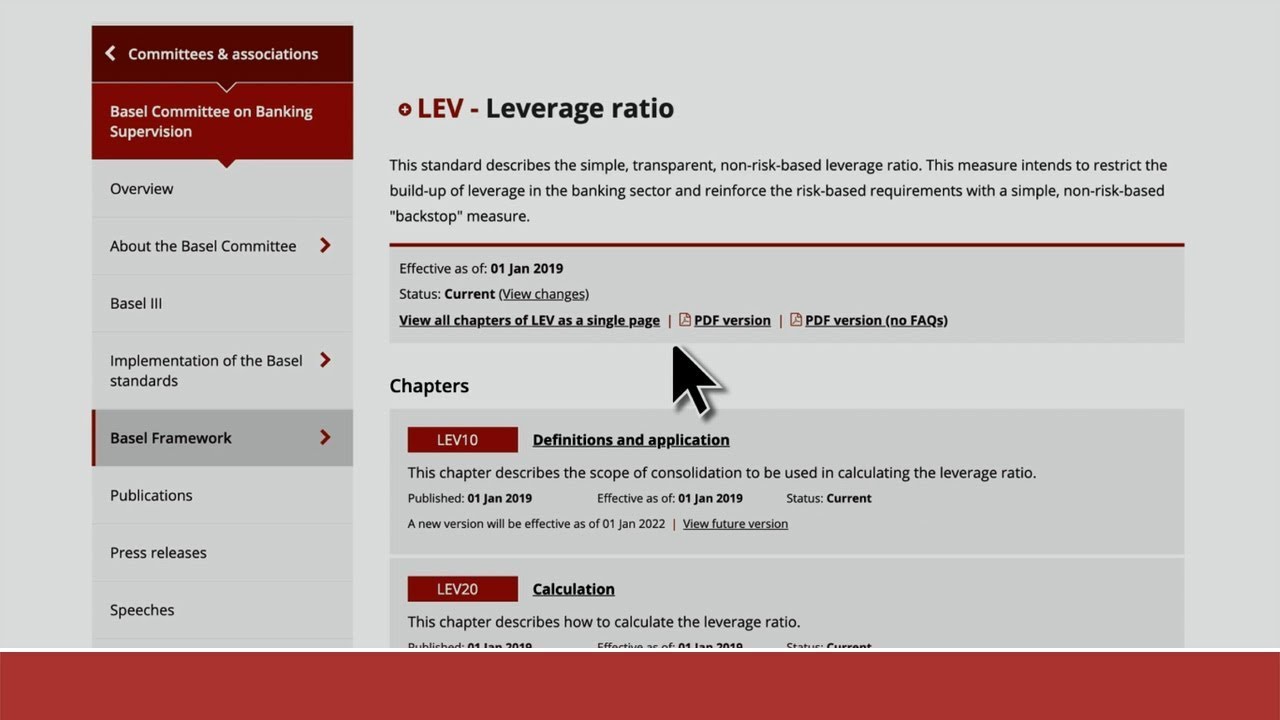
This standard describes the simple, transparent, non-risk-based leverage ratio. This measure intends to restrict the build-up of leverage in the banking sector and reinforce the risk-based requirements with a simple, non-risk-based "backstop" measure.
This standard describes the Liquidity Coverage Ratio, a measure which promotes the short-term resilience of a bank's liquidity risk profile.
The net stable funding ratio requires banks to maintain a stable funding profile in relation to the composition of their assets and off-balance-sheet activities.
Large exposures regulation limits the maximum loss that a bank could face in the event of a sudden counterparty failure to a level that does not endanger the bank's solvency. This standard requires banks to measure their exposures to a single counterparty or a group of connected counterparties and limit the size of large exposures in relation to their capital.
This standard establishes minimum standards for margin requirements for non-centrally cleared derivatives. Such requirements reduce systemic risk with respect to non-standardised derivatives by reducing contagion and spillover risks and promoting central clearing.
The Pillar 2 supervisory review process ensures that banks have adequate capital and liquidity to support all the risks in their business, especially with respect to risks not fully captured by the Pillar 1 process, and encourages good risk management.
This standard sets out disclosure requirements, which aim to encourage market discipline.
The Basel Core Principles provide a comprehensive standard for establishing a sound foundation for the regulation, supervision, governance and risk management of the banking sector.