Standardised approach: use of external ratings
This chapter sets out for the standardised approach to credit risk the conditions to recognise an external credit assessment institution and related implementation considerations.
- Effective as of: 15 Dec 2019
- Last update: 15 Dec 2019
- Status Superseded
External credit assessment
21.1
National supervisors are responsible for determining on a continuous basis whether an external credit assessment institution (ECAI) meets the criteria listed in the paragraph below. National supervisors should refer to the International Organization of Securities Commission’s (IOSCO) Code of Conduct Fundamentals for Credit Rating Agencies when determining ECAI eligibility. The assessments of ECAIs may be recognised on a limited basis, eg by type of claims or by jurisdiction. The supervisory process for recognising ECAIs should be made public to avoid unnecessary barriers to entry.
21.2
An ECAI must satisfy each of the following six criteria.
- Objectivity: The methodology for assigning credit assessments must be rigorous, systematic, and subject to some form of validation based on historical experience. Moreover, assessments must be subject to ongoing review and responsive to changes in financial condition. Before being recognised by supervisors, an assessment methodology for each market segment, including rigorous backtesting, must have been established for at least one year and preferably three years.
- Independence: An ECAI should be independent and should not be subject to political or economic pressures that may influence the rating. The assessment process should be as free as possible from any constraints that could arise in situations where the composition of the board of directors or the shareholder structure of the assessment institution may be seen as creating a conflict of interest.
- International access/Transparency: The individual assessments, the key elements underlining the assessments and whether the issuer participated in the assessment process should be publicly available on a non-selective basis, unless they are private assessments. In addition, the general procedures, methodologies and assumptions for arriving at assessments used by the ECAI should be publicly available.
- Disclosure: An ECAI should disclose the following information: its code of conduct; the general nature of its compensation arrangements with assessed entities; its assessment methodologies, including the definition of default, the time horizon, and the meaning of each rating; the actual default rates experienced in each assessment category; and the transitions of the assessments, eg the likelihood of AA ratings becoming A over time.
- Resources: An ECAI should have sufficient resources to carry out high quality credit assessments. These resources should allow for substantial ongoing contact with senior and operational levels within the entities assessed in order to add value to the credit assessments. Such assessments should be based on methodologies combining qualitative and quantitative approaches.
- Credibility: To some extent, credibility is derived from the criteria above. In addition, the reliance on an ECAI’s external credit assessments by independent parties (investors, insurers, trading partners) is evidence of the credibility of the assessments of an ECAI. The credibility of an ECAI is also underpinned by the existence of internal procedures to prevent the misuse of confidential information. In order to be eligible for recognition, an ECAI does not have to assess firms in more than one country.
Implementation considerations
21.3
Supervisors will be responsible for assigning eligible ECAIs’ assessments to the risk weights available under the standardised risk weighting framework, ie deciding which assessment categories correspond to which risk weights. The mapping process should be objective and should result in a risk weight assignment consistent with that of the level of credit risk reflected in the tables above. It should cover the full spectrum of risk weights.
21.4
When conducting such a mapping process, factors that supervisors should assess include, among others, the size and scope of the pool of issuers that each ECAI covers, the range and meaning of the assessments that it assigns, and the definition of default used by the ECAI. In order to promote a more consistent mapping of assessments into the available risk weights and help supervisors in conducting such a process, Standardised approach - implementing the mapping process (April 2019) provides guidance as to how such a mapping process may be conducted.
21.5
Banks must use the chosen ECAIs and their ratings consistently for each type of claim, for both risk weighting and risk management purposes. Banks will not be allowed to “cherry-pick” the assessments provided by different ECAIs and to arbitrarily change the use of ECAIs.
21.6
If there is only one assessment by an ECAI chosen by a bank for a particular claim, that assessment should be used to determine the risk weight of the claim.
21.7
If there are two assessments by ECAIs chosen by a bank which map into different risk weights, the higher risk weight will be applied.
21.8
If there are three or more assessments with different risk weights, the assessments corresponding to the two lowest risk weights should be referred to and the higher of those two risk weights will be applied.
21.9
Where a bank invests in a particular issue that has an issue-specific assessment, the risk weight of the claim will be based on this assessment. Where the bank’s claim is not an investment in a specific assessed issue, the following general principles apply.
- In circumstances where the borrower has a specific assessment for an issued debt — but the bank’s claim is not an investment in this particular debt — a high quality credit assessment (one which maps into a risk weight lower than that which applies to an unrated claim) on that specific debt may only be applied to the bank’s unassessed claim if this claim ranks pari passu or senior to the claim with an assessment in all respects. If not, the credit assessment cannot be used and the unassessed claim will receive the risk weight for unrated claims.
- In circumstances where the borrower has an issuer assessment, this assessment typically applies to senior unsecured claims on that issuer. Consequently, only senior claims on that issuer will benefit from a high quality issuer assessment. Other unassessed claims of a highly assessed issuer will be treated as unrated. If either the issuer or a single issue has a low quality assessment (mapping into a risk weight equal to or higher than that which applies to unrated claims), an unassessed claim on the same counterparty that ranks pari passu or is subordinated to either the senior unsecured issuer assessment or the exposure assessment will be assigned the same risk weight as is applicable to the low quality assessment.
21.10
Whether the bank intends to rely on an issuer- or an issue-specific assessment, the assessment must take into account and reflect the entire amount of credit risk exposure the bank has with regard to all payments owed to it. For example, if a bank is owed both principal and interest, the assessment must fully take into account and reflect the credit risk associated with repayment of both principal and interest.
21.11
In order to avoid any double counting of credit enhancement factors, no supervisory recognition of credit risk mitigation techniques will be taken into account if the credit enhancement is already reflected in the issue specific rating (CRE22.5).
21.12
Where unrated exposures are risk weighted based on the rating of an equivalent exposure to that borrower, the general rule is that foreign currency ratings would be used for exposures in foreign currency. Domestic currency ratings, if separate, would only be used to risk weight claims denominated in the domestic currency.1
1 Footnote
| 1 | However, when an exposure arises through a bank’s participation in a loan that has been extended, or has been guaranteed against convertibility and transfer risk, by certain multilateral development banks (MDBs), its convertibility and transfer risk can be considered by national supervisory authorities to be effectively mitigated. To qualify, MDBs must have preferred creditor status recognised in the market and be included in the footnote to CRE20.10. In such cases, for risk weighting purposes, the borrower’s domestic currency rating may be used instead of its foreign currency rating. In the case of a guarantee against convertibility and transfer risk, the local currency rating can be used only for the portion that has been guaranteed. The portion of the loan not benefiting from such a guarantee will be risk-weighted based on the foreign currency rating. |
21.13
For risk-weighting purposes, short-term assessments are deemed to be issue-specific. They can only be used to derive risk weights for claims arising from the rated facility. They cannot be generalised to other short-term claims, except under the conditions of CRE21.15. In no event can a short-term rating be used to support a risk weight for an unrated long-term claim. Short-term assessments may only be used for short-term claims against banks and corporates. The table2 3 below provides a framework for banks’ exposures to specific short-term facilities, such as a particular issuance of commercial paper:
| Credit assessment | A-1/P-1 | A-2/P-2 | A-3/P-3 | Others |
| Risk weight | 20% | 50% | 100% | 150% |
21.14
If a short-term rated facility attracts a 50% risk-weight, unrated short-term claims cannot attract a risk weight lower than 100%. If an issuer has a short-term facility with an assessment that warrants a risk weight of 150%, all unrated claims, whether long-term or short-term, should also receive a 150% risk weight, unless the bank uses recognised credit risk mitigation techniques for such claims.
21.15
In cases where national supervisors have decided to apply option 2 under the standardised approach to short term interbank claims to banks in their jurisdiction (see CRE20.13), the interaction with specific short-term assessments is expected to be the following:
- The general preferential treatment for short-term claims, as defined under CRE20.13 and CRE20.15, applies to all claims on banks of up to three months original maturity when there is no specific short-term claim assessment.
- When there is a short-term assessment and such an assessment maps into a risk weight that is more favourable (ie lower) or identical to that derived from the general preferential treatment, the short-term assessment should be used for the specific claim only. Other short-term claims would benefit from the general preferential treatment.
- When a specific short-term assessment for a short term claim on a bank maps into a less favourable (higher) risk weight, the general short-term preferential treatment for interbank claims cannot be used. All unrated short-term claims should receive the same risk weighting as that implied by the specific short-term assessment.
21.16
When a short-term assessment is to be used, the institution making the assessment needs to meet all of the eligibility criteria for recognising ECAIs as presented in CRE21.2 in terms of its short-term assessment.
21.17
External assessments for one entity within a corporate group cannot be used to risk weight other entities within the same group.
21.18
As a general rule, banks should use solicited ratings from eligible ECAIs. National supervisory authorities may, however, allow banks to use unsolicited ratings in the same way as solicited ratings if they are satisfied that the credit assessments of unsolicited ratings are not inferior in quality to the general quality of solicited ratings. However, there may be the potential for ECAIs to use unsolicited ratings to put pressure on entities to obtain solicited ratings. Such behaviour, when identified, should cause supervisors to consider whether to continue recognising such ECAIs as eligible for capital adequacy purposes.
This standard describes the scope of application of the Basel Framework.
This standard describes the criteria that bank capital instruments must meet to be eligible to satisfy the Basel capital requirements, as well as necessary regulatory adjustments and transitional arrangements.
This standard describes the framework for risk-based capital requirements.
This standard describes how to calculate capital requirements for credit risk.
This standard describes how to calculate capital requirements for market risk and credit valuation adjustment risk.
This standard describes how to calculate capital requirements for operational risk.
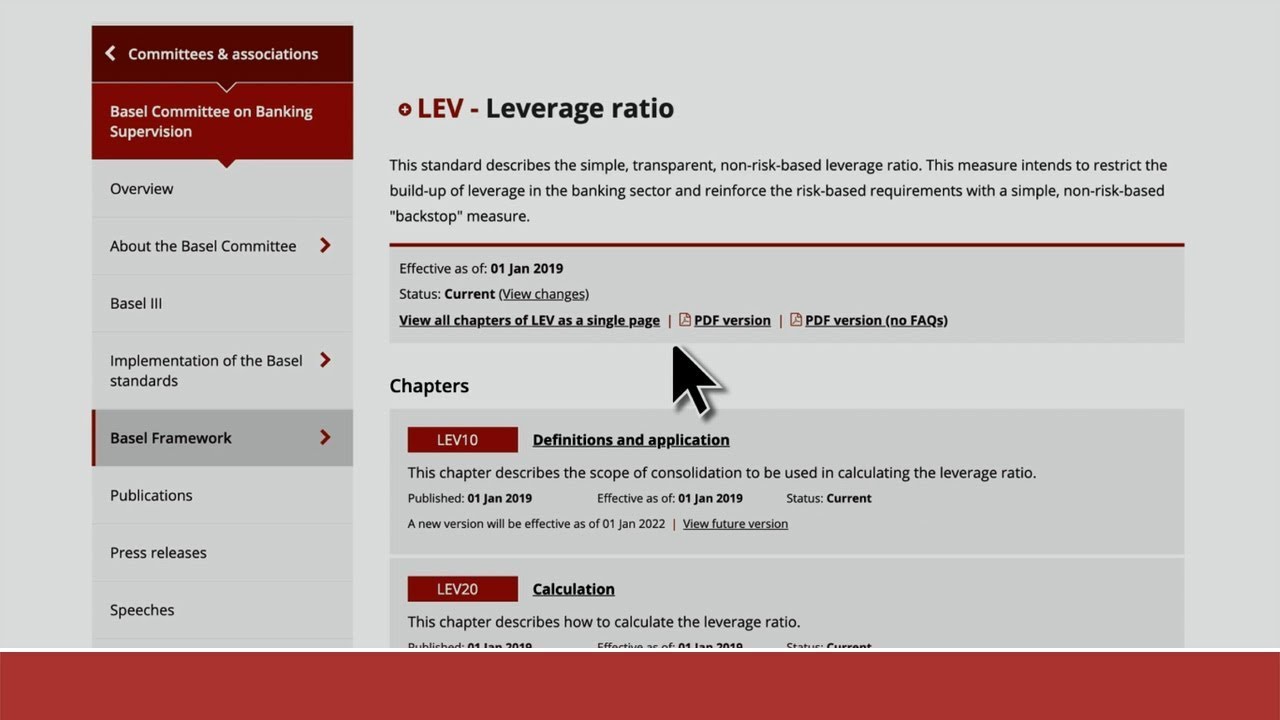
This standard describes the simple, transparent, non-risk-based leverage ratio. This measure intends to restrict the build-up of leverage in the banking sector and reinforce the risk-based requirements with a simple, non-risk-based "backstop" measure.
This standard describes the Liquidity Coverage Ratio, a measure which promotes the short-term resilience of a bank's liquidity risk profile.
The net stable funding ratio requires banks to maintain a stable funding profile in relation to the composition of their assets and off-balance-sheet activities.
Large exposures regulation limits the maximum loss that a bank could face in the event of a sudden counterparty failure to a level that does not endanger the bank's solvency. This standard requires banks to measure their exposures to a single counterparty or a group of connected counterparties and limit the size of large exposures in relation to their capital.
This standard establishes minimum standards for margin requirements for non-centrally cleared derivatives. Such requirements reduce systemic risk with respect to non-standardised derivatives by reducing contagion and spillover risks and promoting central clearing.
The Pillar 2 supervisory review process ensures that banks have adequate capital and liquidity to support all the risks in their business, especially with respect to risks not fully captured by the Pillar 1 process, and encourages good risk management.
This standard sets out disclosure requirements, which aim to encourage market discipline.
The Basel Core Principles provide a comprehensive standard for establishing a sound foundation for the regulation, supervision, governance and risk management of the banking sector.