Standardised approach: individual exposures
This chapter sets out the standardised approach for credit risk as it applies to individual claims.
- Effective as of: 15 Dec 2019
- Last update: 15 Dec 2019
- Status Superseded
Claims on sovereigns
Claims on non-central government public sector entities (PSEs)
Claims on multilateral development banks (MDBs)
Claims on banks
Claims on securities firms
Claims on corporates
Claims included in the regulatory retail portfolios
Claims secured by residential property
Claims secured by commercial real estate
Past due loans
Higher-risk categories
Other assets
Off-balance sheet items
Exposures that give rise to counterparty credit risk
Introduction
20.1
Banks can choose between two broad methodologies for calculating their risk-based capital requirements for credit risk. The first is the standardised approach, which is set out in chapters CRE20 to CRE22:
- The standardised approach assigns standardised risk weights to exposures as described in this chapter, CRE20. Risk weighted assets are calculated as the product of the standardised risk weights and the exposure amount. Exposures should be risk-weighted net of specific provisions (including partial write-offs).
- To determine the risk weights in the standardised approach for certain exposure classes, banks may use assessments by external credit assessment institutions that are recognised as eligible for capital purposes by national supervisors. The requirements covering the use of external ratings are set out in chapter CRE21.1
- The credit risk mitigation techniques that are permitted to be recognised under the standardised approach are set out in chapter CRE22.
1 Footnote
| 1 | The notations in CRE20 to CRE22 follow the methodology used by one institution, S&P. The use of S&P credit ratings is an example only; those of some other external credit assessment institutions could equally well be used. The ratings used throughout this document, therefore, do not express any preferences or determinations on external assessment institutions by the Committee. |
20.3
The treatment of the following exposures is addressed in separate chapters of the credit risk standard:
Claims on sovereigns
20.4
Claims on sovereigns and their central banks will be risk weighted as follows:
| Credit Assessment | AAA to AA- | A+ to A- | BBB+ to BBB- | BB+ to B- | Below B- | Unrated |
| Risk Weight | 0% | 20% | 50% | 100% | 150% | 100% |
20.5
At national discretion, a lower risk weight may be applied to banks’ exposures to their sovereign (or central bank) of incorporation denominated in domestic currency and funded2 in that currency.3 Where this discretion is exercised, other national supervisory authorities may also permit their banks to apply the same risk weight to domestic currency exposures to this sovereign (or central bank) funded in that currency.
20.6
For the purpose of risk weighting claims on sovereigns, supervisors may recognise the country risk scores assigned by Export Credit Agencies (ECAs). To qualify, an ECA must publish its risk scores and subscribe to the Organisation for Economic Cooperation and Development’s (OECD) agreed methodology. Banks may choose to use the risk scores published by individual ECAs that are recognised by their supervisor, or the consensus risk scores of ECAs participating in the “Arrangement on Officially Supported Export Credits”.4 The OECD agreed methodology establishes eight risk score categories associated with minimum export insurance premiums. These ECA risk scores will correspond to risk weight categories as detailed below.
| ECA risk scores | 0-1 | 2 | 3 | 4 to 6 | 7 |
| Risk weight | 0% | 20% | 50% | 100% | 150% |
1 Footnote
| 4 | The consensus country risk classifications of the Participants to the Arrangement on Officially Supported Export Credits are available on the OECD’s website ( http://www.oecd.org ). |
20.7
Claims on the Bank for International Settlements, the International Monetary Fund, the European Central Bank, the European Union, the European Stability Mechanism and the European Financial Stability Facility may receive a 0% risk weight.
Claims on non-central government public sector entities (PSEs)
20.8
Claims on domestic PSEs will be risk-weighted at national discretion, according to either option 1 or option 2 for claims on banks (see CRE20.14).5 When option 2 is selected, it is to be applied without the use of the preferential treatment for short-term claims.
1 Footnote
| 5 | This is regardless of the option chosen at national discretion for claims on banks of that country. It therefore does not imply that when one option has been chosen for claims on banks, the same option should also be applied to claims on PSEs. |
20.9
Subject to national discretion, claims on certain domestic PSEs may also be treated as claims on the sovereigns in whose jurisdictions the PSEs are established.6 Where this discretion is exercised, other national supervisors may allow their banks to risk weight claims on such PSEs in the same manner.
1 Footnote
| 6 | The following examples outline how PSEs might be categorised when focusing on one specific feature, namely revenue raising powers. However, there may be other ways of determining the different treatments applicable to different types of PSEs, for instance by focusing on the extent of guarantees provided by the central government: (a)Regional governments and local authorities could qualify for the same treatment as claims on their sovereign or central government if these governments and local authorities have specific revenue raising powers and have specific institutional arrangements the effect of which is to reduce their risks of default. (b)Administrative bodies responsible to central governments, regional governments or to local authorities and other non-commercial undertakings owned by the governments or local authorities may not warrant the same treatment as claims on their sovereign if the entities do not have revenue raising powers or other arrangements as described above. If strict lending rules apply to these entities and a declaration of bankruptcy is not possible because of their special public status, it may be appropriate to treat these claims in the same manner as claims on banks. (c)Commercial undertakings owned by central governments, regional governments or by local authorities may be treated as normal commercial enterprises. However, if these entities function as a corporate in competitive markets even though the state, a regional authority or a local authority is the major shareholder of these entities, supervisors should decide to consider them as corporates and therefore attach to them the applicable risk weights. |
Claims on multilateral development banks (MDBs)
20.10
The risk weights applied to claims on MDBs will generally be based on external credit assessments as set out under option 2 for claims on banks but without the possibility of using the preferential treatment for short-term claims. A 0% risk weight will be applied to claims on highly rated MDBs that fulfil to the Committee’s satisfaction the criteria provided below.7 The Committee will continue to evaluate eligibility on a case-by-case basis. The eligibility criteria for MDBs risk weighted at 0% are:
- very high quality long-term issuer ratings, ie a majority of an MDB’s external assessments must be AAA;
- shareholder structure is comprised of a significant proportion of sovereigns with long-term issuer credit assessments of AA- or better, or the majority of the MDB’s fund-raising are in the form of paid-in equity/capital and there is little or no leverage;
- strong shareholder support demonstrated by the amount of paid-in capital contributed by the shareholders; the amount of further capital the MDBs have the right to call, if required, to repay their liabilities; and continued capital contributions and new pledges from sovereign shareholders;
- adequate level of capital and liquidity (a case-by-case approach is necessary in order to assess whether each MDB’s capital and liquidity are adequate); and,
- strict statutory lending requirements and conservative financial policies, which would include among other conditions a structured approval process, internal creditworthiness and risk concentration limits (per country, sector, and individual exposure and credit category), large exposures approval by the board or a committee of the board, fixed repayment schedules, effective monitoring of use of proceeds, status review process, and rigorous assessment of risk and provisioning to loan loss reserve.
1 Footnote
| 7 | MDBs currently eligible for a 0% risk weight are: the World Bank Group comprised of the International Bank for Reconstruction and Development, the International Finance Corporation, the Multilateral Investment Guarantee Agency and the International Development Association, the Asian Development Bank, the African Development Bank, the European Bank for Reconstruction and Development, the Inter-American Development Bank, the European Investment Bank, the European Investment Fund, the Nordic Investment Bank, the Caribbean Development Bank, the Islamic Development Bank, the Council of Europe Development Bank, the International Finance Facility for Immunization and the Asian Infrastructure Investment Bank. |
Claims on banks
20.11
There are two options for claims on banks. National supervisors will apply one option to all banks in their jurisdiction. No claim on an unrated bank, except for self-liquidating letters of credit, may receive a risk weight lower than that applied to claims on its sovereign of incorporation.
20.12
Under the first option, all banks incorporated in a given country will be assigned a risk weight one category less favourable than that assigned to claims on the sovereign of that country. However, for claims on banks in countries with sovereigns rated BB+ to B- and on banks in unrated countries the risk weight will be capped at 100%.
20.13
The second option bases the risk weighting on the external credit assessment of the bank itself with claims on unrated banks being risk-weighted at 50%. Under this option, a preferential risk weight that is one category more favourable may be applied to claims with an original maturity8 of three months or less, subject to a floor of 20%. This treatment will be available to both rated and unrated banks, but not to banks risk weighted at 150%.
1 Footnote
| 8 | Supervisors should ensure that claims with (contractual) original maturity under 3 months which are expected to be rolled over (ie where the effective maturity is longer than 3 months) do not qualify for this preferential treatment for capital adequacy purposes. |
20.14
The two options are summarised in the tables below.9
| Option 1 | |||||||
| Credit assessment of Sovereign | AAA to AA- | A+ to A- | BBB+ to BBB- | BB+ to B- | Below B- | Unrated | |
| Risk weight under Option 1 | 20% | 50% | 100% | 100% | 150% | 100% | |
| Option 2 | |||||||
| Credit assessment of Banks | AAA to AA- | A+ to A- | BBB+ to BBB- | BB+ to B- | Below B- | Unrated | |
| Risk weight under Option 2 | 20% | 50% | 50% | 100% | 150% | 50% | |
| Risk weight for short-term claims under Option 2 | 20% | 20% | 20% | 50% | 150% | 20% | |
20.15
When the national supervisor has chosen to apply the preferential treatment for claims on the sovereign as described in CRE20.5, it can also assign, under both options 1 and 2, a risk weight that is one category less favourable than that assigned to claims on the sovereign, subject to a floor of 20%, to claims on banks of an original maturity of 3 months or less denominated and funded in the domestic currency.
Claims on securities firms
20.16
Claims on securities firms may be treated as claims on banks provided these firms are subject to supervisory and regulatory arrangements comparable to those under this Framework (including, in particular, risk-based capital requirements).10 Otherwise such claims would follow the rules for claims on corporates.
1 Footnote
| 10 | That is, capital requirements that are comparable to those applied to banks in this Framework. Implicit in the meaning of the word “comparable” is that the securities firm (but not necessarily its parent) is subject to consolidated regulation and supervision with respect to any downstream affiliates. |
Claims on corporates
20.17
The table provided below illustrates the risk weighting of rated corporate claims, including claims on insurance companies. The standard risk weight for unrated claims on corporates will be 100%. No claim on an unrated corporate may be given a risk weight preferential to that assigned to its sovereign of incorporation.
| Credit assessment | AAA to AA- | A+ to A- | BBB+ to BB- | Below BB- | Unrated |
| Risk weight | 20% | 50% | 100% | 150% | 100% |
20.18
Supervisory authorities should increase the standard risk weight for unrated claims where they judge that a higher risk weight is warranted by the overall default experience in their jurisdiction. As part of the supervisory review process, supervisors may also consider whether the credit quality of corporate claims held by individual banks should warrant a standard risk weight higher than 100%.
20.19
At national discretion, supervisory authorities may permit banks to risk weight all corporate claims at 100% without regard to external ratings. Where this discretion is exercised by the supervisor, it must ensure that banks apply a single consistent approach, ie either to use ratings wherever available or not at all. To prevent “cherry-picking” of external ratings, banks should obtain supervisory approval before utilising this option to risk weight all corporate claims at 100%.
Claims included in the regulatory retail portfolios
20.21
To be included in the regulatory retail portfolio, claims must meet the following four criteria:
- Orientation criterion: The exposure is to an individual person or persons or to a small business;
- Product criterion: The exposure takes the form of any of the following: revolving credits and lines of credit (including credit cards and overdrafts), personal term loans and leases (eg instalment loans, auto loans and leases, student and educational loans, personal finance) and small business facilities and commitments. Securities (such as bonds and equities), whether listed or not, are specifically excluded from this category. Mortgage loans are excluded to the extent that they qualify for treatment as claims secured by residential property (see CRE20.23).
- Granularity criterion: The supervisor must be satisfied that the regulatory retail portfolio is sufficiently diversified to a degree that reduces the risks in the portfolio, warranting the 75% risk weight. One way of achieving this may be to set a numerical limit that no aggregate exposure to one counterpart11 can exceed 0.2% of the overall regulatory retail portfolio.
- Low value of individual exposures: The maximum aggregated retail exposure to one counterpart cannot exceed an absolute threshold of €1 million.
1 Footnote
| 11 | Aggregated exposure means gross amount (ie not taking any credit risk mitigation into account) of all forms of debt exposures (eg loans or commitments) that individually satisfy the three other criteria. In addition, “to one counterpart” means one or several entities that may be considered as a single beneficiary (eg in the case of a small business that is affiliated to another small business, the limit would apply to the bank’s aggregated exposure on both businesses). |
20.22
National supervisory authorities should evaluate whether the risk weights in CRE20.20 are considered to be too low based on the default experience for these types of exposures in their jurisdictions. Supervisors, therefore, may require banks to increase these risk weights as appropriate.
Claims secured by residential property
20.23
Lending fully secured by mortgages on residential property that is or will be occupied by the borrower, or that is rented, will be risk weighted at 35%. In applying the 35% weight, the supervisory authorities should satisfy themselves, according to their national arrangements for the provision of housing finance, that this concessionary weight is applied restrictively for residential purposes and in accordance with strict prudential criteria, such as the existence of substantial margin of additional security over the amount of the loan based on strict valuation rules. Supervisors should increase the standard risk weight where they judge the criteria are not met.
20.24
National supervisory authorities should evaluate whether the risk weights in CRE20.23 are considered to be too low based on the default experience for these types of exposures in their jurisdictions. Supervisors, therefore, may require banks to increase these risk weights as appropriate.
Claims secured by commercial real estate
20.25
In view of the experience in numerous countries that commercial property lending has been a recurring cause of troubled assets in the banking industry over the past few decades, the Committee holds to the view that mortgages on commercial real estate do not, in principle, justify other than a 100% weighting of the loans secured.12
1 Footnote
| 12 | The Committee, however, recognises that, in exceptional circumstances for well-developed and long-established markets, mortgages on office and/or multi-purpose commercial premises and/or multi-tenanted commercial premises may have the potential to receive a preferential risk weight of 50% for the tranche of the loan that does not exceed the lower of 50% of the market value or 60% of the mortgage lending value of the property securing the loan. Any exposure beyond these limits will receive a 100% risk weight. This exceptional treatment will be subject to very strict conditions. In particular, two tests must be fulfilled, namely that: (i) losses stemming from commercial real estate lending up to the lower of 50% of the market value or 60% of loan-to-value based on mortgage-lending-value must not exceed 0.3% of the outstanding loans in any given year; and that (ii) overall losses stemming from commercial real estate lending must not exceed 0.5% of the outstanding loans in any given year. This is, if either of these tests is not satisfied in a given year, the eligibility to use this treatment will cease and the original eligibility criteria would need to be satisfied again before it could be applied in the future. Countries applying such a treatment must publicly disclose that these conditions are met. When claims benefiting from such an exceptional treatment have fallen past due, they will be risk-weighted at 100%. |
Past due loans
20.26
The unsecured portion of any loan (other than a qualifying residential mortgage loan) that is past due for more than 90 days, net of specific provisions (including partial write-offs), will be risk-weighted as follows: 13
- 150% risk weight when specific provisions are less than 20% of the outstanding amount of the loan;
- 100% risk weight when specific provisions are no less than 20% of the outstanding amount of the loan;
- 100% risk weight when specific provisions are no less than 50% of the outstanding amount of the loan, but with supervisory discretion to reduce the risk weight to 50%.
20.27
For the purpose of defining the secured portion of the past due loan, eligible collateral and guarantees will be the same as for credit risk mitigation purposes (see chapter CRE22). Past due retail loans are to be excluded from the overall regulatory retail portfolio when assessing the granularity criterion specified in CRE20.21, for risk-weighting purposes.
20.28
In addition to the circumstances described in CRE20.26, where a past due loan is fully secured by those forms of collateral that are not recognised in CRE22.37 and CRE22.39, a 100% risk weight may apply when provisions reach 15% of the outstanding amount of the loan. These forms of collateral are not recognised elsewhere in the standardised approach. Supervisors should set strict operational criteria to ensure the quality of collateral.
20.29
In the case of qualifying residential mortgage loans, when such loans are past due for more than 90 days they will be risk weighted at 100%, net of specific provisions. If such loans are past due but specific provisions are no less than 20% of their outstanding amount, the risk weight applicable to the remainder of the loan can be reduced to 50% at national discretion.
Higher-risk categories
20.30
The following claims will be risk weighted at 150% or higher:
- Claims on sovereigns, PSEs, banks, and securities firms rated below B-.
- Claims on corporates rated below BB-.
- Past due loans as set out in CRE20.26.
20.31
National supervisors may decide to apply a 150% or higher risk weight reflecting the higher risks associated with some other assets.
Other assets
20.32
The risk weight for investments in significant minority- or majority-owned and –controlled commercial entities is determined according to two materiality thresholds:
- for individual investments, 15% of the bank’s capital; and
- for the aggregate of such investments, 60% of the bank’s capital.
20.33
Investments in significant minority- or majority-owned and –controlled commercial entities below the materiality thresholds in CRE20.32 must be risk-weighted at 100%. Investments in excess of the materiality thresholds must be risk-weighted at 1250%.
20.34
A deduction treatment is specified in CAP30.32 for the following exposures: significant investments in the common shares of unconsolidated financial institutions, mortgage servicing rights, and deferred tax assets that arise from temporary differences. The exposures are deducted in the calculation of Common Equity Tier 1 (CET1) if they exceed the thresholds set out in CAP30.32 and CAP30.33. As specified in CAP30.34, the amount of the items that are not deducted in the calculation of CET1 will be risk weighted at 250%.
20.35
The standard risk weight for all other assets will be 100%.14 Investments in equity or regulatory capital instruments issued by banks or securities firms will be risk weighted at 100%, unless deducted from the capital base according CAP30.
FAQ11 Footnote, 1 FAQ
| 14 | However, at national discretion, gold bullion held in own vaults or on an allocated basis to the extent backed by bullion liabilities can be treated as cash and therefore risk-weighted at 0%. In addition, cash items in the process of collection can be risk-weighted at 20%. |
| FAQ1 | In 2016, the International Accounting Standards Board (IASB) and the Financial Accounting Standards Board (FASB) revised the accounting for lease transactions. Both require that most leases will be reflected on a lessee's balance sheet as an obligation to make lease payments (a liability) and a related right-of-use (ROU) asset (an asset). According to FAQ2 of CAP30.7, an ROU asset should not be deducted from regulatory capital so long as the underlying asset being leased is a tangible asset. When the ROU asset is not deducted from regulatory capital, should it be included in RWA and, if so, what risk weight should apply? Yes, the ROU asset should be included in RWA. The intent of the revisions to the lease accounting standards was to more appropriately reflect the economics of leasing transactions, including both the lessee's obligation to make future lease payments, as well as an ROU asset reflecting the lessee's control over the leased item's economic benefits during the lease term. The ROU asset should be risk-weighted at 100%, consistent with the risk weight applied historically to owned tangible assets and to a lessee's leased assets under leases accounted for as finance leases in accordance with existing accounting standards. |
Off-balance sheet items
20.36
Off-balance-sheet items under the standardised approach will be converted into credit exposure equivalents through the use of credit conversion factors (CCF). Counterparty risk weightings for over-the-counter (OTC) derivative transactions will not be subject to any specific ceiling.
20.37
Commitments with an original maturity up to one year and commitments with an original maturity over one year will receive a CCF of 20% and 50%, respectively. However, any commitments that are unconditionally cancellable at any time by the bank without prior notice, or that effectively provide for automatic cancellation due to deterioration in a borrower’s creditworthiness, will receive a 0% CCF.15
1 Footnote
| 15 | In certain countries, retail commitments are considered unconditionally cancellable if the terms permit the bank to cancel them to the full extent allowable under consumer protection and related legislation. |
20.38
Direct credit substitutes, eg general guarantees of indebtedness (including standby letters of credit serving as financial guarantees for loans and securities) and acceptances (including endorsements with the character of acceptances) will receive a CCF of 100%.
20.39
Sale and repurchase agreements and asset sales with recourse,16 where the credit risk remains with the bank will receive a CCF of 100%.
1 Footnote
| 16 | These items are to be weighted according to the type of asset and not according to the type of counterparty with whom the transaction has been entered into. |
20.40
A CCF of 100% will be applied to the lending of banks’ securities or the posting of securities as collateral by banks, including instances where these arise out of repo-style transactions (ie repurchase/reverse repurchase and securities lending/securities borrowing transactions). See CRE22.37 to CRE22.80 for the calculation of risk-weighted assets where the credit converted exposure is secured by eligible collateral. This paragraph does not apply to posted collateral that is treated under either the standardised approach to counterparty credit risk (CRE52) or the internal models method for counterparty credit risk (CRE53) calculation methods in the counterparty credit risk framework.
20.41
Forward asset purchases, forward forward deposits and partly-paid shares and securities17 , which represent commitments with certain drawdown will receive a CCF of 100%.
1 Footnote
| 17 | These items are to be weighted according to the type of asset and not according to the type of counterparty with whom the transaction has been entered into. |
20.42
Certain transaction-related contingent items (eg performance bonds, bid bonds, warranties and standby letters of credit related to particular transactions) will receive a CCF of 50%.
20.43
Note issuance facilities and revolving underwriting facilities will receive a CCF of 50%.
20.44
For short-term self-liquidating trade letters of credit arising from the movement of goods (eg documentary credits collateralised by the underlying shipment), a 20% CCF will be applied to both issuing and confirming banks.
20.45
Where there is an undertaking to provide a commitment on an off-balance sheet item, banks are to apply the lower of the two applicable CCFs.
Exposures that give rise to counterparty credit risk
20.46
For exposures that give rise to counterparty credit risk according to CRE51.4 (ie OTC derivatives, exchange-traded derivatives, long settlement transactions and securities financing transactions), the exposure amount to be used in the determination of RWA is to be calculated under the rules set out in CRE50 to CRE54.
This standard describes the scope of application of the Basel Framework.
This standard describes the criteria that bank capital instruments must meet to be eligible to satisfy the Basel capital requirements, as well as necessary regulatory adjustments and transitional arrangements.
This standard describes the framework for risk-based capital requirements.
This standard describes how to calculate capital requirements for credit risk.
This standard describes how to calculate capital requirements for market risk and credit valuation adjustment risk.
This standard describes how to calculate capital requirements for operational risk.
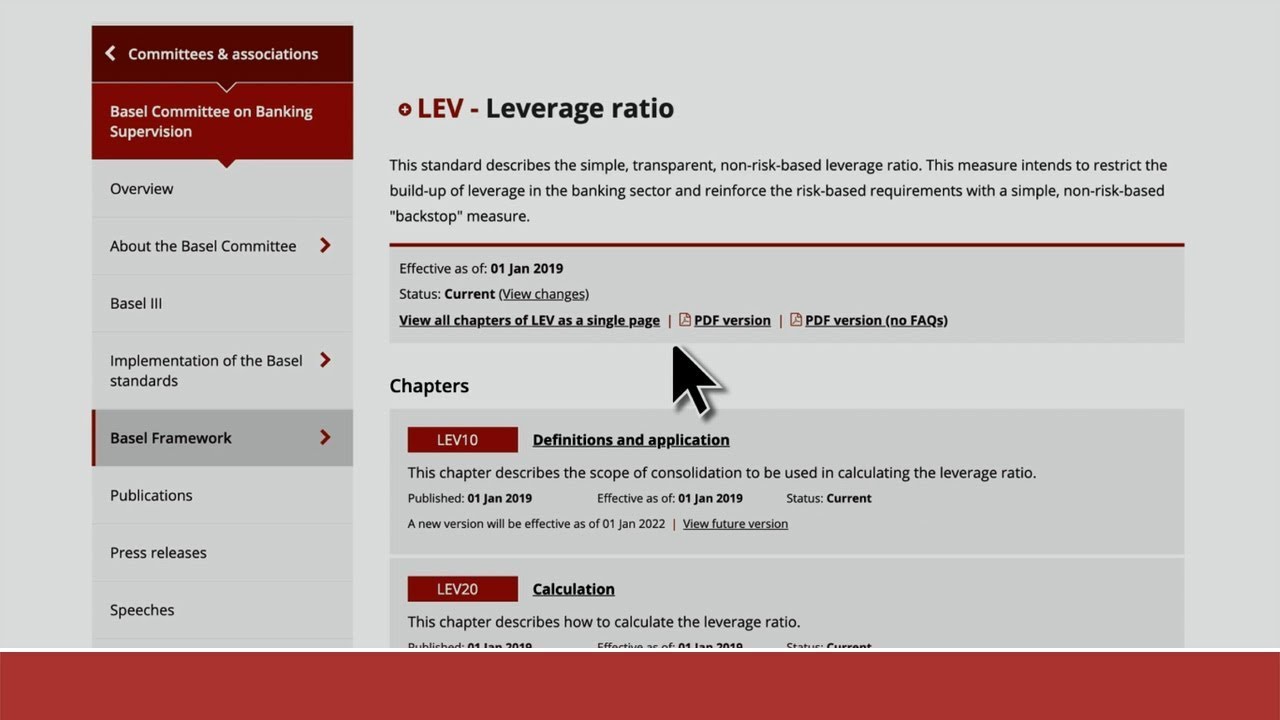
This standard describes the simple, transparent, non-risk-based leverage ratio. This measure intends to restrict the build-up of leverage in the banking sector and reinforce the risk-based requirements with a simple, non-risk-based "backstop" measure.
This standard describes the Liquidity Coverage Ratio, a measure which promotes the short-term resilience of a bank's liquidity risk profile.
The net stable funding ratio requires banks to maintain a stable funding profile in relation to the composition of their assets and off-balance-sheet activities.
Large exposures regulation limits the maximum loss that a bank could face in the event of a sudden counterparty failure to a level that does not endanger the bank's solvency. This standard requires banks to measure their exposures to a single counterparty or a group of connected counterparties and limit the size of large exposures in relation to their capital.
This standard establishes minimum standards for margin requirements for non-centrally cleared derivatives. Such requirements reduce systemic risk with respect to non-standardised derivatives by reducing contagion and spillover risks and promoting central clearing.
The Pillar 2 supervisory review process ensures that banks have adequate capital and liquidity to support all the risks in their business, especially with respect to risks not fully captured by the Pillar 1 process, and encourages good risk management.
This standard sets out disclosure requirements, which aim to encourage market discipline.
The Basel Core Principles provide a comprehensive standard for establishing a sound foundation for the regulation, supervision, governance and risk management of the banking sector.