Explanation of certain terms used in the Core Principles
This chapter provides an explanation of certain key terms that are used throughout the Core Principles.
- Effective as of: 25 Apr 2024
- Last update: 25 Apr 2024
- Status Current
10.1
This section provides an explanation of certain key terms that are used throughout the Core Principles. These explanations should be read only in the context of this document, and they do not apply across, or modify any aspect of, the Basel Framework.
- Applicable Basel standards: the references to "applicable Basel standards" in specific principles refer to the most recent Committee standard or guideline that is effective in relation to that principle.
- Bank: when the Core Principles use the term "bank" this should be read as "bank and banking group", except where "bank" is explicitly referred to on a solo basis.
- Banking group: includes the holding company, the bank and its offices, subsidiaries, affiliates and joint ventures, both domestic and foreign. Risks from other entities in the wider group, for example non-bank (including non-financial) entities, may also be relevant. This group-wide approach to supervision goes beyond accounting consolidation. The scope of consolidation used as the basis for all other Basel requirements is set out in the SCO standard.
- Basel Framework: refers to those Committee standards that are applicable to internationally active banks and are consolidated in the Basel Framework.
- Beneficial owner(s)/beneficial ownership: refers to the natural person(s) who ultimately owns or controls a customer and/or natural person on whose behalf a transaction is being conducted. It also includes those persons who exercise ultimate effective control over a legal person or arrangement.
- Board and senior management: refer to the oversight function and the management function in general and should be interpreted throughout this standard in accordance with the applicable law within each jurisdiction. There are significant differences in the legislative and regulatory frameworks across countries regarding these functions. Some countries use a two-tier board structure, in which the supervisory function of the board is performed by a separate entity known as a supervisory board, which has no executive functions. Other countries, in contrast, use a one-tier board structure, in which the board has a broader role. Owing to these differences, this standard does not advocate a specific board structure.
- Business model sustainability: when conducting business model analysis, the supervisor assesses the soundness of a bank's forward-looking strategies to generate sustainable returns over time, and its capacity to execute its business plan and strategy, considering potential changes in banks' operating environment.
- Climate-related financial risk: refers to the potential risks that may arise from climate change or from efforts to mitigate climate change, their related impacts and their economic and financial consequences. Climate-related physical and transition risk drivers can translate into traditional financial risk categories such as credit, market, operational, liquidity, strategic and reputational risks. Climate-related financial risks can materialise over different time horizons, which may go beyond a bank's traditional capital planning horizon.
- Compliance function: does not necessarily denote an organisational unit. Compliance staff may reside in operating business units or local subsidiaries and report up to operating business line management or local management, provided such staff also have a reporting line through to the head of compliance, who should be independent from business lines.
- Counterparty credit risk: transactions that give rise to counterparty credit risk include: over-the-counter (OTC) derivatives, exchange-traded derivatives, long settlement transactions and securities financing transactions that are bilaterally or centrally cleared. Counterparty credit risk may result from (but is not limited to) transactions with banks, non-financial corporates and non-bank financial institutions (see also Principle 17 BCP40.39).
- Country risk: is the risk of exposure to loss caused by events in a foreign country. The concept is broader than sovereign risk as all forms of lending or investment activity involving individuals, corporates, banks or governments are covered (see also Principle 21 BCP40.48).
- Credit risk: may result from on-balance sheet and off-balance sheet exposures, including loans and advances; investments; interbank lending; derivative transactions; securities financing transactions; and trading activities (see also Principle 17 BCP40.39).
- External experts: may include external auditors or other qualified external parties commissioned with an appropriate mandate, and subject to appropriate confidentiality restrictions.
- Internal audit: does not necessarily denote an organisational unit. Some countries allow smaller banks to implement a system of independent reviews (eg conducted by external experts) of key internal controls as an alternative.
- Macroeconomic environment: should be interpreted broadly and can include the phase of the business or credit cycle, conditions in financial markets and geopolitical developments.
- Off-site work: is a tool to regularly review and analyse the financial condition of banks, follow up on matters requiring further attention, identify and evaluate developing risks and help identify the priorities, scope of further off-site and on-site work etc.
- On-site work: is a tool to obtain independent verification that adequate policies, procedures and controls exist at banks, to determine that information reported by banks is reliable, to obtain additional information on the bank and its related companies that is needed for the assessment of the condition of the bank, to monitor the bank's follow-up on supervisory concerns etc.
- Operational risk: is the risk of loss resulting from inadequate or failed internal processes, people and systems or from external events. The definition includes legal risk but excludes strategic and reputational risk (see also Principle 25 BCP40.56).
- Related parties: should include:
- the bank's subsidiaries and affiliates (including their subsidiaries, affiliates and special purpose entities) and any other party that the bank exerts control over or that exerts control over the bank;
- the bank's major shareholders, including beneficial owners;
- the bank's board members, senior management and key staff, and corresponding persons in affiliated companies, and parties that can exert significant influence on board members or senior management; and
- for the natural persons identified in (a) to (c), their direct and related interests, and their close family members (see also Principle 20 BCP40.46).
- Related party transactions: include on-balance sheet and off-balance sheet credit exposures; dealings such as service contracts, asset purchases and sales; construction contracts; lease agreements; derivative transactions; borrowings; and write-offs. The term "transaction" should be interpreted broadly to incorporate not only transactions that are entered into with related parties but also situations in which an unrelated party (with whom a bank has an existing exposure) subsequently becomes a related party (see also Principle 20 BCP40.46).
- Risk appetite: means the aggregate level and types of risk a bank is willing to assume, decided in advance and within its risk capacity (that is, the maximum amount of risk a bank is able to assume given its capital base, risk management and control capabilities as well as its regulatory constraints), to achieve its strategic objectives and business plan.
- Risk culture: refers to a bank's norms, attitudes and behaviours related to risk awareness, risk-taking and risk management, and controls that shape decisions on risks. Risk culture influences the decisions of management and employees during their day-to-day activities and has an impact on the risks they assume.
- Risk profile: refers to the nature and scale of the risk exposures assumed by a bank.
- Service providers: include third parties, intragroup entities (ie entities within a group such as parent, subsidiary or affiliate companies)1 and (if applicable) other parties further along the supply chain.
- Stress testing: comprises a range of activities from simple sensitivity analysis to more complex scenario analyses and reverse stress testing.
- Supervisor: refers to each of the authorities involved in banking supervision (see Principle 1, essential criterion 1 BCP40.5(1)). Such authority is called "the supervisor" throughout this standard, except where the longer form "the banking supervisor" is necessary for clarification. Unless stated otherwise, the "supervisor" refers to the home country supervisor.
- Systemic importance: is determined by the size, interconnectedness, substitutability, global or cross-jurisdictional activity (if any), and complexity of the bank, as set out in SCO40, SCO50 and RBC40.
- Transfer risk: is the risk that a borrower will not be able to convert local currency into a foreign currency and so will be unable to make debt service payments in a foreign currency. The risk normally arises from exchange restrictions imposed by the government in the borrower's country (see also Principle 21 BCP40.48).
1 Footnote
| 1 | While branches are not considered intragroup providers as they are not separate legal entities, it may also be appropriate to consider risks arising from the provision of services from a head office to its overseas branches, or between branches. |
This standard describes the scope of application of the Basel Framework.
This standard describes the criteria that bank capital instruments must meet to be eligible to satisfy the Basel capital requirements, as well as necessary regulatory adjustments and transitional arrangements.
This standard describes the framework for risk-based capital requirements.
This standard describes how to calculate capital requirements for credit risk.
This standard describes how to calculate capital requirements for market risk and credit valuation adjustment risk.
This standard describes how to calculate capital requirements for operational risk.
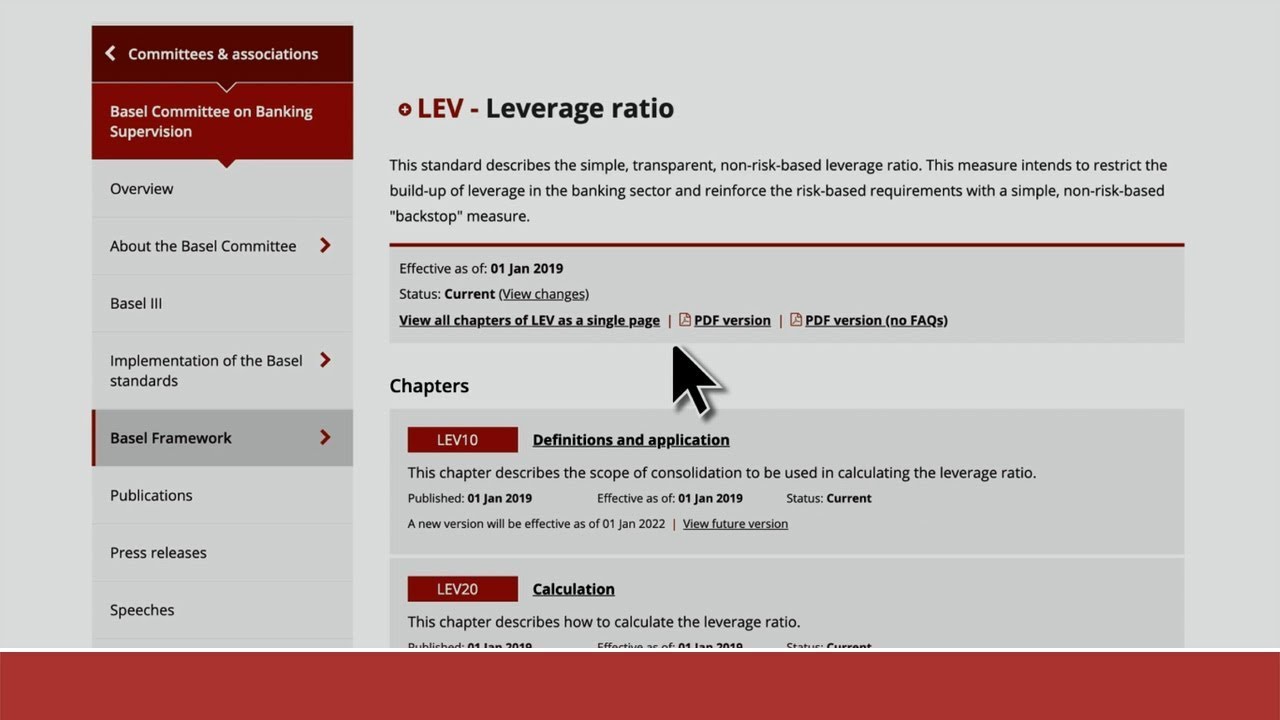
This standard describes the simple, transparent, non-risk-based leverage ratio. This measure intends to restrict the build-up of leverage in the banking sector and reinforce the risk-based requirements with a simple, non-risk-based "backstop" measure.
This standard describes the Liquidity Coverage Ratio, a measure which promotes the short-term resilience of a bank's liquidity risk profile.
The net stable funding ratio requires banks to maintain a stable funding profile in relation to the composition of their assets and off-balance-sheet activities.
Large exposures regulation limits the maximum loss that a bank could face in the event of a sudden counterparty failure to a level that does not endanger the bank's solvency. This standard requires banks to measure their exposures to a single counterparty or a group of connected counterparties and limit the size of large exposures in relation to their capital.
This standard establishes minimum standards for margin requirements for non-centrally cleared derivatives. Such requirements reduce systemic risk with respect to non-standardised derivatives by reducing contagion and spillover risks and promoting central clearing.
The Pillar 2 supervisory review process ensures that banks have adequate capital and liquidity to support all the risks in their business, especially with respect to risks not fully captured by the Pillar 1 process, and encourages good risk management.
This standard sets out disclosure requirements, which aim to encourage market discipline.
The Basel Core Principles provide a comprehensive standard for establishing a sound foundation for the regulation, supervision, governance and risk management of the banking sector.