Fellowship programmes
The Bank for International Settlements (BIS) carries out research to shed light on issues of core interest to the central bank community, to support meetings of Governors and other central bank officials, and to provide analytical backing for the activities of the various Basel-based committees. The Monetary and Economic Department (MED) contributes to these tasks by conducting research on monetary and financial stability, monetary economics, macroeconomics and finance, financial markets, central bank governance and other institutional issues.
We are pleased to invite members of academia, central bank research economists and internationally recognised experts in the fields of banking, monetary policy and financial stability to visit the BIS for a period ranging from a few days to three months through one of the following fellowship programmes:
BIS Research Fellowship (BISRF)
The Bank for International Settlements invites research proposals from academics for its Research Fellowship programme. Fellowships will be awarded to scholars who have established a strong reputation in their field and aim at fruitful collaboration with BIS economists.
Successful candidates will be invited to the BIS's Monetary and Economic Department (MED) for short periods, ranging from a few days to several weeks.
Applications are reviewed once a year, with a deadline on 31 March.
The programme is aimed at internationally recognised economists from academia and research institutions with an outstanding publication record. In considering applications, the BIS will pay particular attention to the relevance of the research to current problems in economics and finance.
Research fellows will be based at the BIS Head Office in Basel, Switzerland, or at the BIS Representative Office in either Hong Kong SAR or Mexico City. Successful candidates will be offered an honorarium, plus accommodation and travel costs.
Applications should be accompanied by:
- A curriculum vitae, including details of the candidate's publication record
- A one-page summary of the research work specifying the objectives, the methodological, and statistical requirements involved, and the approximate timeline for completion
- Suggestions for possible co-authorships with BIS staff and preferred location (Basel, Hong Kong SAR, Mexico City)
Proposals and accompanying files should be sent to Christian Schmieder, Secretary to the BISRF programme at fellowship@bis.org.

Central Bank Research Fellowship (CBRF)
The Bank for International Settlements invites nominations of research economists, from BIS member central banks who wish to develop a research project at the BIS.
The objective of the programme is to enhance the understanding of issues of strategic importance for central banks and the BIS through collaboration with BIS economists on high-quality research.
The programme is aimed at central bank research economists with an established track record. Selection criteria for candidates are:
- The policy relevance of the proposed research topic to central banks and the BIS
- The applicant's research track record and publication list
- The potential for collaboration with BIS economists
Selected candidates spend up to a total of three months in Basel or at one of the BIS representative offices (Hong Kong SAR or Mexico City).
The selected CBRF fellows will continue to receive their salary from their home institution.
The BIS offers a monthly stipend, plus accommodation and travel costs.
The call for nominations is circulated once a year. Nominations for the Central Bank Research Fellowship programme should be sent by 31 March 2026 to fellowship@bis.org.
Expressions of interest should be sent by staff of each central bank to the Head of Research of the same institution, together with a project proposal.
Nominations should be gathered from all departments by the Head of Research (or the senior central bank official responsible for research) and submitted to the BIS accompanied by:
- A curriculum vitae, including details of the candidate's publication record
- A detailed research proposal with timeline for completion of the project, suggestions for possible co-authorship with BIS staff (ideally discussed preemptively with the persons in question) and location preference (Basel, Hong Kong SAR or Mexico City)
- One recent research paper authored by the candidate
Nominations for the research fellowship programme should be sent by email with accompanying files to Christian Schmieder, Secretary to the BIS CBRF programme, at fellowship@bis.org.

Alexandre Lamfalussy Senior Research Fellowship
The Bank for International Settlements invites applications from leading senior professionals in academia and research institutions for the Alexandre Lamfalussy Senior Research Fellowship. This fellowship aims to:
- Promote policy-relevant research that meets the highest academic standards
- Allow prominent scholars to participate in the policy-oriented research activities at the BIS
- Foster joint research between the fellows and BIS economists
- Advise and collaborate with BIS economists in executing and disseminating research
Candidates are expected to be internationally recognised experts with an outstanding publication record in the fields of banking, monetary policy and financial stability.
Selected fellows are offered an assignment in the Monetary and Economic Department (MED) for up to three months to:
- Conduct economic research on issues of relevance to the BIS
- Advise and collaborate with BIS economists in executing and disseminating research
- Complete a research project published in the BIS publication series and in a leading journal
While at the BIS, the fellow will develop a research project with the aim of publishing in the BIS Working Papers series, and in a leading journal.
The selection fellow will spend up to a total of three months in Basel or at one of the BIS representative offices (Hong Kong SAR or Mexico City).
The selected fellow will continue to receive their salary from their home institution.
The BIS offers a monthly honorarium, plus accommodation, travel costs, health insurance and, where appropriate, conference travel.
Applications can be sent year-round by email accompanied by a CV and a detailed research proposal at fellowship@bis.org.

Christiane Baumeister is the Lambert Family Professor of Economics and Associate Chair in the Department of Economics at the University of Notre Dame. She holds several prominent research affiliations, including with the National Bureau of Economic Research (NBER), the Centre for Economic Policy Research (CEPR), and the Deutsche Bundesbank Research Center.
An accomplished empirical macroeconomist, Professor Baumeister's research focuses on the dynamics of energy markets and the transmission of monetary policy. Her recent work emphasises Bayesian inference in structural vector autoregressive models and the high-frequency measurement of economic conditions. Her research has been featured in various leading academic journals.
Beyond her academic achievements, Professor Baumeister serves as an Associate Editor for the American Economic Review and other prestigious journals. Prior to joining the University of Notre Dame in 2015, she was a Principal Researcher in the International Economic Analysis Department at the Bank of Canada and has been a visiting scholar at the International Monetary Fund and several central banks.

Harold James is the Claude and Lore Kelly Professor in European Studies at Princeton University, Professor of History and International Affairs at the Woodrow Wilson School, and an associate at the Bendheim Center for Finance.
Professor James is an economic historian, specialising in the history of Germany, Europe and globalisation. His books include a study of the interwar depression in Germany (1986); International Monetary Cooperation Since Bretton Woods (1996); The End of Globalization (2001); The Creation and Destruction of Value: The Globalization Cycle (2009) and Making the European Monetary Union (2012); Seven Crashes (2023) shortlisted for 2024 Lionel Gelber Prize.
He is the official historian of the International Monetary Fund and a senior fellow at the Centre for International Governance Innovation. In 2004, he was awarded the Helmut Schmidt Prize for Economic History, and in 2005 the Ludwig Erhard Prize for writing about economics.
Frank is former Director General of DG Economics at the European Central Bank and a professor of economics at the Department of Economics of Ghent University.
Frank has an extensive publication record on monetary economics and applied macroeconomics. As the head of the ECB economics departments, he has been responsible for the economic analysis of the euro area economy, including the macroeconomic projections, as a basis for ECB monetary policy decisions. He is also a research fellow at the Centre for Economic Policy Research in London.
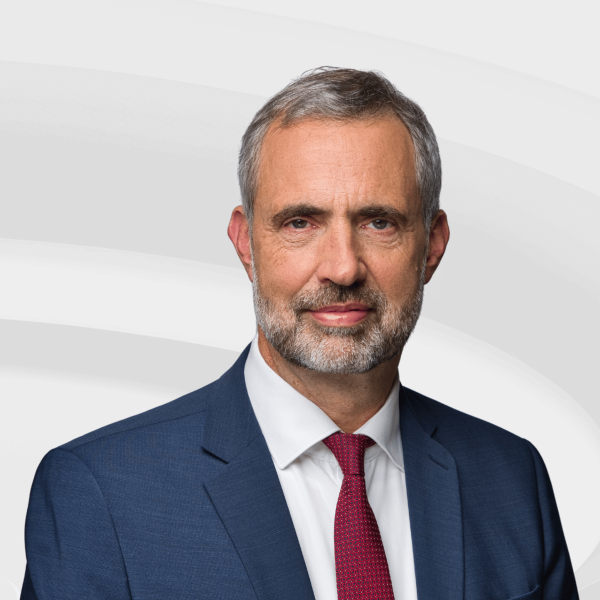
Professor Marc Flandreau, the Howard S Marks Professor of Economic History at the University of Pennsylvania, is a globally recognised expert in the economic history of international money, finance and debt.
He is the founding editor of Capitalism, A Journal of Economics and History and has authored influential works such as The Glitter of Gold (Oxford 2003) and The rise and fall of the dollar (European Review of Economic History 2009, with Barry Eichengreen).
His expertise spans academia and the private sector, including his role as Chief Economist France with Lehman Brothers (2002–2008). He chairs the Historical Monetary and Financial Statistics (HMFS) network under the BIS Irving Fisher Committee on Central Bank Statistics (IFC).
Enrique G Mendoza is Presidential Professor of Economics at the University of Pennsylvania and Co-Editor of the Journal of International Economics. He joined the University of Pennsylvania in 2013 and served as Director of the Penn Institute for Economic Research from 2014 to 2020. Before that, he was Neil Moskowitz Professor of Economics at the University of Maryland and held positions at Duke University, the Board of Governors of the Federal Reserve and the IMF. He is a 1989 PhD from the University of Western Ontario, an NBER Research Associate and a member of the BIS Advisory Panel and the Latin American Shadow Financial Regulatory Committee. He has served on the NSF Economics panel and on the editorial boards of several journals, including the American Economic Review. In 2017, he was awarded the ECB's Wim Duisenberg fellowship.
His research focuses on international capital flows, financial crises, sovereign debt and international business cycles. His main publications include: "Optimal, time-consistent macroprudential policy" with J Bianchi, Journal of Political Economy, 2018; "A general equilibrium model of sovereign default and business cycles" with V Yue, Quarterly Journal of Economics, 2012; "Sudden stops, financial crises and leverage", American Economic Review, 2010; "Financial integration, financial development and global imbalances" with V Quadrini and J V Rios-Rull, Journal of Political Economy, 2009; and "Real business cycles in a small open economy", American Economic Review, 1991.
Ricardo Reis is A W Phillips Professor of Economics, London School of Economics and Political Science.
Professor Reis received his PhD from Harvard University, and has previously held professorships at Columbia University and Princeton University.
He has published widely on macroeconomics. His main areas of research are inflation expectations, unconventional monetary policies and the central bank's balance sheet, disagreement and inattention, business cycle models with inequality, automatic stabilisers, sovereign bond-backed securities, and the role of capital misallocation in the European slump and crisis. Recent honours include the 2016 Bernacer prize for best European economist under the age of 40 working in macroeconomics and finance, and the 2017 Bank of France / Toulouse School of Economics junior prize in monetary economics, finance and bank supervision for a European researcher.
Professor Reis is an academic consultant at the Bank of England and the Federal Reserve System, directs the ESRC Centre for Macroeconomics in the UK, and serves on the council or as an adviser of multiple organisations.
Fernando Alvarez is the inaugural Saieh Family Professor at the Department of Economics, University of Chicago. He is a Fellow of the Econometric Society, an Economic Theory Fellow, a Research Associate of the National Bureau of Economic Research and a member of the American Academy of Arts and Sciences.
Professor Alvarez has held many distinguished professional appointments, including Editor of the Journal of Political Economy and Associate Editor of the Review of Economic Dynamics. He has received grants from the National Science Foundation, the Goldman Sachs Global Markets Institute (as a fellow), the European Research Council, the Banque de France Foundation, the Alfred P. Sloan Foundation (as fellow) and the Tinker Foundation. He has been a Visiting Scholar at the Enaudi Institute of Economics and Finance and the Research Department of the European Central Bank (as the Wim Duisenberg Fellow), a consultant at the Research Departments of the Federal Reserve of Minneapolis, the Federal Reserve Bank of Chicago, the Federal Reserve Bank of Richmond and the Federal Reserve Bank of Philadelphia, and a Visiting Researcher advising the Board of Directors of the Central Bank of Argentina.
Professor Alvarez has an outstanding record of publications in macroeconomics, dynamic general equilibrium models, monetary economics, and asset pricing in all the leading peer-reviewed academic. His recent research includes work on frictional labor markets, information disclosure, money demand and payment choices, and nominal rigidities on firms' price setting.
Robert Townsend is the Elizabeth & James Killian Professor of Economics at the Massachusetts Institute of Technology (MIT).
Professor Townsend has held distinguished academic positions at the University of Chicago and Carnegie Mellon University and visiting professorships at Yale, University College London, the London School of Economics, the University of Chicago and Stanford. He is Research Associate at the NBER, Distinguished Research Fellow at the Becker Friedman Institute and Associate at the University of Chicago Department of Economics.
He has a distinguished record of publications, with several books and many journal articles on financial systems in developing and developed economies, financial structure and economic organisations, monetary theory and macroeconomics, and micro level studies on household finances in village economies and in urban neighbourhoods. He has received many professional and academic distinctions and awards including member of the National Academy of Sciences, member of the American Academy of Arts and Sciences, two Frisch Medals, the Jean-Jacques Laffont Prize, Fellow of the Econometric Society, the Society for the Advancement of Economic Theory (SAET), and the Center for Economic and Policy Research (CEPR).
Professor Townsend has been a visiting scholar at the Federal Reserve Banks of Minneapolis and New York and adviser to the Federal Reserve Banks of Chicago and Boston, the IMF and the World Bank.
Catherine Schenk is Professor of Economic and Social History at the University of Oxford and a Professorial Fellow at St Hilda's College, Oxford.
Professor Schenk has held academic positions at Victoria University of Wellington, New Zealand, Royal Holloway, University of London and the University of Glasgow. Professor Schenk is a Fellow of the Royal Society of Arts, the Royal Historical Society and the Academy of Social Sciences. Outside academia, she has spent time as a visiting Research Fellow at the International Monetary Fund and at the Hong Kong Institute for Monetary Research.
She has a distinguished record of publications, with several books and journal articles on the history of central banking, international monetary systems and global finance. Her research interests focus primarily on international economic relations, international monetary system and international banking and finance.
Professor Amit Seru is the Steven and Roberta Denning Professor of Finance at the Graduate School of Business, Stanford University. He is also a Senior Fellow at the Hoover Institution and the Stanford Institute for Economic Policy Research, and a Research Associate at the National Bureau of Economic Research.
His primary research interest is in corporate finance and banking. He has made path-breaking contributions to the study of financial intermediation and regulation, the interaction of the internal organisation of firms with financing and investment, and incentive provision in firms. He is a co-editor of the Journal of Finance and has a distinguished record of influential publications in economics and finance.
Bengt Holmström, the Paul A. Samuelson Professor of Economics at Massachusetts Institute of Technology, is one of the world's foremost scholars in the application of microeconomic principles to concrete economic issues. He was awarded the Sveriges Riksbank Prize in Economic Sciences in Memory of Alfred Nobel in 2016, together with Oliver Hart, for contributions to contract theory.
His work examines how to formulate optimal contracts, for example between the owner of a firm and its chief executive, and applies this to corporate governance and to liquidity problems in financial crises. In a paper for the 2014 BIS Annual Conference, he explored the role of debt in the financial system.
Professor Viral V Acharya is the C V Starr Professor of Economics in the Department of Finance at the New York University Stern School of Business.
In addition, he is a member of the Economic Advisory Committee of the Financial Industry Regulation Authority (FINRA), International Advisory Board of the Securities and Exchange Board of India (SEBI) and Advisory Committee to the Reserve Bank of India Research Academy. Professor Acharya is also an Academic Advisor to the Federal Reserve Banks of Cleveland and Philadelphia.
His primary research interest is in theoretical and empirical analysis of systemic risk in the financial sector, its nexus with sovereigns, and its implications for monetary policy. Professor Acharya will take up his Fellowship in the summer of 2017.
Markus K Brunnermeier is the Edwards S Sanford Professor of Economics and Director of the Bendheim Center for Finance at Princeton University.
He has a distinguished research record in international financial markets and the macroeconomy with special emphasis on bubbles, liquidity, and financial and monetary stability.
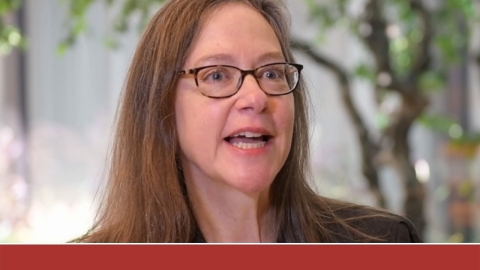
Catherine Schenk, 2018-19 Lamfalussy Fellow
Schenk discusses her experience as the 2018-19 Alexandre Lamfalussy Senior Research Fellow.
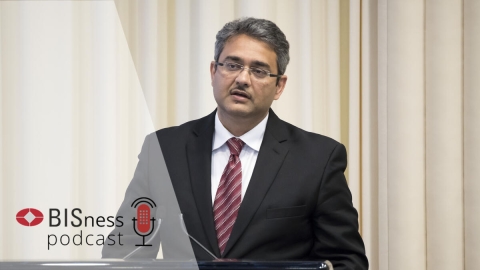
Policy challenges of the fintech revolution
Amit Seru discusses the policy challenges from tech firms' entry into payments and financial services and explains how the current surge in fintech innovation matches up to the past.
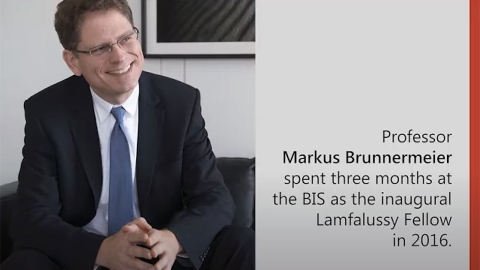
Markus Brunnermeier, 2016 Lamfalussy Fellow
Markus Brunnermeier discusses his experience as the 2016 Alexandre Lamfalussy Senior Research Fellow.
BIS PhD Fellowship Programme
The Bank for International Settlements invites applications from students who are currently enrolled in a PhD programme in economics, finance or related fields and who wish to develop a research project at the BIS. The PhD Fellowship programme helps you acquire practical experience in supporting central banks and other financial authorities and in contributing to high-level meetings and BIS publications.
Candidates must be enrolled in a PhD programme in economics, finance or related fields with an:
- Excellent knowledge of financial and monetary economics, with specialisation in topics relevant to the BIS research agenda
- Experience in conducting research in relevant field
- Ability to apply tools used in economic analysis to a range of topics
Successful candidates will be invited to the BIS's MED for a period ranging from three to 11 months.
The BIS offers a competitive salary, health insurance coverage and travel and relocation assistance, including accommodation.
Applications are open in the summer and fall at bis.org/careers under current vacancies as soon as available. Click on the relevant link and follow the instructions to apply for a particular position.
We welcome applications from candidates of all nationalities and located anywhere in the world.

Embedding in the Monetary and Economic Department (MED) with regular interaction with staff and first-hand insight into BIS research and policy work, you will engage on topical issues in economics and finance, including:
- Financial intermediation and regulation
- Financial innovation and digitisation
- Monetary policy
- Fiscal policy
- International finance and international spillovers