Engagement with public and private sector stakeholders
The G20 roadmap for enhancing cross-border payments is an ambitious and comprehensive initiative. It requires coordinated efforts from authorities and private sector stakeholders globally, with engagement from a diverse range of market participants being critical to its success. The CPMI provides the platform for a variety of market stakeholders, global market practice groups and central banks from across the globe. In many cases, regional and international organisations participate as well.
Cross-border Payments Interoperability and Extension (PIE) task force
The Cross-border Payments Interoperability and Extension (PIE) task force supports the roadmap by providing expert advice on market conventions and industry practices. Its members come from a wide variety of jurisdictions and regions and represent financial infrastructures, banks, non-bank payment service providers and industry associations. The PIE task force also serves as a forum for the exchange of implementation experiences and coordination between public authorities and private sector stakeholders.
Co-chairs
Chiara Scotti
Deputy Governor, Banca d’Italia
Inge van Dijk
Director Payments, Cash & Market Infrastructure, De Nederlandsche Bank
Taskforce members (alphabetical by entity)
Sabine Mensah
Deputy Chief Executive Officer, AfricaNenda
David O’Mahony
Cross-border Payments Specialist, AusPayNet
Jun Xu
Director, Senior Manager, Bank of China
Damien Godderis
Head of Payments Industry Engagement, BNP Paribas
Isabel Schmidt
Executive Platform Owner Payments Enablement Platform, BNY
Faisal Alhijawi
Chief Strategy & Development Officer, Buna
Emanuela Saccarola
Head of Cross Border Payments, Citi
Dirk Bullmann
Managing Director, Office of the Chief Executive Officer, CLS
Susan Yang
General Manager, High Value & International Payments Commonwealth, Bank of Australia
Paula Roels
Head Swift & Market Infrastructure, Corporate Bank Deutsche Bank
Edward Aitken
Global Head of Corporate Affairs, dLocal
Arjan Bol
General Manager, Dutch Payments Association
Erwin Kulk
Head, Service Development and Management, EBA Clearing
Monica Jasuja
Chief Expansion and Innovation Officer, Emerging Payments Association Asia (EPAA)
Thomas Egner
Secretary General, European Banking Association
Giorgio Andreoli
Director, General European Payments Council
Simone Cortese
Head of Product, Fnality International
Andrew Harvey
Managing Director, Europe Global Financial Markets Association (GFMA)
Haster Tang
Chief Executive Officer, Hong Kong Interbank Clearing Limited
Mark Evans
Managing Director, Global Head of Cross Border and Cross Currency Payments HSBC
José-Luis Langa
Deputy Managing Director, Iberpay
Jessica Renier
Managing Director, Digital Finance Institute of International Finance (IIF)
Noritoshi Murakami
Executive Vice President, MUFG Japanese Bankers Association
Maha Bahou
Chief Executive Officer, Jordan Payments and Clearing Company (JoPACC)
Helena Forest
Executive Vice President, Global Product and Commercial Real-Time Payments, Mastercard
Juliana Sheridan
Regional Legal Manager, Mercado Pago
Michael Richards
Principal Architect, Mojaloop Foundation
Damian Richardson
Head of Payments Product and Schemes, Payments CoE NatWest Group
Piero Crivellaro
Group Head of Public and Regulatory Affairs, Nexi Group
Andrew McCormack
Chief Executive Officer, Nexus Global Payments (NGP)
John Bosco
Sebabi Deputy Chief Executive Officer, Pan-African Payment and Settlement System (PAPSS)
Daniel Jonas
Head of Research and Insight, Pay.UK
Ruhling Herbst
Executive Head Africa Business Development and Strategy and Transformation Officer, PayInc
Zarin Ahmed
Director of Emerging Payment Products, Payments Canada
Nath Parameshwaran
Senior Director, India and South Asia, PayPal Payments Council of India (PCI)
Azleena Idris
Senior Director, Corporate Strategy and ESG, PayNet Malaysia
Nicholas Edge
Head of Policy and Regulatory Affairs for EMEA and APAC, Remitly
Ignacio Reid
Chief Operating Officer, Ria
Frantz Teissèdre
Head Interbank Relationships, Société Générale
Brad Gillis
Head Payments Africa Regions, Standard Bank
Jens Olsson
Senior Advisor, Swedish Financial Technology Association (SweFinTech)
Shriyanka Hore
Global Head of Industry Engagement Swift
David Fortney
Executive Vice President, Strategy The Clearing House (TCH)
Katja Lehr
Managing Director, J.P. Morgan UK Finance
Nicholas Senechal
Strategic Advisor, Visa
Chloe Baker
Head of PCSO and FMI Network Management, Payments Operations Chief Operating Office Operations, Wells Fargo
Edward Bowles
Global Head of Government Relations and ESG, Wise
1. Background
Enhancing cross-border payments can offer benefits to all, through lower costs, faster speed, greater transparency and improved access. In October 2020, the G20 leaders endorsed the roadmap for enhancing cross-border payments. Since then, the Bank for International Settlements’ Committee on Payments and Market Infrastructures (CPMI), in coordination with the Financial Stability Board (FSB) and other relevant international organisations and standard-setting bodies, has laid the foundation for further developments through stocktakes and analyses.
In 2023, the G20 endorsed the revised roadmap focusing on three priority themes: (i) payment system interoperability and extension; (ii) data exchange and message standards; and (iii) legal, regulatory and supervisory frameworks. The G20 roadmap is both ambitious and comprehensive, requiring coordinated efforts from authorities and private sector stakeholders worldwide to advance its priority themes. Engagement from a diverse range of market participants is critical to ensuring the roadmap’s successful implementation.
Interoperability of payment systems is essential to prevent undue fragmentation, which is often the source of cross-border payments frictions. Progress in technical interoperability, such as the global ISO 20022 migration and API harmonisation, is paving the way for enhanced cross-border payments. The extension of payment systems – both in functionality and participant access – can further improve service offerings and promote increased competition among payment service providers (PSPs).
Since early 2023, two industry task forces, composed of senior private-sector representatives, have provided valuable industry perspectives to the G20 cross-border payments programme: the CPMI led Cross-border Payments Interoperability and Extension task force (“PIE task force”) and the FSB-led task force on legal, regulatory, and supervisory matters (“LRS task force”). This document outlines the terms of reference for the PIE task force effective from 2025 onwards.
2. Purpose
The PIE task force provides a platform for obtaining expert practitioner advice and enabling collaboration on the enhancement of cross-border payment arrangements. Its focus areas include:
- Fostering harmonised implementation of messaging standards: Encouraging consistent
implementation of messaging standards, such as ISO 20022, to improve interoperability. - Promoting fast payments: Supporting the adoption and use of cross-border fast payment schemes to improve speed and transparency.
- Promoting the use of harmonised pre-validation application programming interfaces (APIs): Supporting the use of harmonised pre-validation API solutions to enhance transparency and predictability in payments.
- Improving cross-border settlement: Reviewing settlement practices and exploring ways to enhance efficiency and alignment in global payment processes.
These focus areas can be complemented by ongoing information exchange to support the safety of cross-border payments and deepening the insights into corridor- and regional-level developments and challenges:
- Enhancing payment safety: Sharing insights and promoting practices to reduce fraud and improve compliance with financial crime regulations.
- Gathering market intelligence: Deepening understanding of cross-border payment flows and challenges at corridor and regional levels.
- Engaging with end users: Collaborating with end-user groups to incorporate their perspectives into the PIE task force work.
3. Responsibilities and tasks
The PIE task force should provide expert advice on cross-border payment market conventions and industry practices. It should suggest key considerations and concrete steps to strengthen these conventions and practices to enhance cross-border payments. Additionally, the PIE task force should facilitate regional and global coordination to support the dissemination of findings among market participants. The PIE task force jointly agrees on the form of outputs to meet its responsibilities, which include:
- Actively support cross-border payment enhancements: working towards progressing on the G20 cross-border payments targets;
- Providing a forum to exchange views: sharing implementation experiences, challenges, and best practices among members;
- Identifying harmonisation needs: finding out specific areas where further harmonisation is required and developing approaches to achieve it;
- Contributing to progress monitoring: providing timely information about progress made.
In line with these responsibilities and within its area of expertise, the PIE task force defines and agrees on specific deliverables and proposes them to the CPMI. The task force ensures that its technical work does not conflict or overlap with activities underway in other forums, such as those conducted by existing industry groups.
4. Composition
The PIE task force is composed of two Co-Chairs, around 40 members and a limited number of public sector observers.
Co-Chairs
The task force is co-chaired by senior CPMI representatives with subject-matter expertise. The Co-Chairs will report to the CPMI. If the one Co-Chair is unavailable, meetings can be chaired by the other Co Chair. The CPMI secretariat can step in as required if both Co-Chairs are unavailable.
Members
The PIE task force membership should have a balanced institutional and geographic composition. The CPMI seeks broad geographic coverage across a wide range of business models when selecting task force members. Members are drawn from individual firms and industry associations based on a public call for nomination. They represent key stakeholder groups (eg banks, non-bank PSPs, financial infrastructures and technical service providers) and cover different geographic regions.
Members are experienced, senior-level officials with strategic decision-making authority, at least for their functional areas of expertise and responsibility, and/or hold an industry-wide thoughtleadership role (eg chairs of existing industry groups). They can mobilise specialised resources within their organisations to support the work on specific deliverables. Members are nominated for a renewable term of two years. Members who change affiliation should notify the secretariat. The Co-Chairs will review and can approve their continued membership and/or assign the seat to a new member (from the member’s former affiliation or another institution).
The Co-Chairs may review the membership of any individuals who fail to comply with the terms of reference, do not actively contribute or regularly attend meetings, or are unable to support the G20 objective of enhanced cross-border payments due to a conflict of interest. Non-compliance with these responsibilities may lead to the discontinuation of the member’s participation, and/or that of their organisation, in the work of the PIE task force.
Observers and guests
A small number of public sector representatives (CPMI members and/or international organisations) can join as observers. The Co-Chairs can invite private or public sector stakeholders as guests to attend task force meetings or specific agenda items on an ad-hoc basis.
Secretariat
The CPMI secretariat and staff members from the institutions of the Co-Chairs support the task force. A CPMI secretariat member acts as task force secretary.
5. Members’ responsibilities
Members and their institutions are expected to support the objectives of safe and efficient cross-border payments. Members’ institutions must ensure that members have sufficient time to actively contribute to the task force's work. Members are expected to actively participate in the work of the PIE task force and attend meetings regularly. Members can nominate an alternate who can backbench and replace members on an exceptional basis, upon prior notification of the secretariat.
Conflicts of interest
Members and observers are responsible for identifying and declaring any potential or perceived conflicts of interest, including financial interests. In case of a conflict, members and observers should notify the secretariat along with proposed mitigation measures, such as pausing their participation.
Compliance with competition laws and regulations
Members must ensure compliance with competition laws and regulations applicable to them. The task force will not discuss commercially sensitive aspects, and relevant meeting documents will be published on the CPMI website for transparency. If there are doubts about the sensitivity of specific aspects under competition law, members should inform the secretariat. Failure to comply may result in the discontinuation of the member’s participation.
Handling and dissemination of information
Meetings will be held under the Chatham House Rule, allowing members to use the information received without revealing the identity or affiliation of contributors. Views expressed in meetings are those of the members and may not reflect their respective organisations. High-level summaries of the meetings will not associate any position with individual members or their affiliations. Meetings will not be recorded by the secretariat nor by participants. The use of automated transcript tools is prohibited.
Members and observers must treat all documents accessed during their work as confidential. Meeting summaries and other documents may not be distributed outside the recipients’ organisations without express permission from the secretariat or until they are published on the CPMI website.
The PIE task force email distribution list should be treated as confidential and should not be shared or used for a member institution’s own communications. Members are expected to coordinate with the Secretariat if they wish to distribute materials to the PIE task force.
BIS or CPMI opinion, name and logo
Participation in the PIE task force should not be construed as an endorsement of any member’s products, services, or related business. Neither the participation in the PIE task force nor the BIS or CPMI name and logo should be used by any member or their organisation without prior written consent from the secretariat. This includes advertising, press releases, social media posts, presentations or any other publicly distributed information.
6. Organisation of the work
Meetings and other convening venues
The PIE task force has several possible convening venues, including virtual and in-person workshops, written consultations and online collaboration tools. It will hold four meetings per year until end-2027. Additional meetings may be scheduled by the Co-Chairs as needed. Meetings can be conducted in virtual or hybrid formats. Meeting dates should be set and communicated to members and observers sufficiently in advance.
Sub-structures
The PIE task force may establish sub-structures to conduct specific work if deemed necessary to advance any work component effectively. These thematic groups are referred to as "task teams". Task teams will be led by PIE task force members and can involve representatives other than the task force members. The involvement of institutions not represented on the PIE task force has to be agreed with the secretariat. Ownership of any work undertaken must be deemed solely under the PIE task force and task team structure without references, commercial or otherwise, to any contributing external parties.
7. Working procedures
Decision making and reporting
The Co-Chairs hold the decision-making authority to achieve the objectives of the task force, including meeting agendas, scheduling, and outputs. The Co-Chairs will seek to achieve consensus or establish broad agreement among the members. If consensus cannot be achieved on certain outputs, the CoChairs can still decide to put it forward by including a relevant qualification (eg "endorsed by the majority of members") or explaining opposing views in the document. The PIE task force will report to the CPMI and inform the FSB Cross-border Payments Coordination (CPC) group on progress. The Co-Chairs will review outputs before submitting the final deliverables to the CPMI.
Coordination with other groups
The Co-Chairs will coordinate with the secretariat to involve all relevant governance bodies and avoid duplication of sub-structures on similar topics. The Co-Chairs will coordinate with the chairs of the LRS task force and the CPMI Community of Practice on Payment Systems (CoPS), as appropriate. Material will be shared across groups to support coordination and avoid duplication of efforts. Joint meetings may be held to deepen cooperation or establish joint sub-structures if useful. Chairs of other CPMI working groups can participate as observers in the PIE task force.
Work materials
Meeting materials, including the agenda, should be circulated at least five working days before each meeting. Materials circulated closer to the meeting might still be discussed at the meeting on a “no objection” basis. The working language will be English.
Public reporting
The PIE task force works in an open and transparent manner. The list of task force members (ie their name and affiliation), meeting documentation (eg agenda, reports, presentations), task team reports and high-level meeting summaries are published on the CPMI website to allow market participants not represented in the task force to follow the relevant discussions. The BIS reserves the right not to consider or publish individual task team reports. These reports are not to be used to express political, religious or ideological views. Unless expressly stated otherwise, the views stated in any material on the BIS website are those of the named authors or responsible working groups. Their content should not be interpreted to reflect the views of the BIS, the CPMI or member central banks. Reference in any material on the BIS website to specific companies, products or services does not imply that they are endorsed or recommended by the BIS, the CPMI or member central banks in preference to similar companies, products or services that are not mentioned. Further details on general conditions can be found on the BIS website under terms and conditions of use.
8. Duration of mandate and changes to the terms of reference
The PIE task force mandate and membership will be evaluated end-2026. The terms of reference will be updated as necessary to support the task force’s objectives. Any amendment requires approval by the CPMI.
The Community of Practice on Payment Systems (CoPS) is a forum for exchange among central banks on developing or upgrading their domestic payment systems, factoring an international dimension into them and discussing innovative developments. The community has representatives from over 50 jurisdictions as well as from regional and international organisations. It aims to strengthen the involvement of both G20 and non-G20 central banks in the cross-border payments programme and to support their implementation of payment system enhancements.
The Harmonisation Panel for ISO 20022 is responsible for the effective governance and maintenance of the CPMI’s harmonised ISO 20022 data requirements by (i) reviewing and, where necessary, recommending updates to the harmonisation requirements or data models to the CPMI; (ii) encouraging operators and industry stakeholders to adopt the harmonisation requirements and data models; and (iii) informing payment system stakeholders of any updates to the harmonisation requirements or harmonised data models.
| 12th meeting (19-20 Nov 2025) | Agenda |
| 11th meeting (8 Sep 2025) | Agenda / Summary |
| 10th meeting (21 May 2025) | Agenda / Summary |
| 9th meeting (30 Jan 2025) | Agenda / Summary |
| 8th meeting (4-5 Nov 2024) | Agenda / Summary |
| 7th meeting (1 Jul 2024) | Agenda / Summary |
| 6th meeting (25 Apr 2024) | Agenda / Summary |
| 5th meeting (15 Feb 2024) | Agenda / Summary |
| 4th meeting (29 Nov 2023) | Agenda / Summary / Presentations |
| 3rd meeting (19 Sep 2023) | Agenda / Summary |
| 2nd meeting (20 Jun 2023) | Agenda / Summary / Presentations |
| 1st meeting (11 May 2023) | Agenda / Summary / Presentations |
The CPMI, through its PIE task force, has sought input from industry stakeholders and other external parties on how to enhance cross-border payments. The task force has been organised into task teams to bring together focused strategic industry perspectives and practical subject matter expertise. These reports provide analysis and outputs on areas identified as important by the industry. The views expressed in these reports are those of the authors and do not necessarily reflect those of the BIS, the CPMI, its member central banks or the PIE task force as a whole.
- Fostering ISO 20022 harmonisation – follow-up report (February 2026): This follow-up report reviews the global alignment of market infrastructures with CPMI's harmonised ISO 20022 data requirements, building on the January 2025 report and incorporating expanded engagement with RTGS operators and key stakeholders.
- Expanding access to payment systems – considerations for a path forward (February 2026): This report offers a high-level overview of key issues, benefits, and challenges of expanding access to payment systems, providing jurisdiction-specific examples to guide initial discussions.
- Enhancing cross-border payments – addressing fraud (February 2026): This report outlines key challenges and considerations for improving fraud prevention in fast payments, stressing the importance of international collaboration and coordinated efforts.
- Fast payment system (FPS) interlinking (February 2026): The report explores opportunities and challenges, based on a stocktake of 54 FPS, providing industry insights, case studies, and recommendations for public and private sector collaboration.
- FX settlement risk mitigation in (wholesale) cross-border payments (March 2025): This report provides the industry perspective and outlines suggested next steps for mitigating FX settlement risk.
- Extending and aligning RTGS operating hours (March 2025): This report summarises industry feedback on potential follow-up work to align and extend RTGS operating hours in support of enhancing cross-border payments.
- Fostering ISO 20022 harmonisation (January 2025): This report focuses on fostering harmonisation around ISO 20022 messaging, assessing challenges to broad adoption and developing proposals to address identified issues.
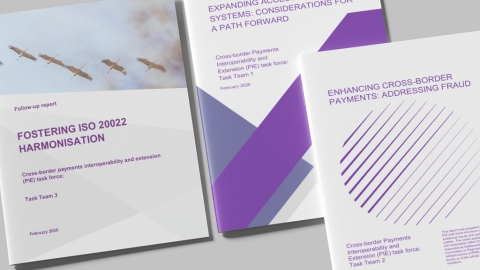
PIE task force reports
The CPMI, through the PIE task force seeks input from industry stakeholders and other external parties on how to enhance cross-border payments. The resulting PIE task force reports provide analysis and outputs on areas identified as important by industry stakeholders. The views expressed in these reports are those of the authors and do not necessarily reflect those of the BIS, the CPMI, its member central banks or the PIE task force as a whole.