- BIS Innovation Hub experiment was conducted jointly with Bank of Israel and Hong Kong Monetary Authority.
- Project tests new intermediary, the Access Enabler, that reduces liquidity and settlement risks and operating costs.
- Project Sela shows that, with preventative design, access to rCBDC does not compromise cyber security.
Project Sela, a joint experiment by the Bank for International Settlements (BIS) and the central banks of Hong Kong SAR and Israel, has proven the feasibility of a retail central bank digital currency (rCBDC) ecosystem that combines accessibility, competition and preventative cyber security, while retaining key advantages of physical cash.
The project, coordinated by the BIS Innovation Hub Hong Kong Centre, leverages the Bank of Israel's cyber security expertise and ongoing work on the digital shekel and the Hong Kong Monetary Authority's (HKMA) learnings from Projects Aurum and e-Hong Kong Dollar, as well as other Innovation Hub experiments on rCBDCs.
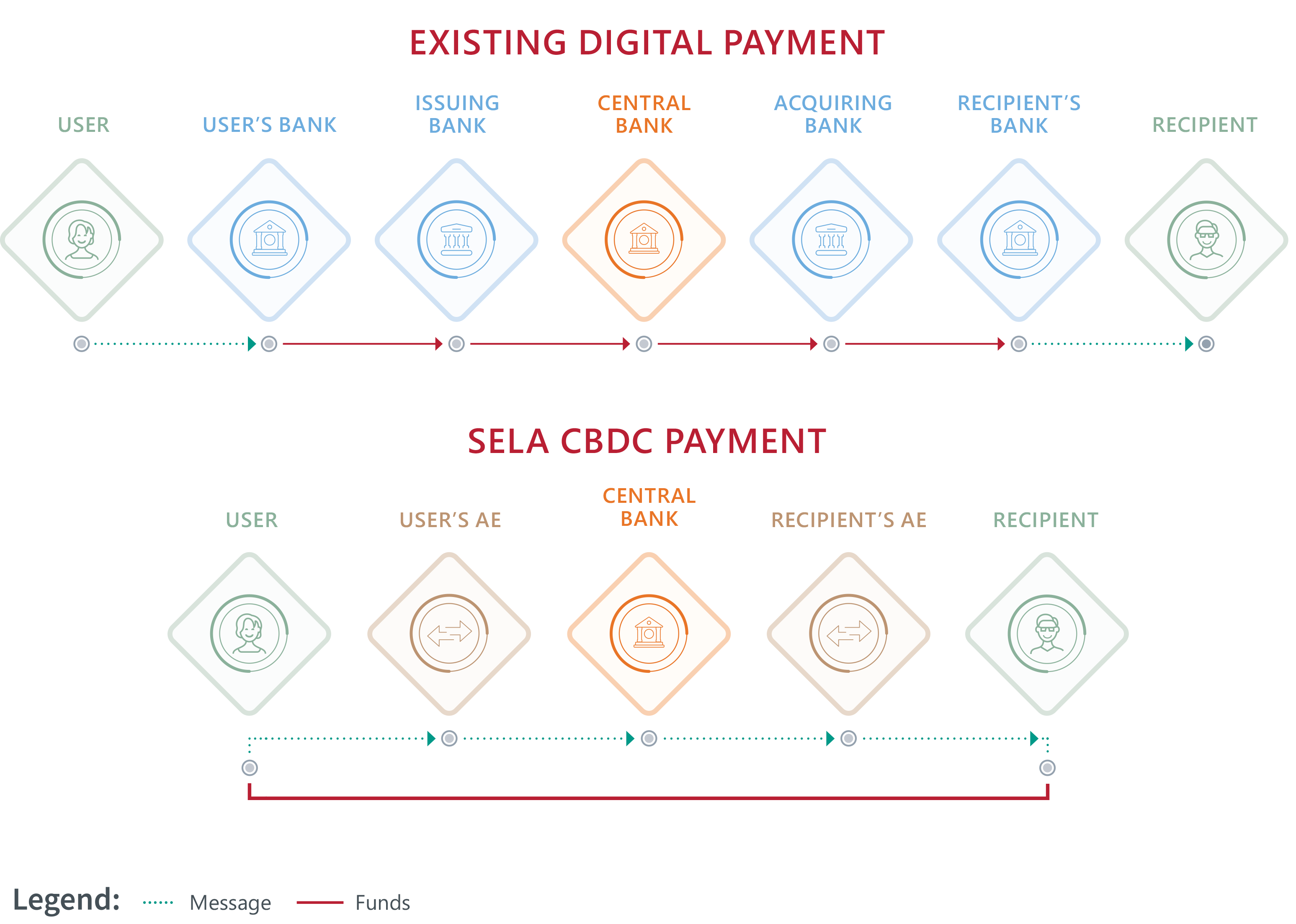
A key policy goal of Sela was to promote an accessible, competitive and innovative rCBDC ecosystem that can serve a wide range of use cases. As such, it aimed to lower the barriers to entry for service providers and unbundle and redistribute the activities related to rCBDC accounts among public and private actors.
Another important goal was to achieve a digital means of payment which preserves desirable attributes of cash, like being free from credit risk; is widely accessible and a safe means of payment and store of value; provides instant settlement; operates at a low cost; and maintains an appropriate level of privacy for end users. In Sela, the rCBDC ledger is operated by the central bank without compromising end user privacy as personal identifiers are obfuscated. Retail payments are therefore settled directly on the central bank's balance sheet in a privacy-preserving manner, meaning instant finality for transactions.
A novel type of intermediary, the Access Enabler, is a core part of the system. It handles all customer-facing rCBDC services without ever "holding" end users' rCBDC at any point in the process, thus eliminating the need to hold funds to ensure liquidity or to reduce settlement risk. Moreover, the Access Enabler does not need to hold funds on its own balance sheet. This removes two significant sources of costs, complexity and risk when compared with current payment service providers.
Related information
Project Sela: an accessible and secure retail CBDC ecosystem
Project Sela, a joint experiment by the BIS Innovation Hub, Bank of Israel and Hong Kong Monetary Authority, explores how to create a retail CBDC that is cyber secure and retains desirable features of cash.