Project Mandala explores the feasibility of encoding jurisdiction-specific policy and regulatory requirements into a common protocol for cross-border use cases such as foreign direct investment, borrowing and payments.
Disparate policy and regulatory frameworks between different jurisdictions are among the chief obstacles to smooth and efficient cross-border payments. They contribute to the regulatory compliance burden across the payment chain, increase the time for cross-border transactions and introduce uncertainties among stakeholders.
Project Mandala – a proof-of-concept run by BISIH Singapore Centre, the Reserve Bank of Australia (RBA), the Bank of Korea (BOK), the Central Bank of Malaysia (BNM), and the Monetary Authority of Singapore (MAS), with the collaboration of financial institutions – seeks to ease the policy and regulatory compliance burden by automating compliance procedures, providing real-time transaction monitoring and increasing transparency and visibility around country-specific policies.
In doing so, it aims to address key challenges identified during Project Dunbar, which developed an experimental multiple central bank digital currency (mCBDC) platform.
The envisioned compliance-by-design architecture could enable a more efficient cross-border transfer of any digital assets including CBDCs and tokenised deposits. It could also serve as the foundational compliance layer for legacy and nascent wholesale or retail payment systems.
The measures could include quantifiable and configurable foreign exchange rules, as well as anti-money laundering and countering the financing of terrorism (AML/CFT) measures.
Project Mandala aligns with the Financial Stability Board 2023 priority actions for achieving the G20 targets for enhancing cross-border payments in the area of promoting an efficient legal, regulatory and supervisory environment for cross-border payments while maintaining their safety, security and integrity.
Update November 2025: Project Mandala Phase 2
The Bank for International Settlements (BIS) is moving Project Mandala into the next phase to advance its work on streamlining cross-border compliance and further explore programmable compliance for digital assets. This work is led by the BIS Innovation Hub Singapore Centre together with the Reserve Bank of Australia, the Bank of France, the Reserve Bank of India, the Central Bank of Kuwait, the Central Bank of Malaysia, Bangko Sentral ng Pilipinas and the Monetary Authority of Singapore.
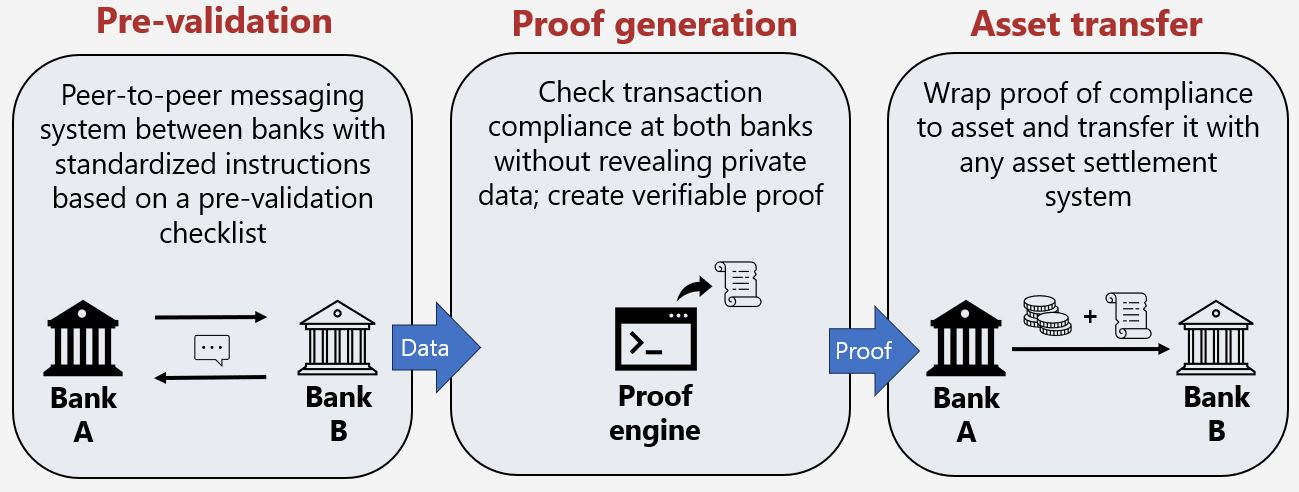
The project's first phase explored embedding jurisdiction specific compliance requirements into a peer-to-peer protocol that facilitates compliance pre-validation and the generation of a cryptographic proof of compliance. This showed potential to automate compliance procedures while improving data privacy through technologies such as zero-knowledge proofs (ZKPs) and multi-party computation (MPC).
Phase 2 builds on this momentum to extend Mandala's research and development efforts, with a focus on evaluating potential benefits empirically, expanding to broader use cases, and utility to other platforms and projects.
Project updates
Project Mandala has demonstrated that regulatory compliance can be embedded in cross-border transaction protocols. It developed a compliance-by-design decentralised system that could help streamline cross-border payments by embedding regulatory compliance within a network of financial institutions and central banks. This decentralised architecture integrates three core components: a peer-to-peer messaging system, a rules engine and a proof engine. It ensures that all necessary compliance checks have been completed before the payment instruction is initiated. Once all checks have been completed, the Mandala system automatically generates a compliance proof, which can accompany any digital settlement asset or payment instructions across borders. To preserve privacy, the compliance proof can be verified without revealing underlying customer data.
Project Mandala has developed a second use case that investigates streamlining compliance processes related to cross-border financing of capital investments involving corporations in Korea and Australia. In parallel, the project explores compliance monitoring to show the usefulness of the Mandala protocol for central banks.
The new use case seeks to automate mandatory approvals and reporting requirements to the relevant authorities in both Australia and Korea in addition to concurrent sanctions screening and compliance checks against capital flow management measures in Korea.
Project Mandala has developed a first use case, which examines compliance processes around cross-border lending from an entity located in Singapore to an entity located Malaysia. For this use case, the team is investigating technological solutions that enable concurrent sanctions screening and compliance checks against capital flow management measures during the pre-validation phase.
A common protocol queries the required checks for the lending transaction and then generates a proof that certifies policy and regulatory compliance, which can be attached to the settlement asset. Through this approach, the project team intends to simplify existing compliance procedures and expedite the overall payment process.
Related information
Project Mandala: shaping the future of cross-border payments compliance
Project Mandala explores the feasibility of encoding jurisdiction-specific policy and regulatory requirements into a common protocol for cross-border transactions such as borrowing, foreign direct investment, or payments.
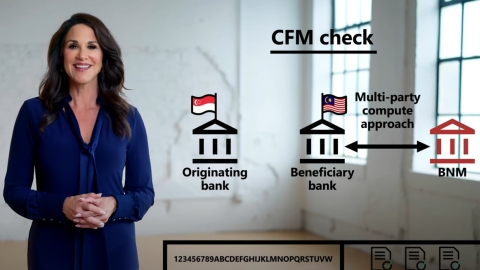
Project Mandala technical explainer
Real-world use cases demonstrate Project Mandala's proof of concept, the core components of the system, how they work, and how participants interact with the system.
Read the full report here.