Emerging risks such as natural disasters are an increasingly important concern for central banks and supervisory authorities due to their potential impact on financial stability. Extreme weather events such as floods, wildfires, cyclones and droughts can cause significant disruptions to households, businesses, infrastructure and financial institutions.
Assessing these risks remains challenging. Central banks and supervisory authorities often face limitations in data availability, analytical tools and real-time monitoring capabilities. A particular challenge is that relevant climate-related information is often distributed across multiple external data sets that differ in format, coverage and quality, making integration and analysis difficult. To overcome these constraints, new approaches are needed that integrate diverse data sources, support timely analysis and help translate physical climate impacts into meaningful financial risk indicators.
Project Danu, led by the Bank for International Settlements (BIS), explored how the concept of a digital twin can be used for climate-related risk analysis. A digital twin is a virtual representation of a real-world system. Building on a proof of concept developed by the Bank of France, De Nederlandsche Bank and the Hong Kong Monetary Authority, the key question was how the approach can be made scalable, adaptable and reusable by central banks and supervisory authorities for a broad range of risk analysis use cases.
The results provide a pathway for central banks and supervisory authorities seeking to generate timely indicators of the potential impacts of extreme weather events and support the assessment of risks to financial institutions and financial stability. The project establishes a foundation for future development towards the incorporation of predictive and simulation capabilities, damage and financial models to support more forward-looking climate risk analysis.
The project was carried out by the BIS in partnership with the Bank of France, De Nederlandsche Bank, the Hong Kong Monetary Authority and the Monetary Authority of Singapore. It also brought together a global user reference group of central banks and supervisory authorities across five continents to ensure its analytical design and practical use cases reflected real supervisory needs.
The Danu prototype is a reusable code base that can be further developed and adapted within an institution's own technical environment. The framework was therefore designed around the following key principles: the integration of diverse data sources; support for different user profiles; adaptability and scalability to institution-specific requirements; and minimising barriers to adoption.
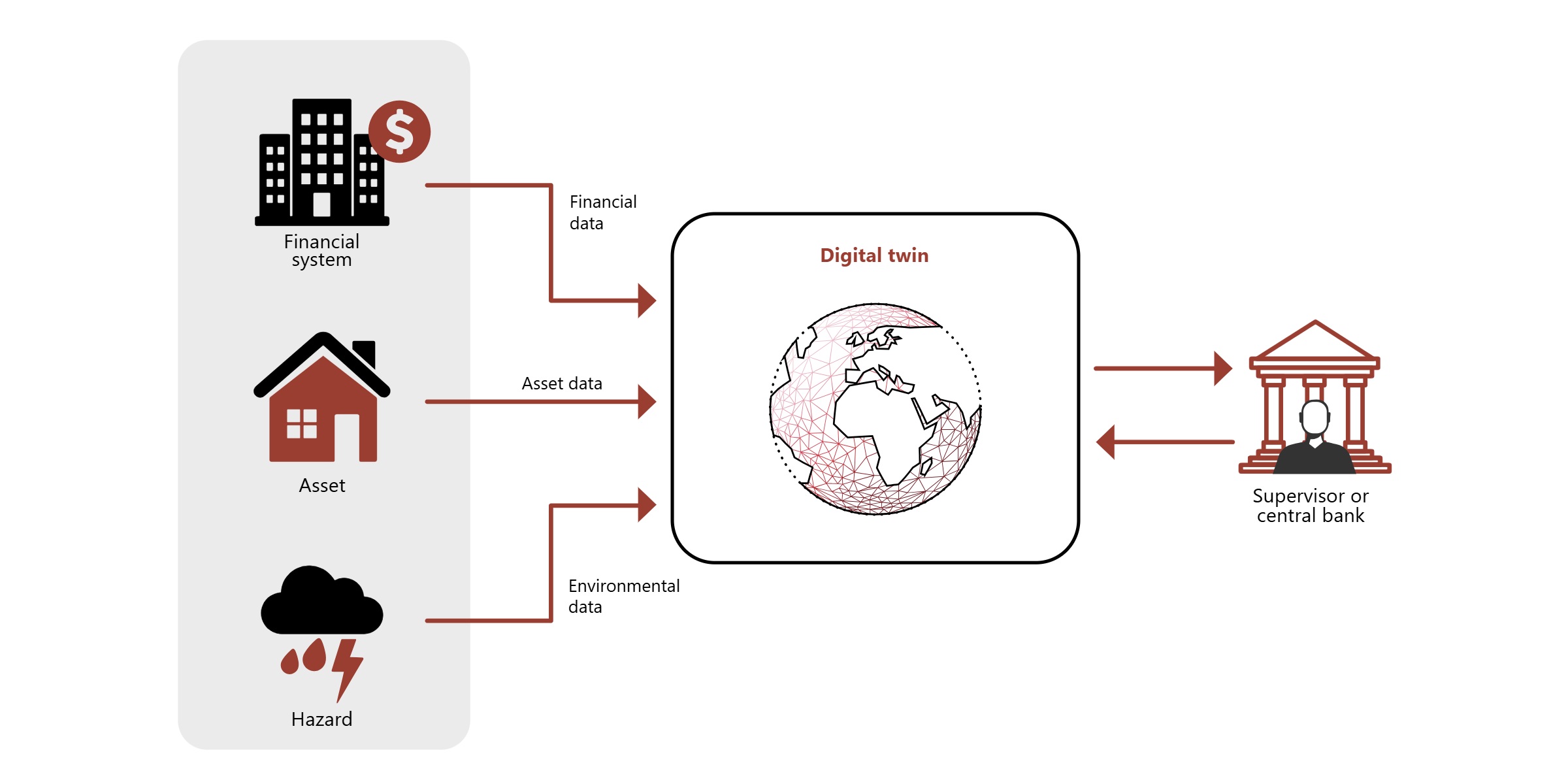
Project Danu demonstrates how the digital twin concept and granular geospatial data can support more dynamic, forward-looking climate risk analysis. Key insights include:
- Digital twin concepts can support climate risk assessment by integrating environmental, geospatial, asset and financial information within a common analytical framework.
- Climate risk assessments can be generated using globally available and satellite-derived data sets, helping to lower barriers to adoption across jurisdictions.
- Practical implementation requires interoperability, adaptability and scalability to support different institutional environments, data architectures and analytical needs.
- Climate risk methodologies often require local calibration, highlighting the importance of flexible frameworks that can incorporate institution-specific data sets and models.