Digital cash has the potential to provide a secure and convenient means of payment. For it to be widely accepted, however, people may require assurances that at least some of their spending is not tracked. At the same time, authorities must continue to prevent financial crime, protect consumers and maintain financial stability. This presents a key policy challenge: how can digital cash provide a degree of privacy comparable to physical cash while still supporting legitimate public policy objectives?
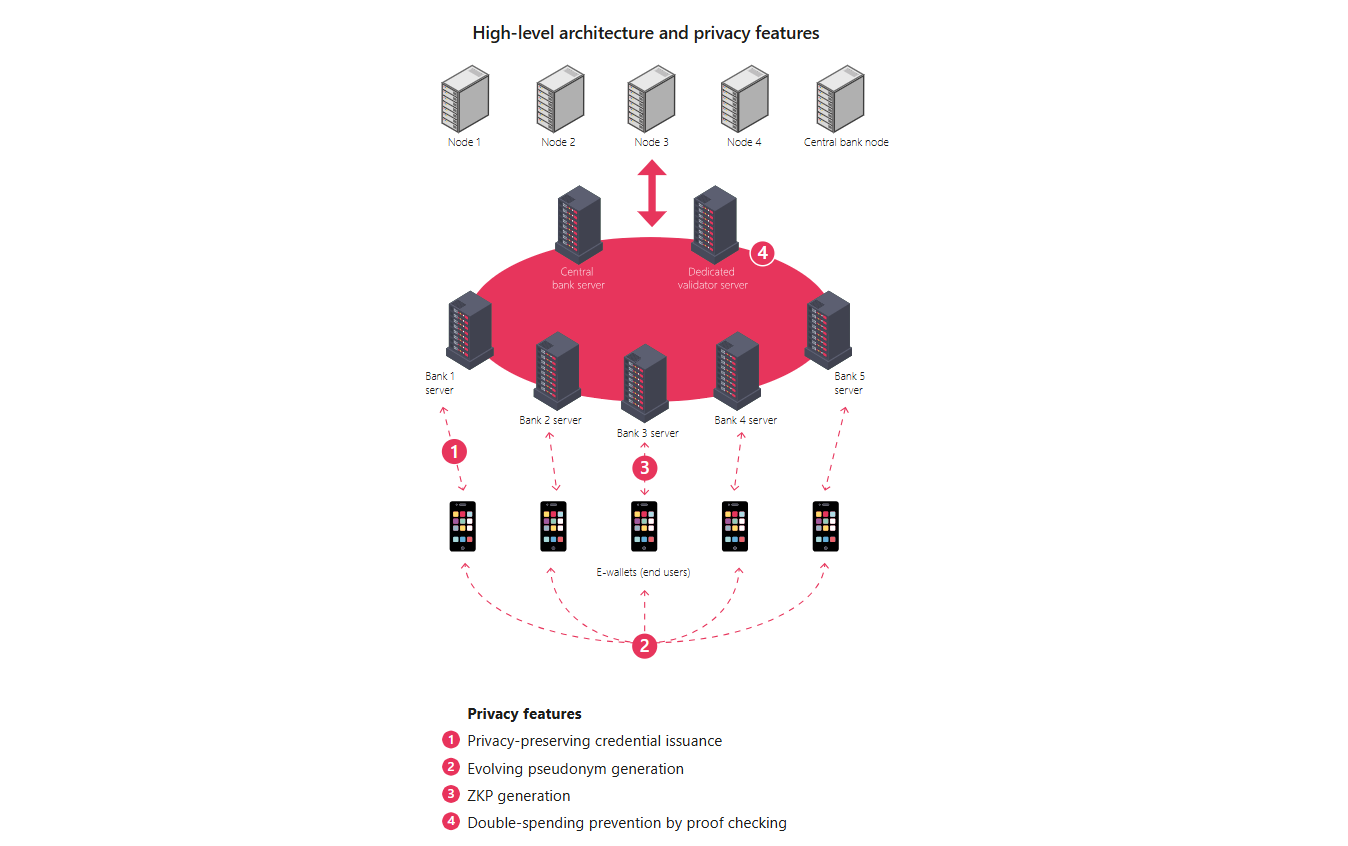
Project Aurum Phase 2, led by the BIS Innovation Hub, explores how privacy-enhancing technologies (PETs) can help address this challenge. The project developed an exploratory proof of concept (PoC) that combines encryption, BBS+ signatures, pseudonym-based ownership and zero-knowledge proofs (ZKPs) to support privacy-preserving payments while maintaining mechanisms for compliance. Rather than treating privacy and compliance as conflicting objectives, the project examines how both can be incorporated into the design of digital cash systems.
The project was carried out by the BIS Innovation Hub Hong Kong Centre in collaboration with the Hong Kong Monetary Authority, the Hong Kong Polytechnic University and the Hong Kong Applied Science and Technology Research Institute (ASTRI).
Project Aurum Phase 2 demonstrates how privacy considerations can be explored at the technology design stage of digital cash systems, rather than relying solely on institutional safeguards. Key insights include:
- Privacy and compliance need not be mutually exclusive objectives.
- PETs can support a practical middle ground between complete anonymity and full transaction transparency in digital payment.
- Payment integrity and regulatory safeguards can be maintained without routinely making sensitive payment information visible to parties that do not need it.
- Stronger privacy protections may involve trade-offs relating to programmability, performance and operational complexity.
- Central banks can benefit from PETs across a range of use cases, including AML.
As an exploratory prototype, the PoC provides a foundation for further experimentation and policy discussion on how digital cash systems can balance privacy, integrity and regulatory requirements.