Cross-border finance remains more challenging than the movement of people, goods, and services. While open banking and open finance frameworks have transformed domestic markets in around 95 jurisdictions, their benefits rarely extend across borders. Differences in technical standards, data formats, and trust frameworks often impair the seamless exchange of financial data and API-based services between countries. These frameworks have delivered clear benefits inside individual countries, including greater competition, innovation, and financial inclusion (BIS Paper: Opening doors to open finance: evidence from the international experience). Moving financial data and using APIs across borders remains difficult. Domestic frameworks use different technical standards, data formats, and trust frameworks. As a result, businesses – especially small and medium-sized enterprises (SMEs) – frequently encounter repeated manual checks, duplicated document submissions, lengthy onboarding processes, and limited access to overseas accounts, credit, and trade finance.
Project Aperta, led by the Bank for International Settlements (BIS), tackled this challenge by designing, developing and testing a prototype for cross-border open finance interconnectivity via application programming interfaces (APIs) – a "network of networks" that connects existing domestic networks through a neutral interoperability layer. The prototype connected the open finance networks of the United Kingdom, the United Arab Emirates, Brazil, Hong Kong, and India.
The project was carried out by the BIS Innovation Hub (BISIH) in collaboration with the Hong Kong Monetary Authority, the Central Bank of Brazil, the Central Bank of the United Arab Emirates, and the Financial Conduct Authority of the United Kingdom, together with participation from the Global Legal Entity Identifier Foundation (GLEIF), the International Chamber of Commerce Digital Standards Initiative (ICC DSI), and the Hong Kong University Standard Chartered Foundation FinTech Academy. The prototype was tested together with private-sector commercial banks and fintechs.
Project Aperta supports key priorities for central banks by advancing secure, interoperable cross-border open finance infrastructure that can promote the smooth functioning of payment and data systems, as well as greater efficiency and resilience across jurisdictions. Open finance falls within the mandates of many central banks, and Project Aperta aims to extend the value of domestic open finance internationally in a secure and interoperable way.
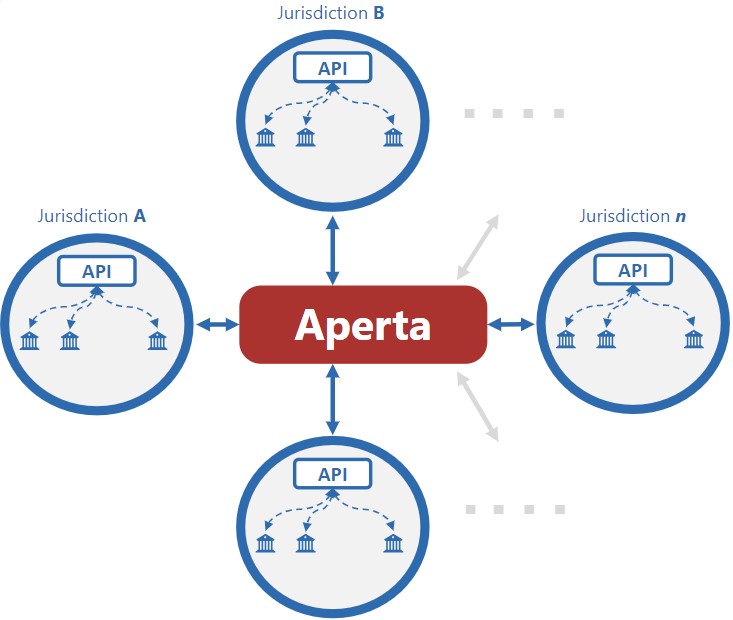
The architecture demonstrates that cross-border data sharing is possible without changing domestic open finance networks. Aperta preserves local rules, security, and supervisory oversight, while enabling interconnectivity through open standards, encryption, and modular design. New open finance networks can be added to Aperta with ease and participate in the cross-border network.
Demonstrated use cases and benefits for data portability
The prototype was tested across five economies using two practical, SME-focused use cases:
- Cross-border business account opening: Secure sharing of verified business profiles and transaction histories between jurisdictions allows faster onboarding, reduces manual checks, and strengthens due diligence.
- Trade finance and payments: By aligning APIs with recognised trade finance standards, Aperta showed how digital, structured data flows can replace fragmented, paper-based processes and bring open finance principles to new domains. This covered the full transaction lifecycle, from contract and letter of credit issuance through the exchange of shipping documents to final payment.
These experiments showed how cross-border open finance interconnectivity can make financial services more accessible and efficient, while reducing duplication, compliance costs, and onboarding times for businesses.
Project Aperta successfully demonstrated the technical feasibility and policy potential of linking domestic open finance frameworks through a common interconnectivity layer. Key findings include:
- Open finance systems can connect across borders without altering their core architecture.
- Achieving interconnectivity requires sustained collaboration among regulators, central banks, standard setters, and industry participants.
- Legal and regulatory adjustments would be needed to support deployment.
- The project's modular, open-source design offers a foundation to extend connections into new jurisdictions and sectors.
A foundation for a more interconnected global finance
Project Aperta delivered a successful proof of concept for a multilateral open finance network, involving multiple jurisdictions in the joint development and testing of a common prototype. It lays a foundation for more efficient global trade, stronger SME participation in international markets, and a new wave of inclusive, re-globalised finance.
All architectural blueprints, translation protocols, trust framework designs, reference code, and data models have been developed as open, reusable public goods, ready for other jurisdictions and scheme operators to adopt and build upon.
