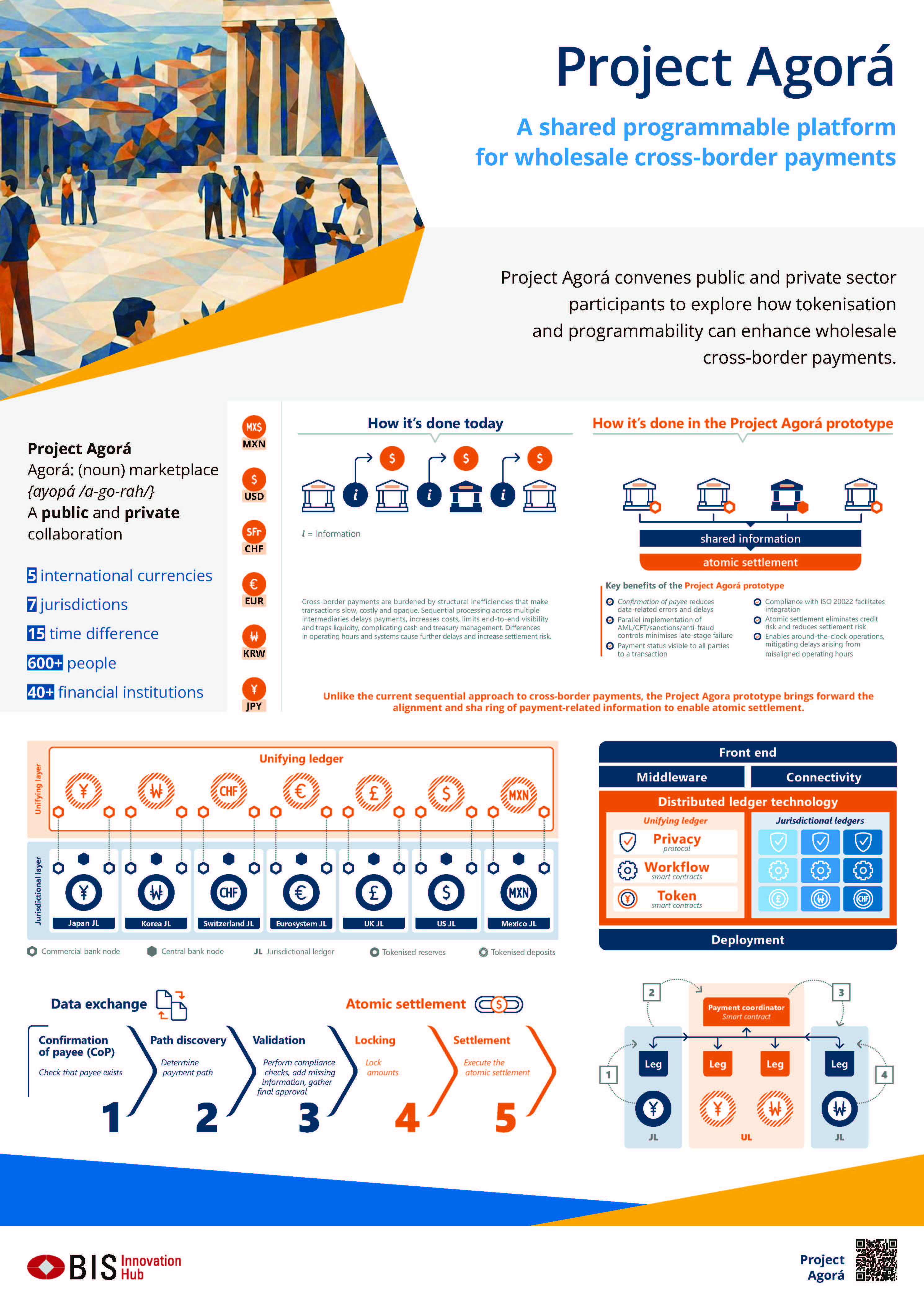
Project Agorá is a public-private collaboration that aims to test the desirability, feasibility and viability of a multi-currency shared programmable platform for wholesale cross-border payments. It is based on a concept initially proposed by the BIS.
Cross-border payments today are burdened by structural inefficiencies that make them slow, costly and opaque. Complex, sequential processes and networks delay transactions, increase costs, limit end-to-end visibility and silo liquidity – complicating cash and treasury management. Together these frictions weigh on global trade and financial activity, constraining innovation and growth.
Project Agorá is tackling this problem by exploring a new way to process wholesale cross-border payments using tokenisation, making these payments faster, safer, and more transparent.
By tokenising – recording central bank reserves and commercial bank deposits on a shared platform – Project Agorá seeks to enable atomic settlement of wholesale cross-border transactions while preserving the safety, trust and reliability of the existing banking system.
In turn, a Project Agorá-like solution could open new possibilities for businesses, such as conditional or always-on payments, while maintaining the safety, reliability, and soundness of banking payments.
What makes Project Agorá truly unique is its combination of innovation and global collaboration at scale. It brings together eight central banks, including those of five major reserve currencies, and over 40 leading financial institutions - convened by the Institute of International Finance (IIF) - in a public-private partnership.
The prototype demonstrates that tokenised commercial bank deposits can be successfully combined with the trust and safety of tokenised central bank reserves on a shared platform. The prototype enables atomic, multi-currency settlement of wholesale cross-border payments, which could occur on an around-the-clock basis if implemented. More broadly, by leveraging smart contracts, the platform allows financial institutions to embed workflow logic, compliance requirements and conditional payment triggers directly into transactions. This promises to reduce reconciliation burdens, manual intervention and other operational frictions – key sources of delay, cost and payment failure in today's cross-border system.
In addition to its technical innovations, Project Agorá is exploring critical regulatory and legal considerations. The project is examining how tokenised central bank reserves and commercial bank deposits can comply with existing rules on issues like settlement finality, anti-money laundering/countering the financing of terrorism and data privacy.
Project Agorá is not about building a finished product but rather has delivered a prototype to evaluate the potential of this new approach. The project intends to advance testing, including conducting real-value transactions involving certain currencies and participants.
Project participants, including central banks, have expressed strong and sustained interest in further exploring the potential benefits of the prototype. Future work is expected to involve an enhanced role for the private sector, supported by continued and active engagement from participating central banks.
Real-Value Testing
The development of the Project Agorá prototype included real-value testing (RVT) in a controlled environment. RVT went beyond functional testing of the prototype by validating real-value payments between participating institutions under realistic operating conditions. The testing framework covered operational, technical, governance and legal aspects.
Project Agorá conducted RVT in July 2026. Twenty-eight financial institutions and central banks across Asia, Europe and North America completed transactions in a selection of currencies totalling approximately CHF 800,000. The programme covered 17 transaction scenarios, with values ranging from CHF 9,000 to CHF 125,000 or local currency equivalents.
RVT marked an important milestone for Project Agorá, demonstrating the feasibility of settling real-value transactions on a multi-currency programmable and shared platform using tokenised reserves and tokenised deposits. The project is grateful to the participating institutions whose commitment made the successful testing possible. As Project Agorá progresses, testing will continue.
- Twenty-eight private sector institutions and central banks completed transactions totalling approximately CHF 800,000 in a selection of currencies during real-value testing (RVT). The programme covered 17 transaction scenarios, with values ranging from CHF 9,000 to CHF 125,000 or local currency equivalents.
- The testing demonstrated that the prototype can successfully support a broad range of cross-border payment use cases, including corporate and interbank single- and dual-currency payments, payment-versus-payment (PvP) transactions, and intragroup bank transfers.
- RVT demonstrated the practical benefits of tokenisation and atomic settlement, including faster settlement and greater transparency. Despite the prototype not being integrated with existing real-time gross settlement (RTGS) and core banking systems, the average time from payment initiation to settlement was approximately 80 seconds. Participants also valued the end-to-end visibility of payment status and routing as well as the ability to support corporate payment processing directly on the platform.
- The prototype was designed to interoperate with diverse external systems across jurisdictions, and RVT demonstrated the feasibility of this approach. Test transactions interacted with RTGS and core banking systems using established ISO 20022 payment and reporting standards, including pacs.008, pacs.009 and camt.053.
- Approximately 250 public and private sector staff members participated in the testing. The exercise enhanced operational readiness across payments, compliance, risk and legal teams, helping institutions to assess the organisational implications of adopting a Project Agorá-like platform in the future.
RVT demonstrated the feasibility of conducting real-value transactions on the Project Agorá platform under realistic operating conditions. In the testing, issued tokens represented real monetary value, representing central bank reserves and commercial bank deposits.
The testing covered a selection of currencies, payment use cases and transaction scenarios (Table 1). The participating financial institutions and central banks conducted the testing on behalf of all Project Agorá participants.
Table 1: Real value testing overview
| Currencies | CHF, EUR, GBP, JPY, KRW, USD |
| Testing central banks | Bank of England, Bank of France (for the Eurosystem), Bank of Japan, Bank of Korea, Swiss National Bank |
| Testing financial institutions |
|
| RVT operational facilitator | SIX |
| RVT technology provider | Kaleido |
| Use cases | Dual-currency cross-border payment (corporate and interbank) Payment-versus-payment (PvP) (interbank) Single currency payment (corporate, interbank and intragroup) |
| Transaction scenarios | 17 transaction scenarios based on the three uses cases, processing 30 transactions in total
|
| Transaction value | The total transaction value was approximately CHF 800,000. Individual transaction values ranged between CHF 9,000 and 125,000. Transaction value by currency:
|
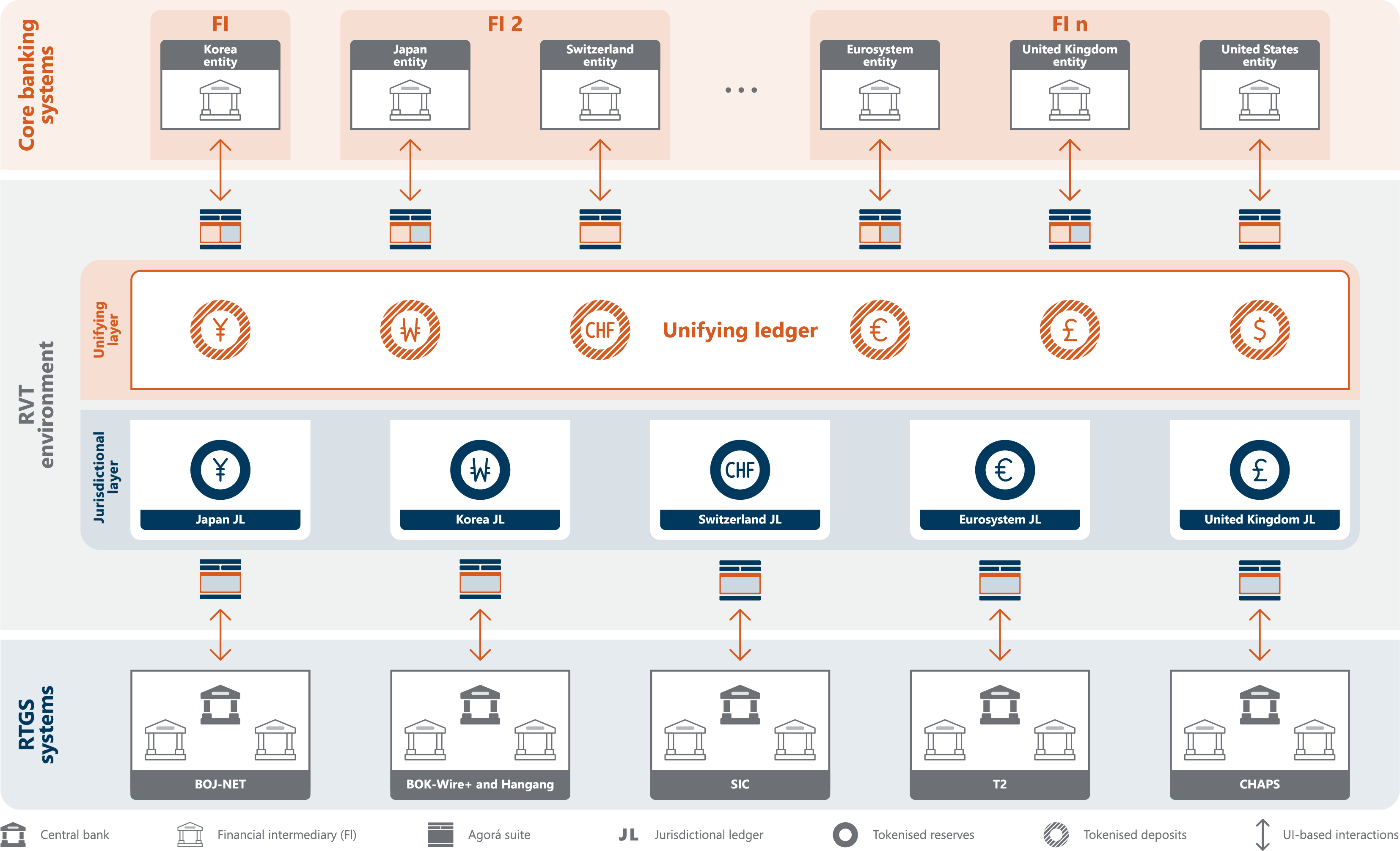
Testing in the RVT environment incorporated central banks' RTGS systems and participants' core banking systems (Figure 1). Interactions with the RVT environment were facilitated through user interfaces within each participant's Project Agorá prototype software stack (suite). Public and private sector participants adopted different operational approaches, demonstrating the prototype platform's flexibility to accommodate a range of user requirements.
Central banks used their Project Agorá suites to issue and redeem tokenised reserves and to monitor settlement on the jurisdictional ledger. The suites in Figure 1 illustrate that central banks interacted with the jurisdictional ledger only (blue suites). The issuance of tokenised reserves was triggered outside the RVT environment, typically following a payment from the requesting financial institution to a dedicated RTGS account (eg an escrow or omnibus account). Redemptions were initiated by the financial institutions through the RVT environment and subsequently settled in the RTGS system by crediting the institution's reserve account.
Financial institutions used their Project Agorá suites to issue and redeem tokenised deposits, manage tokenised reserve holdings, submit payments and monitor account balances and transaction activity on the platform. Depending on their business activity and transaction scenarios, financial institutions issued tokenised deposits in one or several currencies on the unifying ledger and managed tokenised reserves in one or several jurisdictional ledgers. The suites in Figure 1 reflect the varying approaches. Some of the entities issued tokenised deposits and managed tokenised reserves (orange and blue suites), others managed tokenised deposits only (orange suites). To issue tokenised deposits, financial institutions earmarked the corresponding funds or booked the equivalent amount to a designated account in the core banking system. The redemption process reversed these steps.
Figure 1: stylised real-value testing (RVT) setup
All transactions were coordinated by SIX in its role as the RVT operational facilitator during predefined, intraday transaction windows using a detailed runbook. Kaleido supported transaction execution as the technology provider. A typical RVT transaction began with the issuance of tokenised reserves and deposits. Debtors, debtor agents (for corporate transactions) or the initiation service provider (for PvP transactions) initiated payments by preparing payment instructions in accordance with established ISO 20022 standards (pacs.008 or pacs.009). Payment instructions were submitted once the participating financial institutions had completed compliance checks and, for dual-currency transactions, the cross-currency provider manually confirmed the corresponding amount. This triggered the locking of funds and the subsequent atomic settlement.
Following settlement, creditors or their agents requested the redemption of the tokens. Once the token issuer approved the redemption request, the corresponding funds were transferred through the underlying external systems. Selected transaction scenarios also included the execution of offsetting transactions prior to redemption.
The testing framework covered governance, legal, operational and technical aspects. It was based on a contractual agreement between testing institutions, complemented by a runbook and fallback procedures (Table 2) as well as a dedicated RVT environment for the execution of transactions (Table 3).
Table 2: Testing framework
| Contractual agreement | Legal framework governing roles and responsibilities on the platform and transaction execution. The main roles and responsibilities on the platform were:
|
| Runbook | Detailed operational guide for the execution of transaction scenarios. The runbook covers step-by-step instructions for each transaction scenario, covering the issuance of tokenised reserves and deposits, transaction preparation and execution, and redemptions of tokenised reserves and deposits. |
| Fallback procedures | Contingency framework if one or several steps in the runbook cannot be executed as planned. The operational facilitator coordinates activation, documentation and execution of fallback procedures in collaboration with affected parties. |
The RVT environment was developed on the Project Agorá prototype (full description in Project Agorá report and incorporates several functional enhancements to meet operational requirements for the execution of real-value transactions.
Table 3: Core platform enhancements for real-value transactions
| Maker-checker | Implement an internal two-step process (maker and checker) for requests, payments, issuance and redemption instructions. |
| Manual breakpoints | Implement manual commercial bank approvals for issuance/redemption requests for tokenised deposits. Implement manual central bank approval for redemption requests for tokenised reserves (no issuance requests of tokenised reserves on the platform). |
| Status | Display the status of redemption and issuance requests with other banks and redemption requests with central banks. |
| Manual cross-currency amount | Require the cross-currency provider to manually input cross-currency amounts in the platform. |
| End-of-day statements | Generate end-of-day statements per account for central banks and commercial banks (camt.053). |
| Multi-factor authentication | Implement multi-factor authentication for each user. |
Additional files
Related information
Project Agorá: exploring tokenisation of wholesale cross-border payments
Project Agorá, a unique public-private collaboration convened by the Bank for International Settlements (BIS) and the Institute of International Finance (IIF), has demonstrated that tokenisation can help to address inefficiencies in wholesale cross-border payments in a safe and secure manner through multi-currency settlement using tokenised central bank reserves and tokenised commercial bank deposits.