
About the conference
A conference co-organised by the Bank for International Settlements, the Bank of Japan, the Bank of Spain and the Network for Greening the Financial System.
The fourth edition of the Green Swan Conference brings together high-calibre speakers – comprising corporate leaders from sectors most relevant for GHG emissions, experts, academics and policymakers – to discuss how climate risk, adaptation and mitigation affect the supply side of the economy and what these economic effects imply for the work of central banks.
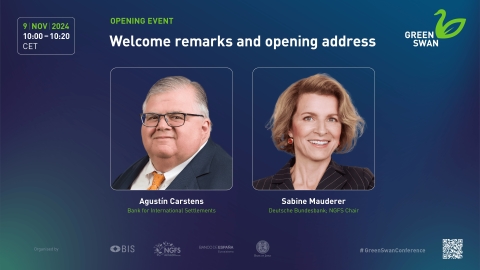
Opening - Steering through uncharted waters: monetary policy in the face of climate change
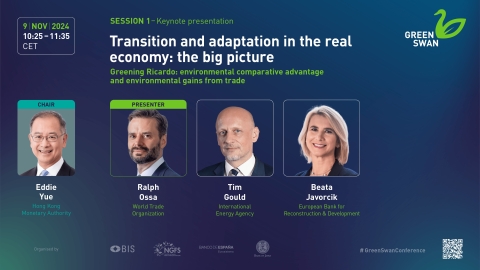
Session 1 - Transition and adaptation in the real economy: the big picture
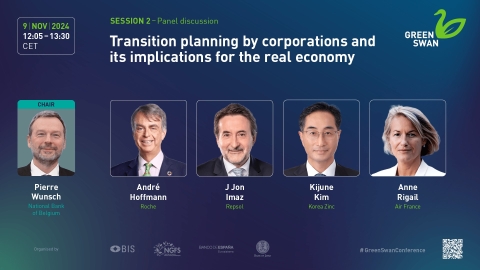
Session 2 - Transition planning by corporations and its implications for the real economy
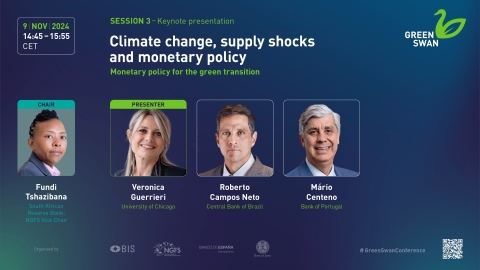
Session 3 - Climate change, supply shocks and monetary policy
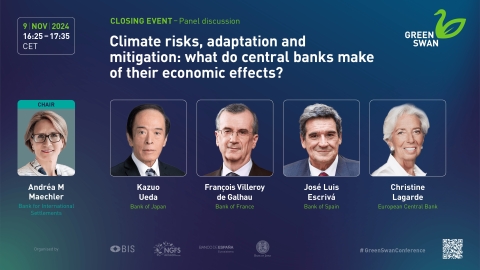
Closing - Climate risks, adaptation and mitigation: what do central banks make of their economic effects?
Speakers
He holds a Bachelor's and Master's Degree in Economics from the University of California Los Angeles (UCLA) and has extensive professional experience in the financial sector. For over two decades, he held positions and leadership roles in financial institutions, in Brazil and abroad, such as Bozano Simonsen, Claritas, B3 and Santander, where he headed the Global Treasury for the Americas.
As head of Banco Central do Brasil, he launched Agenda BC#, a set of structuring measures that aim to foster competition, inclusion, transparency, education, and sustainability in the national financial system.
Among the highlights of Agenda BC# are the creation of the award-winning Pix instant payment system, the implementation of Open Finance, the pilot project of the Brazilian digital money (Drex), in addition to the incentive and modernization of actions in microcredit, cooperatives, rural and real estate credit and the development of the financial green agenda.
Campos Neto was named "Central Banker of the Year 2021" by Financial Times magazine The Banker and "Central Bank Governor of the year" in 2022 and 2023 by LatinFinance. In 2024, under his leadership, Banco Central do Brasil was awarded "Central Bank of the Year" by Central Banking magazine.
Agustín Carstens became General Manager of the BIS on 1 December 2017.
Mr Carstens was Governor of the Bank of Mexico from 2010 to 2017. A member of the BIS Board from 2011 to 2017, he was chair of the Global Economy Meeting and the Economic Consultative Committee from 2013 until 2017. He also chaired the International Monetary and Financial Committee, the IMF's policy advisory committee from 2015 to 2017.
Mr Carstens began his career in 1980 at the Bank of Mexico. From 1999 to 2000, he was Executive Director at the IMF. He later served as Mexico's deputy finance minister (2000-03) and as Deputy Managing Director at the IMF (2003-06). He was Mexico's finance minister from 2006 to 2009.
Mr Carstens has been a member of the Financial Stability Board since 2010 and is a member of the Group of Thirty.
Mr Carstens holds an MA and a PhD in economics from the University of Chicago.
Mário Centeno is the Governor of Banco de Portugal and member of the Governing Council of the European Central Bank since July 2020. He served as President of the Eurogroup and Chair of the Board of Governors of the European Stability Mechanism, and for over four years he was Finance Minister of Portugal. An experienced economist, Mr Centeno has held several positions in Banco de Portugal, where he started his career in 1993. He has a strong academic background with a PhD in Economics, from Harvard University, and has published several academic papers.
José Luis Escrivá is Governor of the Banco de España and member of the ECB's Governing Council and General Council. He chairs the Board of Governors of CEMLA and is member of international committees such as the European Systemic Risk Board, the Financial Stability Board and the Group of Central Bank Governors and Heads of Supervision. He is Vice-Chair of the Spanish Macroprudential Authority Financial Stability Council (AMCESFI).
He was previously Spain's Minister for Digital Transformation and Civil Service (2023-2024) and Minister for Inclusion, Social Security and Migration (2020-2023). He was the first President of Spain's Independent Authority for Fiscal Responsibility (2014-2020) and the Chair of the EU Network of Independent Fiscal Institutions (2015-2019).
He began his career at the Banco de España in the Economic and Research General Directorate. He was an adviser to the European Monetary Institute (1993-1995), before being appointed Head of the Monetary Policy Division of the ECB in 2000.
From 2004 to 2012, he worked at BBVA, first as its global Chief Economist and Director of the Research Department, and then its Managing Director responsible for Global Public Finance. From 2012 to 2014, he served as the Chief Representative of the BIS Office for the Americas.
Tim Gould was appointed the Agency's Chief Energy Economist in 2021. As Chief Energy Economist, he provides strategic advice on energy economics across a wide range of IEA activities and analysis. Mr Gould is also Head of the Office of the Chief Energy Economist, in which capacity he co-leads the World Energy Outlook, the IEA's flagship publication series, and oversees the Agency's work on investment and finance, including the World Energy Investment report.
Mr Gould joined the IEA in 2008, initially as a specialist on Russian and Caspian energy, and in recent years has designed and directed a wide range of IEA analytical outputs, while continuing to contribute also as an author. Prior to joining the IEA, Mr Gould worked on European and Eurasian energy issues in Brussels and has ten years of experience in Eastern Europe, primarily in Ukraine. He graduated from Oxford University and has a post-graduate diploma from the School of Advanced International Studies of Johns Hopkins University.
Veronica Guerrieri is the Ronald E Tarrson Distinguished Service Professor of Economics and Williard Graham Faculty Scholar at Chicago Booth. She is also a fellow of the Econometric Society, a Research Associate at the NBER, a Research Fellow at the CEPR, and the co-director of the Macro Initiative of the Becker Friedman Institute. Professor Guerrieri has been managing editor of the Review of Economic Studies in 2017-2021. She is also an academic member of the Bellagio Group, a consultant at the Federal Reserve Bank of Chicago, and she has been a consultant for the Italian Prime Minister in 2021. Professor Guerrieri's work focuses on macroeconomics, labor and financial markets, business cycles, and growth. She won the Bernácer Prize in 2015 for the best European economist under 40 in macroeconomics and finance, the Carlo Alberto medal in 2013 for the best Italian economist under 40, the Alfred P. Sloan Research Fellowship in 2011, and the Excellence Award in Global Economic Affairs in 2010 from the Kiel Institute for the World Economy. She earned a PhD in economics at MIT and joined the Chicago Booth faculty in 2006.
André Hoffmann is vice chairman of Roche Holding AG, a pharmaceutical company established by his great-grandfather in 1896. He also serves on the board of the fully owned subsidiary, Genentech Inc.
Alongside these non-executive roles in the family business, Mr Hoffmann is a member of the board of SystemIQ, the board of trustees of the World Economic Forum and the Center for the Fourth Industrial Revolution. He is president of W.A. de Vigier Stiftung and vice chairman of the board of the Venture Foundation.
Mr Hoffmann also has a distinguished career in nature conservation and sustainability. He is the president of Fondation Tour du Valat, a world-renowned institute dedicated to wetland conservation, and serves on the boards of Capitals Coalition, b-Team, Peace Parcs and the Givaudan Foundation.
Mr Hoffmann helped establish the Hoffmann Global Institute in Business and Society at INSEAD and chairs its advisory board.
He studied economics at St Gallen University and holds an MBA from INSEAD.
Josu Jon Imaz is Doctor of Chemical Sciences from the University of the Basque Country. He graduated in Chemical Sciences and received the award of excellence up
on completion of his degree.
He began his career as researcher as well as in the field of industrial (Grupo Mondragón) and business project promotion. He was also a research visitor fellow at Harvard Kennedy School in the United States.
In 2008, Josu Jon Imaz joined Repsol as chairman of its subsidiary Petronor. In 2012, he joined the Executive Committee as executive managing director of the Industrial Area and New Energies and since April 2014 he has been chief executive officer leading Repsol's transformation process, which has established itself today as a global multi-energy company.
Josu Jon Imaz also held a number of political roles, including Regional Minister of Industry, Trade, and Tourism of the Basque Government from 1999 to 2004.
He is currently CEO of Repsol and chairman of Fundación Consejo España-EE.UU.
Beata Javorcik is Chief Economist of the European Bank for Reconstruction and Development (EBRD) in London. She is currently on leave from the University of Oxford, where she is the first woman to hold a Statutory Professorship in Economics. She is also a Fellow of All Souls College, Oxford and the Director of the International Trade Programme at the CEPR in London. She is a member of the Scientific Advisory Committee at ifo Institute, University of Munich, as well as of the Executive and Supervisory Committee of CERGE-EI in Prague. Before taking up her position at Oxford, she worked at the World Bank in Washington DC, where she focused on research, lending operations and policy advice. She holds a Ph.D. in Economics from Yale and a B.A. in Economics (Summa cum Laude) from the University of Rochester.
Kijune Kim joined Korea Zinc in September 2022 as Executive Vice President in charge of ESG topics including environmental aspects, social responsibility, and corporate governance.
Kijune worked for almost 30 years at the Ministry of Trade, Industry and Energy of Korea, where he accumulated valuable experience in the fields of energy, industry and trade, among others, including being chief negotiator of several free trade agreement (FTA) negotiations.
He lived six years in Paris. From 2009 to 2012, Kijune was a diplomat in Korea's Delegation to the OECD covering trade, industry, green growth and energy topics. Later, he served as Head of Energy Policy Division at the International Energy Agency, from 2012 to 2015.
His résumé also includes two years as Executive Vice Chairman of the Korean Federation of Textile Industries, and three years as a Korean Navy Officer.
Kijune has a BA in Economics at the Seoul National University. He has MA in Economics and JD degree at the University of Maryland, USA. He is a member of the New York Bar Association since 2007.
Christine Lagarde has been President of the ECB and, in this function, also Chair of the European Systemic Risk Board since November 2019.
Between 2011 and 2019 she served as Managing Director of the International Monetary Fund. Prior to that she served as French Minister of Economy and Finance from 2007 to 2011, having been Trade Secretary from 2005 to 2007. A lawyer by background, she practised for 20 years with international law firm Baker McKenzie, of which she became Global Chair in 1999. She was the first woman to hold each of these positions.
In 2022 President Lagarde was ranked the second most influential woman in the world by Forbes. She has also been recognised by TIME as one of the 100 most influential people in the world. She was named Officer in the French Order of the Legion of Honor in April 2012 and Commander in the National Order of Merit in May 2021.
Andréa M Maechler became Deputy General Manager of the BIS on 1 September 2023.
Ms Maechler was a member of the Governing Board of the Swiss National Bank (SNB) from 2015 until 2023. At the SNB, she was responsible for the Money Market and Foreign Exchange, Asset Management, Banking Operations and Information Technology portfolios.
Prior to joining the SNB, she was Deputy Division Chief in the Global Markets Analysis Division of the International Monetary Fund. She has worked at other international organisations, including the European Systemic Risk Board and the Organisation for Economic Co-operation and Development.
She was Chair of the Global Foreign Exchange Committee of central banks from December 2021 to June 2023. Ms Maechler has a PhD and a master's degree in International Economics from the University of California, Santa Cruz, and a Diploma of Higher Studies (DES) in International Relations from the Graduate Institute of International Studies in Geneva, Switzerland.
Dr. Sabine Mauderer is the First Deputy Governor of the Deutsche Bundesbank and responsible for Markets, Sustainability, Data and Statistics, as well as Controlling, Accounting and Organisation. Sabine Mauderer is the alternate to the President of the Bundesbank on the ECB's Governing Council and the Bundesbank's deputy in the G20 and G7 and at the IMF. In addition, she is Chair of the "Central banks and Supervisors Network for Greening the Financial System (NGFS)" and a member of the Exchange Experts Commission.
Prior to becoming First Deputy Governor in September 2024, she had already been a member of Deutsche Bundesbank's Executive Board since September 2018. Previously, she also held several senior positions at the KfW Banking group, and worked as a senior adviser at the Federal Ministry of Finance and at the German Embassy in Washington.
Sabine Mauderer was born in Schleswig in 1970. She studied law in Germany and Spain, holds a PhD from Osnabrück University and an Executive MBA from ESSEC & Mannheim Business School.
Ralph Ossa is Chief Economist and Director of the Economic Research and Statistics Division at the World Trade Organization. He joined the World Trade Organization after a distinguished career in academia with appointments at Princeton University, the University of Chicago, and the University of Zurich.
Professor Ossa's research focuses on international economics with a particular emphasis on questions of policy relevance. For example, he has explored the economics of trade wars and trade talks and estimated how much countries gain from international trade.
He holds a PhD in economics from the London School of Economics.
Anne Rigail joined Air Inter in 1991. In 1996, she was appointed head of Air France Customer Services at Orly. In 1999, she became Director of Passenger and Baggage Connections at the Paris-CDG hub, then head of Customer and Baggage Products for Ground Operations. In 2005, she became head of the Paris-CDG Hub Operations, then VP Ground Operations at Paris-CDG in 2009. She joined the Executive Committee in 2013 as EVP In-flight Services. In 2017 she was appointed EVP Customer. Anne was appointed CEO of Air France on December 12, 2018.
Ms Fundi Tshazibana has been a deputy governor and an executive director of the Board of the South African Reserve Bank (SARB) since 2019. She is currently also the CEO of the Prudential Authority. The Prudential Authority regulates banks, insurers, cooperative financial institutions, financial conglomerates and certain market infrastructures. As CEO of the Prudential Authority, Ms Tshazibana leads the Prudential Cluster of the SARB, which includes the Financial Surveillance Department and the departments within the Prudential Authority She was appointed as vice Chair of the Network for Greening the Financial System (NGFS) in early 2024.
Before the rotation of the deputy governors on 1 April 2022, she oversaw the Financial Markets and International Cluster and Chaired the Board of the Corporation for Public Deposits. Ms Tshazibana joined the SARB in 2018 as Adviser to the Governor. From 2015-2018 she was alternate executive director on the Executive Board of the International Monetary Fund and was previously Deputy Director General responsible for Economic Policy at Forecast at the National Treasury.
Dr. Kazuo Ueda was appointed Governor of the Bank of Japan in April 2023.
He started his career as an assistant professor in the Department of Economics at the University of British Columbia in 1980. In 1982, he became an associate professor at Osaka University, and in 1993 he became a professor at the University of Tokyo, specializing in macroeconomics and financial theory. From 1998 to 2005, he was a member of the Bank of Japan's Policy Board, the central bank's highest decision-making body, where he led discussions on the introduction of forward guidance under the Bank's zero interest rate policy. After completing the term of the Policy Board member, he became a professor at the Graduate School of Economics at the University of Tokyo in 2005 (serving as dean from 2005 to 2007). In 2017, he became a professor at Kyoritsu Women's University. He was awarded the title of Professor Emeritus from the University of Tokyo in 2017 and from Kyoritsu Women's University in 2023.
Born in September 1951, Dr. Ueda holds a Bachelor of Science in Mathematics from the University of Tokyo (1974) and a Doctor of Philosophy in Economics from the Massachusetts Institute of Technology (1980).
François Villeroy de Galhau has been Governor of the Banque de France since November 2015 and was reappointed for a second term in November 2021. He is a member of the Governing Council of the European Central Bank and Chairman of the Autorité de contrôle prudentiel et de résolution (ACPR – Prudential Supervision and Resolution Authority). In 2022, he was also appointed Chair of the Board of Directors of the Bank for International Settlements. After graduating from ENA as an Inspector of Finance, he went on to join the French Treasury in 1988. He subsequently held various positions in ministerial offices and in Brussels, before being appointed Chief of Staff for the Minister of the Economy, Finance and Industry in 1997, and Head of the French General Tax Directorate in 2000. In 2003 he was appointed Chief Executive Officer of Cetelem, and in 2008 became Head of French Retail Banking at BNP Paribas. From December 2011 to May 2015 he served as Chief Operating Officer of BNP Paribas Group. He is the author of several books including L'Espérance d'un Européen (Odile Jacob, 2014) and Retrouver confiance en l'économie (Odile Jacob, 2021).
(Guillaume) Pierre Wunsch is Governor at the National Bank of Belgium, member of the ECB's Governing and General Council, member of the European Systemic Risk Board, member of the Board of Directors of the Bank for International Settlements, IMF Governor, Chairman of the Resolution College, member of the High Council for Finance, member of the Board of Directors of the National Accounts Institute. He is also Chair of the Board of Governors of the King Baudouin Foundation.
He was Director of the Strategic Finance Cell at the Ministry of Finance during the financial crisis of 2008. He holds a PhD in Economics (UCL) and a Master's degree in Public and international Affairs (Princeton).
Eddie Yue was appointed Chief Executive of the Hong Kong Monetary Authority (HKMA) from 1 October 2019. He began his career as an Administrative Officer in the Hong Kong Government in 1986. He joined the HKMA upon its establishment in 1993 and was promoted to Division Head a year later. He was appointed Executive Director in 2001 and subsequently Deputy Chief Executive in 2007 before taking up his current position.
Mr Yue has participated in numerous areas of the HKMA's work. During his tenure as Deputy Chief Executive, he steered major policies and initiatives relating to reserves management, research, external affairs and market development. Mr Yue was also actively involved in tackling major financial crises and played an instrumental role in enhancing the Linked Exchange Rate System.
Agenda
| Opening event |
|---|
Welcome remarks Agustín Carstens (Bank for International Settlements) Opening address - Steering through uncharted waters: monetary policy in the face of climate change Sabine Mauderer (Deutsche Bundesbank; NGFS Chair) |
| Session 1 - Transition and adaptation in the real economy: the big picture |
|---|
Keynote presentation - Greening Ricardo: environmental comparative advantage and environmental gains from trade (paper) The paper is based on joint work by Mathilde Le Moigne (University of Zurich), Simon Lepot (University of Zurich), Ralph Ossa (World Trade Organization and University of Zurich), Marcos Ritel (Kuehne Logistics University) and Dora Simon (University of Stavanger) Presenter Discussants
Chair |
| Session 2 - Transition planning by corporations and its implications for the real economy |
|---|
Panellists
Chair |
| Session 3 - Climate change, supply shocks and monetary policy |
|---|
Keynote presentation - Monetary policy for the green transition (paper) The paper is based on joint work by Luca Fornaro (CREI), Veronica Guerrieri (University of Chicago) and Lucrezia Reichlin (London Business School) Presenter Discussants
Chair |
| Closing event - Climate risks, adaptation and mitigation: what do central banks make of their economic effects? |
|---|
Panellists
Chair |