
Reallocation of liabilities to the ultimate obligor
Box extracted from chapter "International finance through the lens of BIS statistics: offshore activity"
The nationality perspective highlights who controls the operations and balance sheet of a borrower, but the controlling parent is not necessarily the ultimate obligor responsible for repaying debt if the immediate borrower is unable to. Whether a borrower's liabilities are ultimately backed by its parent depends on corporate structures and guarantees. A parent is not obligated to support a subsidiary unless it has given an explicit guarantee (although they sometimes do even in the absence of a legally binding guarantee). Conversely, some firms guarantee the debt of unaffiliated firms (eg banks often do for trade finance). Thus, a comprehensive assessment of a country's financial vulnerabilities requires information beyond the borrower's nationality.
The BIS consolidated banking statistics are one of the few data sources that shed light on the reallocation of liabilities from immediate borrowers in one country to ultimate obligors in another. The statistics capture credit risk transfers used by banks, mainly guarantees but also collateral and credit derivatives (Aldasoro and Ehlers (2017)). Some of these transfers, like credit derivatives, reduce banks' risk exposure but do not alter a borrower's debts; thus from a borrower's perspective, risk transfers overstate the reallocation of liabilities to ultimate obligors. Still, they can help to pinpoint where contingent liabilities may ultimately materialise.
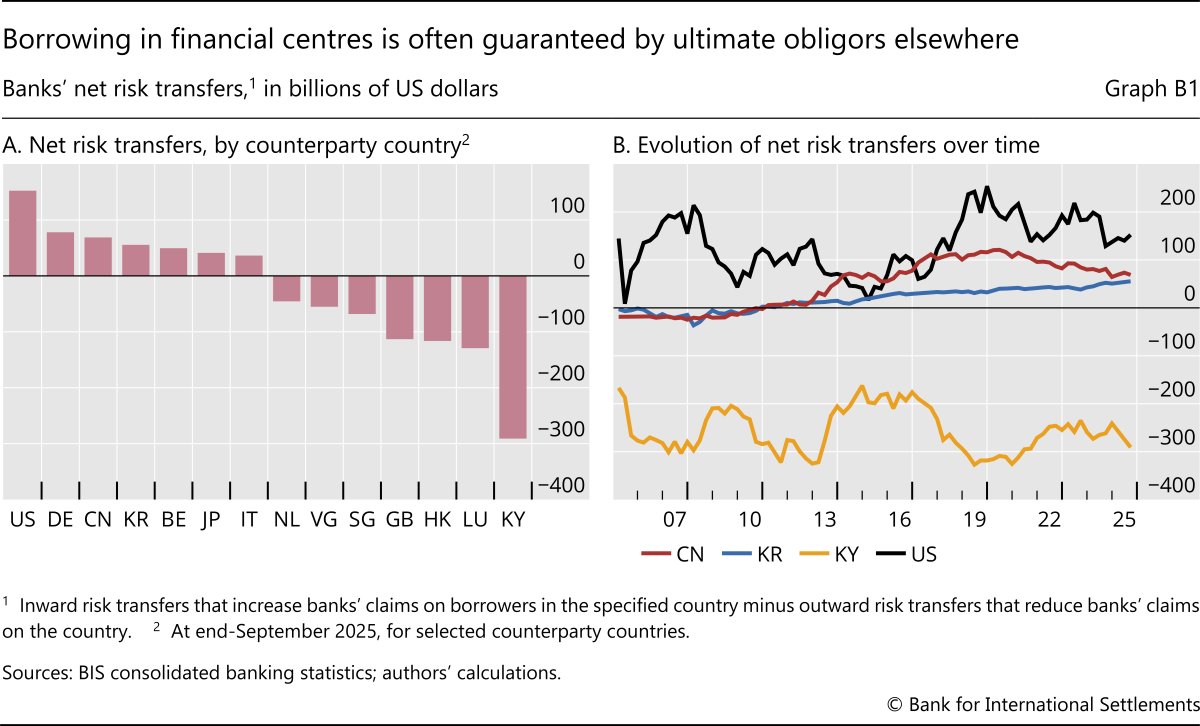
Not surprisingly, a sizeable portion of offshore borrowing through affiliates in financial centres is guaranteed by entities elsewhere. For example, in late 2025 risk transfers reduced banks' claims on borrowers in the Cayman Islands by close to $300 billion and in Luxembourg by about $130 billion (Graph B1.A). Over time, outward risk transfers from the Cayman Islands have moved closely with inward risk transfers to the United States, suggesting that borrowing activity in the Cayman Islands was driven by US developments (Graph B1.B). As banks and firms from emerging market economies expanded internationally, their debt increased on an ultimate obligor basis. For example, since 2011 inward risk transfers to China and Korea have exceeded outward ones, indicating that guarantees given by Chinese and Korean firms and banks to their overseas affiliates have exceeded guarantees given by foreign firms to their own affiliates operating in China and Korea (Graph B1.B).
The views expressed here are those of the authors and not necessarily those of the BIS or its member central banks. Liabilities of banks' branches are regarded as being guaranteed even in the absence of an explicit guarantee.