
About the 96th Annual General Meeting
At its Annual General Meeting, the BIS released its Annual Economic Report and its Annual Report.
Publications
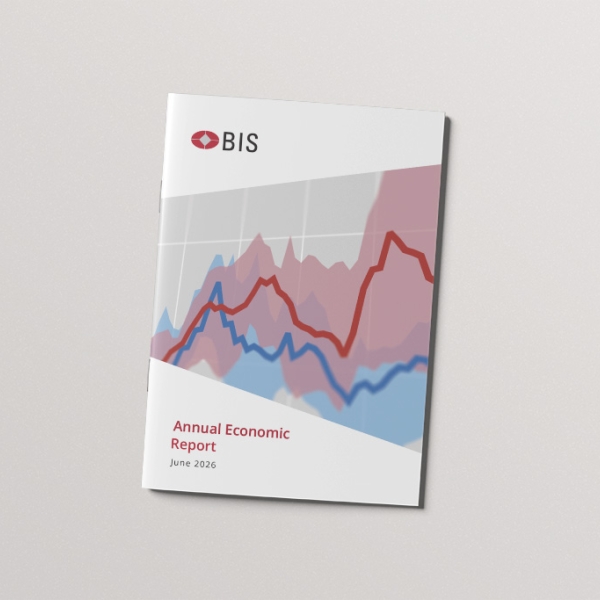
BIS Annual Economic Report 2026
Annual Report 2025/26
Speeches
Per Jacobsson Foundation Lecture
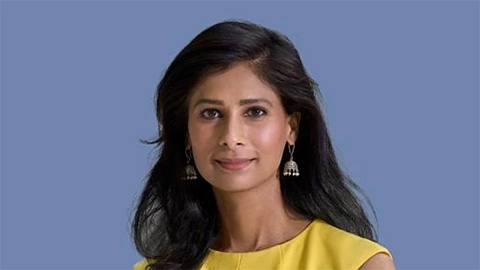
The lecture will be delivered by Gita Gopinath (Gregory and Ania Coffey Professor of Economics, Harvard University) on "Stablecoins and anonymous money", followed by panel discussion moderated by Pablo Hernández de Cos, with Michele Bullock (Governor, Reserve Bank of Australia), François Villeroy de Galhau (Former Governor, Bank of France) and Hyun Song Shin (Governor, Bank of Korea).
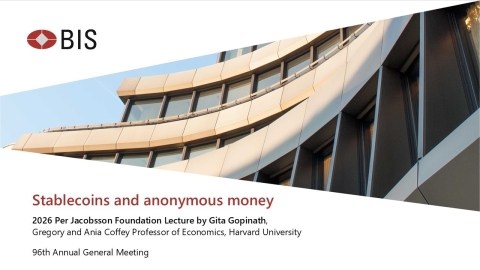
2026 Per Jacobsson Lecture: Stablecoins and anonymous money
Lecture delivered by Gita Gopinath (Gregory and Ania Coffey Professor of Economics, Harvard University) on "Stablecoins and anonymous money", on the occasion of the Bank's Annual General Meeting.
2026 Per Jacobsson Lecture: Panel discussion
Panel discussion on the lecture delivered by Gita Gopinath (Gregory and Ania Coffey Professor of Economics, Harvard University) on "Stablecoins and anonymous money", on the occasion of the Bank's Annual General Meeting.