Implementation: Regulatory Consistency Assessment Programme (RCAP)
Full, timely and consistent adoption and implementation of Basel standards is critical to:
- improve the resilience of the global banking system
- promote confidence in prudential ratios
- encourage a predictable and transparent regulatory environment for internationally active banks
The Basel Committee and its governing body, the Group of Central Bank Governors and Heads of Supervision, have therefore set as a high priority the full and effective implementation of Basel standards within the globally agreed time frame. The Committee closely monitors and assesses these dimensions – timeliness and consistency - on a regular basis.
After implementation, the Committee's focus is on evaluation. This encompasses the assessment of the effectiveness of the implemented Basel standards in achieving the intended goals as well as the identification of any unintended consequences. Objective, agnostic and empirically based evaluation is an integral part of the Committee's policy development process.
RCAP on timeliness
The timely transposition of Basel III regulatory standards into domestic regulations is monitored periodically based on information provided by each member jurisdiction. The RCAP Implementation dashboard uses colour codes to signal the different stages of adoption of the standards. The aim is to ensure that the internationally agreed timeline remains on track.
The RCAP: Basel III implementation dashboard shows views by standard and jurisdiction. It also includes references and links to domestic implementation documents.
The full Basel III implementation history can be downloaded here.

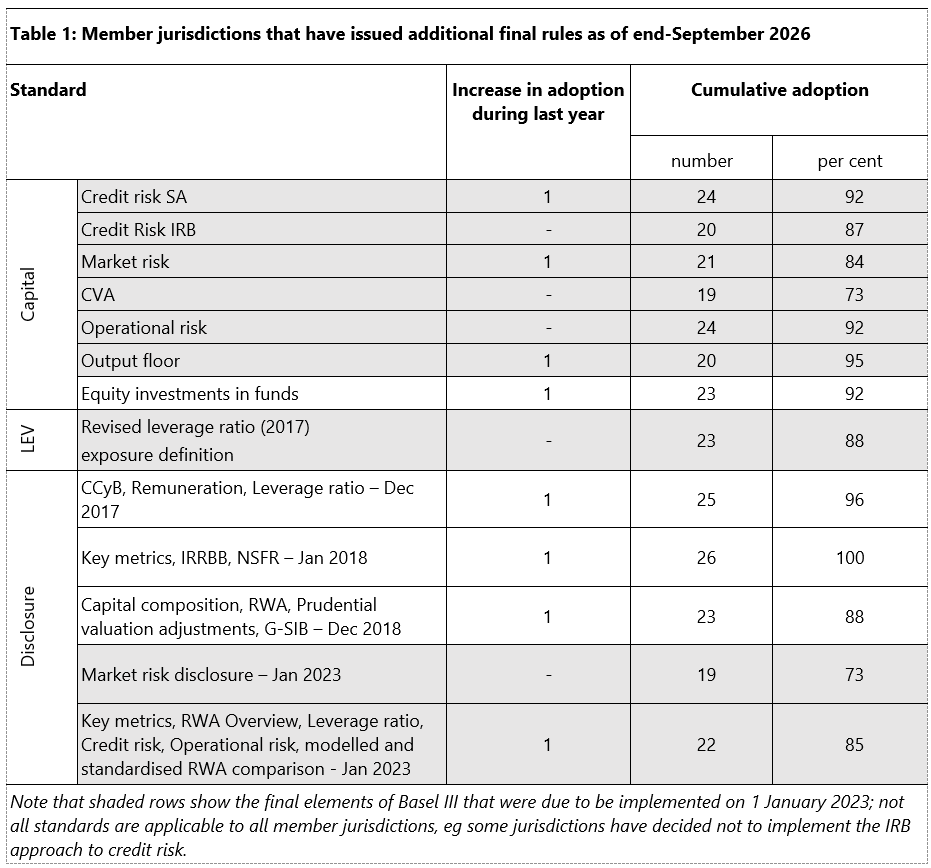
Basel III adoption progress summary (September 2026)
The Basel Committee on Banking Supervision (BCBS) and its oversight body, the Group of Central Bank Governors and Heads of Supervision (GHOS), have set as their highest priority the implementation of all aspects of the Basel III framework in full, consistently, and as soon as possible. This includes the finalised Basel III post-crisis reforms published by the Committee in 2017–19 and set to be in effect since 1 January 2023 with a five-year phase-in for some elements.
Continuing the periodic monitoring initiated more than a decade ago, this update sets out the adoption status of Basel III standards for each of the BCBS member jurisdictions1 as of end-September 2026. It is part of the Committee’s Regulatory Consistency Assessment Programme (RCAP), which was established to follow progress in adopting and implementing corresponding domestic regulations, assessing their consistency and analysing regulatory outcomes.
As of 30 September 2026, three quarter of the member jurisdictions have published their rules adopting the final Basel III, ie all standards with an implementation date of 1 January 2023 (see Table 1). Since the last summary as of end-September 2025, three jurisdictions have published additional Basel III standards. Further progress has also been made for other standards. In the past 12 months, one additional jurisdiction adopted the equity investment in funds standard and two implemented different elements of the disclosure framework.
Regarding the actual implementation of the Basel III standards by banks, the standard for market risk became effective in one additional jurisdiction during the past 12 month. Overall, the implementation of the final Basel III standards is now completed in 47% of the member jurisdictions. The revised credit risk and operational risk standards, as well as the output floor, are effective in around 85% of the member jurisdictions, the CVA standard in nearly 70%, and the revised market risk standards in more than 40%. Looking ahead, the implementation of the final Basel III standards is expected to be nearly complete by the first half of 2027. With few exceptions, all member jurisdictions have publicly announced that banks must apply the standards by April 2027 or earlier.
Details on the adoption of Basel standards and the full history of implementation for each jurisdiction can be viewed via the RCAP Basel III implementation dashboard. The evaluation of the consistency of jurisdictional implementations is addressed through the RCAP jurisdictional assessments.
1 Footnote
| 1 | The status of implementation in Russia is not included in this summary or the accompanying dashboard as its progress has not been updated since end-September 2021. |
RCAP jurisdictional assessments: regulatory implementation consistency
Jurisdictional assessments review the extent to which domestic regulations in each member jurisdiction are aligned with the minimum regulatory standards agreed by the Committee (more about the RCAP remit and methods). The results of each assessment are published in a separate report on the specific jurisdiction.
See also: RCAP on timeliness: Basel III implementation dashboard on the adoption of the Basel regulatory framework - a high-level view of Basel Committee members' progress in adopting Basel III regulations
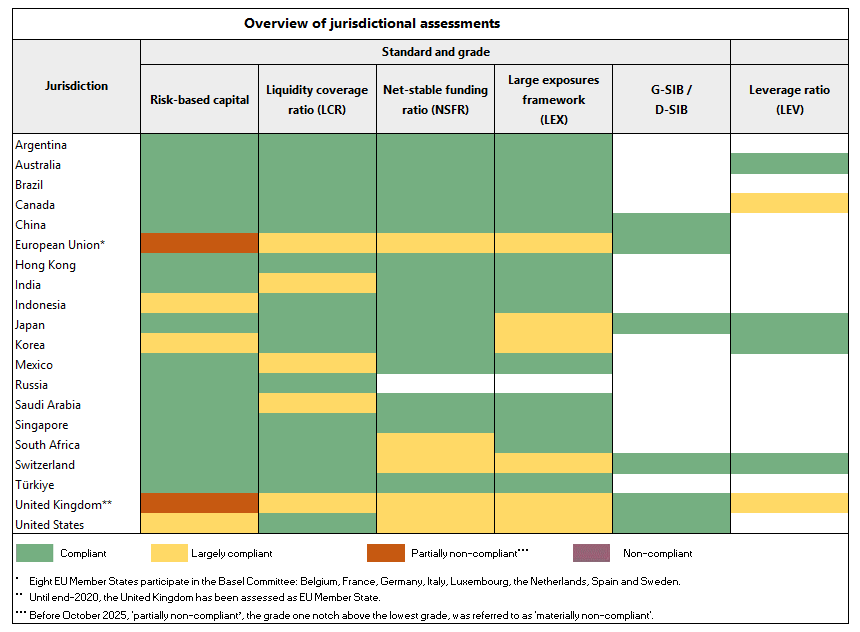
Twenty-eight jurisdictions covering 90% of the world's banking assets
The full assessment reports completed to date are set out below. For information on the timing of past and planned future assessment, please see the schedule of member assessments.
| Risk based capital standards | September 2016 |
|---|---|
| Liquidity (LCR) | September 2016 |
| Net Stable Funding Ratio (NSFR) | November 2019 |
| Large exposure framework | November 2019 |
| G-SIB / D-SIB requirements | |
| Post RCAP follow up (self reporting) | March 2018 March 2019 |
| Risk based capital standards | March 2014 |
|---|---|
| Liquidity (LCR) | October 2017 |
| Net Stable Funding Ratio (NSFR) | July 2019 |
| Large exposure framework | July 2019 |
| G-SIB / D-SIB requirements | |
| Post RCAP follow up (self reporting) | March 2016 March 2017 March 2018 March 2019 |
| Leverage ratio (LEV) | October 2026 |
| Risk based capital standards | December 2013 |
|---|---|
| Liquidity (LCR) | October 2017 |
| Net Stable Funding Ratio (NSFR) | March 2019 |
| Large exposure framework | March 2019 |
| G-SIB / D-SIB requirements | |
| Post RCAP follow up (self reporting) | March 2015 March 2016 March 2017 March 2018 March 2019 |
| Risk based capital standards | September 2013 |
|---|---|
| Liquidity (LCR) | July 2017 |
| Net Stable Funding Ratio (NSFR) | November 2019 |
| Large exposure framework | November 2019 |
| G-SIB / D-SIB requirements | June 2016 |
| Post RCAP follow up (self reporting) | March 2015 March 2016 March 2017 March 2018 March 2019 |
| Risk based capital standards | December 2014 October 2012 (Preliminary version) |
|---|---|
| Liquidity (LCR) | July 2017 |
| Net Stable Funding Ratio (NSFR) | July 2022 |
| Large exposure framework | July 2022 |
| G-SIB / D-SIB requirements | June 2016 |
| Post RCAP follow up (self reporting) | March 2016 March 2017 March 2018 March 2019 |
| Risk based capital standards | March 2015 |
|---|---|
| Liquidity (LCR) | March 2015 |
| Net Stable Funding Ratio (NSFR) | March 2020 |
| Large exposure framework | March 2020 |
| G-SIB / D-SIB requirements | |
| Post RCAP follow up (self reporting) | March 2017 March 2018 March 2019 |
| Risk based capital standards | June 2015 |
|---|---|
| Liquidity (LCR) | June 2015 |
| Net Stable Funding Ratio (NSFR) | July 2019 |
| Large exposure framework | July 2019 |
| G-SIB / D-SIB requirements | |
| Post RCAP follow up (self reporting) | March 2017 March 2018 March 2019 |
| Risk based capital standards | December 2016 |
|---|---|
| Liquidity (LCR) | December 2016 |
| Net Stable Funding Ratio (NSFR) | March 2020 |
| Large exposure framework | March 2020 |
| G-SIB / D-SIB requirements | |
| Post RCAP follow up (self reporting) | March 2018 March 2019 |
| Risk based capital standards | October 2012 December 2016 (Follow-up assessment) |
|---|---|
| Liquidity (LCR) | December 2016 |
| Net Stable Funding Ratio (NSFR) | September 2022 |
| Large exposure framework | September 2022 |
| G-SIB / D-SIB requirements | June 2016 |
| Post RCAP follow up (self reporting) | March 2015 March 2016 March 2017 March 2018 March 2019 |
| Leverage ratio (LEV) | October 2026 |
| Risk based capital standards | September 2016 |
|---|---|
| Liquidity (LCR) | September 2016 |
| Net Stable Funding Ratio (NSFR) | December 2024 |
| Large exposure framework | December 2024 |
| G-SIB / D-SIB requirements | |
| Post RCAP follow up (self reporting) | March 2018 March 2019 |
| Leverage ratio (LEV) | October 2026 |
| Risk based capital standards | March 2015 |
|---|---|
| Liquidity (LCR) | March 2015 December 2023 (Follow-up assessment) |
| Net Stable Funding Ratio (NSFR) | December 2023 |
| Large exposure framework | December 2023 |
| G-SIB / D-SIB requirements | |
| Post RCAP follow up (self reporting) | March 2017 March 2018 March 2019 |
| Risk based capital standards | March 2016 |
|---|---|
| Liquidity (LCR) | March 2016 |
| Net Stable Funding Ratio (NSFR) | |
| Large exposure framework | |
| G-SIB / D-SIB requirements | |
| Post RCAP follow up (self reporting) | March 2018 March 2019 |
| Risk based capital standards | September 2015 |
|---|---|
| Liquidity (LCR) | September 2015 |
| Net Stable Funding Ratio (NSFR) | September 2018 |
| Large exposure framework | September 2018 |
| G-SIB / D-SIB requirements | |
| Post RCAP follow up (self reporting) | March 2017 March 2018 March 2019 |
| Risk based capital standards | March 2013 |
|---|---|
| Liquidity (LCR) | December 2016 |
| Net Stable Funding Ratio (NSFR) | March 2020 |
| Large exposure framework | March 2020 |
| G-SIB / D-SIB requirements | |
| Post RCAP follow up (self reporting) | March 2015 March 2016 March 2017 March 2018 March 2019 |
| Risk based capital standards | June 2015 |
|---|---|
| Liquidity (LCR) | June 2015 |
| Net Stable Funding Ratio (NSFR) | April 2023 |
| Large exposure framework | April 2023 |
| G-SIB / D-SIB requirements | |
| Post RCAP follow up (self reporting) | March 2017 March 2018 March 2019 |
| Risk based capital standards | June 2013 |
|---|---|
| Liquidity (LCR) | October 2017 |
| Net Stable Funding Ratio (NSFR) | December 2023 |
| Large exposure framework | December 2023 |
| G-SIB / D-SIB requirements | June 2016 |
| Post RCAP follow up (self reporting) | March 2015 March 2016 March 2017 March 2018 March 2019 |
| Leverage ratio (LEV) | October 2026 |
| Risk based capital standards | March 2016 |
|---|---|
| Liquidity (LCR) | March 2016 |
| Net Stable Funding Ratio (NSFR) | April 2025 |
| Large exposure framework | April 2025 |
| G-SIB / D-SIB requirements | |
| Post RCAP follow up (self reporting) | March 2018 March 2019 |
| Net Stable Funding Ratio (NSFR) | December 2025 |
|---|---|
| Large exposure framework | December 2025 |
| Leverage ratio (LEV) | October 2026 |
| Risk based capital standards | December 2014 October 2012 (Preliminary 2012) |
|---|---|
| Liquidity (LCR) | July 2017 |
| Net Stable Funding Ratio (NSFR) | July 2023 |
| Large exposure framework | July 2023 |
| G-SIB / D-SIB requirements | June 2016 |
| Post RCAP follow up (self reporting) | March 2016 March 2017 March 2018 March 2019 |
RCAP thematic assessments: consistency of bank outcomes
The Basel Committee's assessments of regulatory outcomes seek to ensure that the prudential ratios calculated by banks are consistent across banks and jurisdictions. The Committee's initial focus is on banks' calculation of risk-weighted assets (RWA, or the denominator of the Basel risk-based capital ratio) for credit risk, counterparty credit risk and market risk.
Differences in the application of the standards can lead to variations in the risk-based capital ratios. Therefore, thematic assessments distinguish between variations in RWA based on risks and those based on practices. The Basel reforms introduced changes to the RWA framework which are yet to be fully implemented before any consistency assessment could be performed.
Assessment schedule for member jurisdictions
Assessment of implementation of Basel III capital regulations (2012-16): all members' implementation of the risk-based capital framework has been reviewed.
Assessment of implementation of Basel III liquidity regulations (2014-17): all members' implementation of the liquidity coverage ratio (LCR) has been reviewed.
Assessments of implementation of the net stable funding ratio (NSFR) and large exposures framework (LEX) (2018-25): all members' implementation of the NSFR and the LEX has been reviewed.
Jurisdictional assessments of the leverage ratio framework (LEV) and the Basel III revisions to the risk weighted assets (RWA) started in 2025. The timetable for these assessments is set out below. Details on the scope of these jurisdictional assessments are set out in the Handbook for jurisdictional assessments.
RCAP LEV
| Member jurisdiction | Expected publication |
|---|---|
| Australia, Canada, Japan, Korea, United Kingdom, Switzerland | Q4 2026 |
| China, European Union, Indonesia, United States | Q2 2027 |
| Argentina, Brazil, India, South Africa, Türkiye | Q4 2027 |
| Hong Kong, Mexico, Singapore, Saudi Arabia | Q2 2028 |
RCAP RWA
| Member jurisdiction | Expected publication |
|---|---|
| Hong Kong | Q4 2026 |
| Japan, Korea, Singapore | Q4 2027 |
| Saudi Arabia | Q2 2028 |
| Australia, Canada, United Kingdom, Indonesia | Q4 2028 |
| European Union, Switzerland, United States | Q2 2029 |
| Argentina, Brazil, China, India | Q4 2029 |
| Mexico, South Africa, Türkiye | Q2 2030 |