Definitions and application
This chapter defines operational risk and introduces the methodologies available for calculating operational risk capital requirements.
- Effective as of: 15 Dec 2019
- Last update: 15 Dec 2019
- Status Superseded
Introduction
10.1
Operational risk is defined as the risk of loss resulting from inadequate or failed internal processes, people and systems or from external events. This definition includes legal risk,1 but excludes strategic and reputational risk.
1 Footnote
| 1 | Legal risk includes, but is not limited to, exposure to fines, penalties, or punitive damages resulting from supervisory actions, as well as private settlements. |
10.2
The framework outlined in this standard presents three methods for calculating operational risk capital requirements in a continuum of increasing sophistication and risk sensitivity:
- the Basic Indicator Approach;
- the Standardised Approach; and
- Advanced Measurement Approaches (AMAs).
10.3
Banks are encouraged to move along the spectrum of available approaches as they develop more sophisticated operational risk measurement systems and practices. Qualifying criteria for the Standardised Approach and AMA are presented below.
10.4
Internationally active banks and banks with significant operational risk exposures (for example, specialised processing banks) are expected to use an approach that is more sophisticated than the Basic Indicator Approach and that is appropriate for the risk profile of the institution.2 A bank will be permitted to use the Basic Indicator or Standardised Approach for some parts of its operations and an AMA for others provided certain minimum criteria are met; see OPE10.6 to OPE10.9.
1 Footnote
| 2 | Supervisors will review the capital requirement produced by the operational risk approach used by a bank (whether Basic Indicator Approach, Standardised Approach or AMA) for general credibility, especially in relation to a firm’s peers. In the event that credibility is lacking, appropriate supervisory action under Pillar 2 will be considered. |
10.5
A bank will not be allowed to choose to revert to a simpler approach once it has been approved for a more advanced approach without supervisory approval. However, if a supervisor determines that a bank using a more advanced approach no longer meets the qualifying criteria for this approach, it may require the bank to revert to a simpler approach for some or all of its operations, until it meets the conditions specified by the supervisor for returning to a more advanced approach.
Partial use
10.6
A bank will be permitted to use an AMA for some parts of its operations and the Basic Indicator Approach or Standardised Approach for the balance (partial use), provided that the following conditions are met:
- All operational risks of the bank’s global, consolidated operations are captured;
- All of the bank’s operations that are covered by the AMA meet the qualitative criteria for using an AMA, while those parts of its operations that are using one of the simpler approaches meet the qualifying criteria for that approach;
- On the date of implementation of an AMA, a significant part of the bank’s operational risks are captured by the AMA; and
- The bank provides its supervisor with a plan specifying the timetable to which it intends to roll out the AMA across all but an immaterial part of its operations. The plan should be driven by the practicality and feasibility of moving to the AMA over time, and not for other reasons.
10.7
Subject to the approval of its supervisor, a bank opting for partial use may determine which parts of its operations will use an AMA on the basis of business line, legal structure, geography, or other internally determined basis.
10.8
Subject to the approval of its supervisor, where a bank intends to implement an approach other than the AMA on a global, consolidated basis and it does not meet the third and/or fourth conditions in OPE10.6, the bank may, in limited circumstances:
- Implement an AMA on a permanent partial basis; and
- Include in its global, consolidated operational risk capital requirements the results of an AMA calculation at a subsidiary where the AMA has been approved by the relevant host supervisor and is acceptable to the bank’s home supervisor.
10.9
Approvals of the nature described in OPE10.8 should be granted only on an exceptional basis. Such exceptional approvals should generally be limited to circumstances where a bank is prevented from meeting these conditions due to implementation decisions of supervisors of the bank’s subsidiary operations in foreign jurisdictions.
This standard describes the scope of application of the Basel Framework.
This standard describes the criteria that bank capital instruments must meet to be eligible to satisfy the Basel capital requirements, as well as necessary regulatory adjustments and transitional arrangements.
This standard describes the framework for risk-based capital requirements.
This standard describes how to calculate capital requirements for credit risk.
This standard describes how to calculate capital requirements for market risk and credit valuation adjustment risk.
This standard describes how to calculate capital requirements for operational risk.
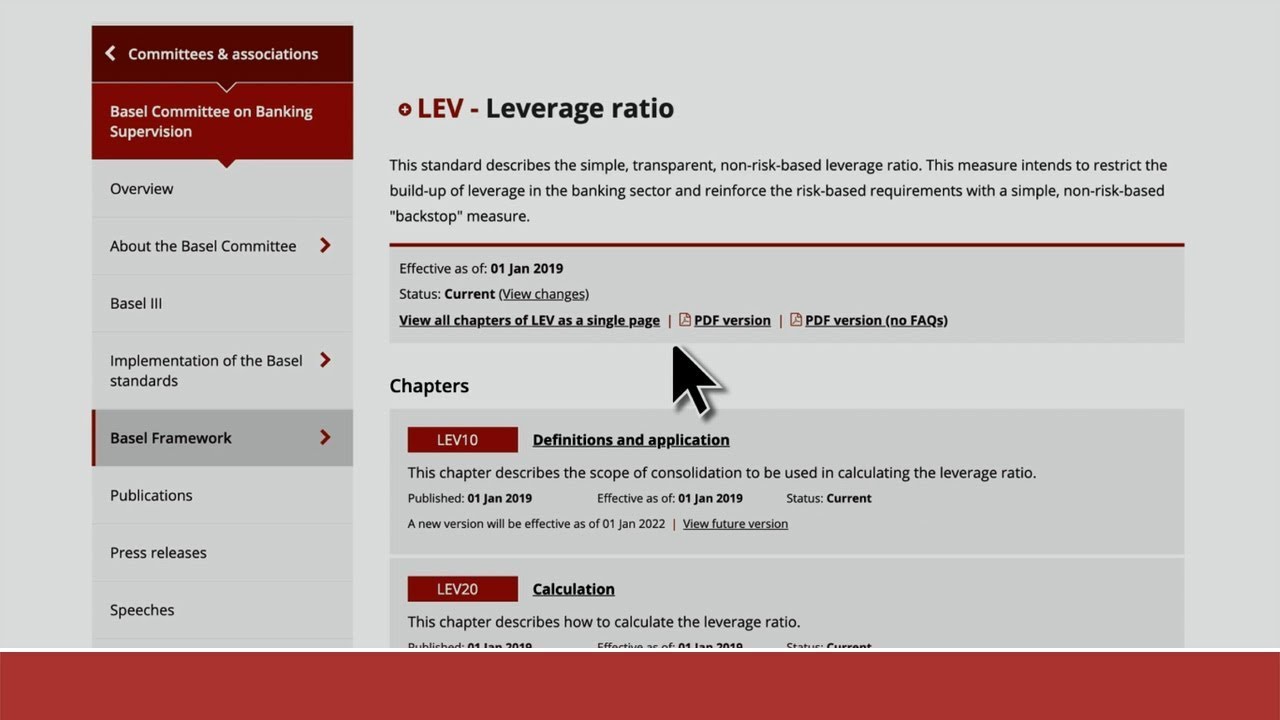
This standard describes the simple, transparent, non-risk-based leverage ratio. This measure intends to restrict the build-up of leverage in the banking sector and reinforce the risk-based requirements with a simple, non-risk-based "backstop" measure.
This standard describes the Liquidity Coverage Ratio, a measure which promotes the short-term resilience of a bank's liquidity risk profile.
The net stable funding ratio requires banks to maintain a stable funding profile in relation to the composition of their assets and off-balance-sheet activities.
Large exposures regulation limits the maximum loss that a bank could face in the event of a sudden counterparty failure to a level that does not endanger the bank's solvency. This standard requires banks to measure their exposures to a single counterparty or a group of connected counterparties and limit the size of large exposures in relation to their capital.
This standard establishes minimum standards for margin requirements for non-centrally cleared derivatives. Such requirements reduce systemic risk with respect to non-standardised derivatives by reducing contagion and spillover risks and promoting central clearing.
The Pillar 2 supervisory review process ensures that banks have adequate capital and liquidity to support all the risks in their business, especially with respect to risks not fully captured by the Pillar 1 process, and encourages good risk management.
This standard sets out disclosure requirements, which aim to encourage market discipline.
The Basel Core Principles provide a comprehensive standard for establishing a sound foundation for the regulation, supervision, governance and risk management of the banking sector.