
QIS 3 FAQ: G. Maturity
1. Will the maturity adjustment in both the Foundation and Advanced IRB approaches now definitely be Mark to Market (MTM) based, rather than the choice of MTM or Default Mode that existed in CP2?
Answer: There is no longer a Default Mode-based option as contemplated in CP2. The explicit maturity adjustments being used for both the FIRB and AIRB are based on a mark to market methodology.
2. The maturity adjustment in paragraph 235 of the instructions contains a LOG-function. Is this a power 10 log (10log) or a natural logarithm (elog)?
Answer: The IRB maturity adjustment function uses the natural logarithm (i.e. elog which in Excel is the LN() function).
3. We understand that there can be a maturity adjustment exemption for smaller corporates (i.e., domestic firms) that have less than € 500 million in consolidated sales and consolidated asset. Must both of these conditions be met individually? That is, sales must be less then € 500 million and assets less than € 500 million? It does not mean the combination of sales and assets must be less than € 500 million, correct?
Answer: Although banks using advanced IRB generally are required to use the explicit maturity adjustment, national supervisors may exempt facilities to certain smaller domestic corporate borrowers from this adjustment. Both sales and assets for the consolidated group of which the firm is a part should be less that € 500 million, i.e. both criteria have to be met individually. Also note that if your supervisor uses this option you are required to use it, i.e. if this exemption is applicable all eligible domestic firms should be risk weighted using an implicit maturity correction.
4. Could you please indicate in which cases your proposals rely on maturity at origination and in which cases they use remaining maturity?
Answer: In general, the Technical Guidance relies on the remaining maturity of a facility. Some preferential treatments refer to the nature of a transaction, rather than its remaining maturity and consequently rely on the maturity at origination. For your convenience, a list of definitions relying on maturity at origination is provided below:
-
1) Paragraphs 36 and 38 of the Technical Guidance describe a preferential treatment for short-term exposures to banks that subject to national treatment may be available. The definition of short-term exposures relies on maturity at origination (which should be 3 months or less).
2) Credit conversion factors for off-balance sheet items (paragraph 50) also rely on maturity at origination: 'Commitments with an original maturity up to one year and commitments with an original maturity over one year will receive, respectively, a credit conversion factor of 20% and 50%.'
3) Paragraph 239 describes a national discretion for the application of lower risk weights to certain short-term specialised lending exposures. This preferential treatment is only available for exposures with an original maturity of less than 2.5 years.
4) Where applicable, maturity adjustment under IRB is based on remaining maturity subject to a floor of one year. However, a carve-out exists for some exposures with an original maturity of less than three months (note that the carve-out depends on maturity at origination, whereas the maturity used for the maturity adjustment is the remaining maturity-see paragraphs 282-283 of the Technical Guidance).
5) The definition of receivables eligible for treatment as 'pools of receivables' relies on maturity at origination (see paragraph 459 of the Technical Guidance).
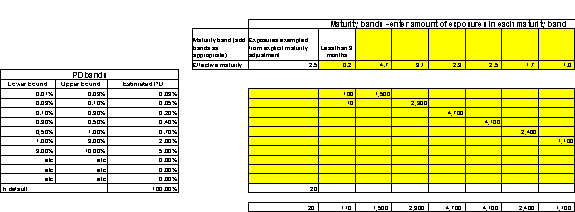
5. If a bank is using the explicit maturity adjustment, is it acceptable to put all exposures into a single maturity band and to assign the average maturity of all exposures within the exposure class to this band?
Answer: Unfortunately no. The maturity adjustment depends both on PD and on maturity. Banks should at least calculate the average maturity per rating grade. If they employ such an approach the PD maturity matrix may look similar to the one presented below.
6. Paragraph 280 of the Technical Guidance discusses the potential for an exemption from a maturity adjustment for certain smaller domestic corporate borrowers if the reported sales (i.e.turnover) as well as total assets for the consolidated group of which the firm is a part of is less than € 500 million. However, paragraph 236 allows for loans to small- and medium-sized entities to be distinguished from other corporate borrowers if the sales for the consolidated group of which the firm is a part is less than € 50 million. Were these two thresholds intended to be the same?
Answer: There are different thresholds and exemptions, including discretion by national supervisors, in many areas of the Technical Guidance. The €50 mm turnover (i.e. sales) criterion is used to determine whether a corporate enterprise qualifies for the preferential capital treatment afforded 'SMEs.' There is a separate 'maturity adjustment' exemption for corporate exposures that have less the € 500 million in consolidated sales and less than € 500 million in consolidated assets. These criteria are separate and distinct. The former is used to identify SMEs that qualify for preferential capital treatment, and the latter is used to determine if a maturity adjustment exemption can be applied to the capital calculation of certain exposures.
Return to QIS3 FAQ Table of Contents