Leverage ratio
This chapter describes disclosure requirements for the leverage ratio.
- Effective as of: 15 Dec 2019
- Last update: 15 Dec 2019
- Status Superseded
Introduction
80.1
The disclosure requirements set out in this chapter are:
- Template LR1 - Summary comparison of accounting assets vs leverage ratio exposure measure
- Template LR2 - Leverage ratio common disclosure template
80.2
Template LR1 provides a reconciliation of a bank’s total assets as published in its financial statements to the leverage ratio exposure measure, and Template LR2 provides a breakdown of the components of the leverage ratio exposure measure.
Template LR1 - Summary comparison of accounting assets vs leverage ratio exposure measure
TABLE.1
|
Purpose: Reconcile the total assets in the published financial statements to the leverage ratio exposure measure. |
|||
|
Scope of application: The table is mandatory for all banks. |
|||
|
Content: Quantitative information. The Basel III leverage ratio framework follows the same scope of regulatory consolidation as used for the risk-based capital framework. Disclosures should be reported on a quarter-end basis. However, banks may, subject to supervisory approval, use more frequent calculations (eg daily or monthly averaging), as long as they do so consistently. |
|||
|
Frequency: Quarterly. |
|||
|
Format: Fixed. |
|||
|
Accompanying narrative: Banks are required to disclose and detail the source of material differences between their total balance sheet assets (net of on-balance sheet derivative and securities financing transaction (SFT) assets) as reported in their financial statements and their on-balance sheet exposures as set out in row 1 of Template LR2. Banks are required to include the basis for their disclosures (eg quarter-end, daily averaging or monthly averaging). |
|||
|
a |
|||
|
1 |
Total consolidated assets as per published financial statements |
||
|
2 |
Adjustment for investments in banking, financial, insurance or commercial entities that are consolidated for accounting purposes but outside the scope of regulatory consolidation |
||
|
3 |
Adjustment for fiduciary assets recognised on the balance sheet pursuant to the operative accounting framework but excluded from the leverage ratio exposure measure |
||
|
4 |
Adjustments for derivative financial instruments |
||
|
5 |
Adjustment for securities financing transactions (ie repos and similar secured lending) |
||
|
6 |
Adjustment for off-balance sheet items (ie conversion to credit equivalent amounts of off-balance sheet exposures) |
||
|
7 |
Other adjustments |
||
|
8 |
Leverage ratio exposure measure |
||
|
Definitions and instructions |
|||
|
Row number |
Explanation |
||
|
1 |
The bank's total consolidated assets as per published financial statements. |
||
|
2 |
Where a banking, financial, insurance or commercial entity is outside the regulatory scope of consolidation, only the amount of the investment in the capital of that entity (ie only the carrying value of the investment, as opposed to the underlying assets and other exposures of the investee) shall be included in the leverage ratio exposure measure. However, investments in those entities that are deducted from the bank's Common Equity Tier 1 (CET1) capital or from additional Tier 1 capital in accordance with CAP30.29 to CAP30.34 may also be deducted from the leverage ratio exposure measure. As these adjustments reduce the total leverage ratio exposure measure, they shall be reported as a negative amount. |
||
|
3 |
This row shows the reduction of the consolidated assets for fiduciary assets that are recognised on the bank's balance sheet pursuant to the operative accounting framework and which meet the de-recognition criteria of IAS 39 / IFRS 9 or the IFRS 10 de-consolidation criteria. As these adjustments reduce the total leverage ratio exposure measure, they shall be reported as a negative amount. |
||
|
4 |
Adjustments related to derivative financial instruments. The adjustment is the difference between the accounting value of the derivatives recognised as assets and the leverage ratio exposure value as determined by application of LEV30. If this adjustment leads to an increase in exposure, institutions shall disclose this as a positive amount. If this adjustment leads to a decrease in exposure, institutions shall disclose this as a negative amount. |
||
|
5 |
Adjustments related to securities financing transactions (SFTs) (ie repos and other similar secured lending). The adjustment is the difference between the accounting value of the SFTs recognised as assets and the leverage ratio exposure value as determined by application of LEV30. If this adjustment leads to an increase in the exposure, institutions shall disclose this as a positive amount. If this adjustment leads to a decrease in exposure, institutions shall disclose this as a negative amount. |
||
|
6 |
The credit equivalent amount of off-balance sheet items determined by applying the relevant credit conversion factors (subject to a floor of 10%) to the nominal value of the off-balance sheet item. As these adjustments increase the total leverage ratio exposure measure, they shall be reported as a positive amount. |
||
|
7 |
Any other adjustments. If these adjustments lead to an increase in the exposure, institutions shall report this as a positive amount. If these adjustments lead to a decrease in exposure, the institutions shall disclose this as a negative amount. |
||
|
8 |
The leverage ratio exposure, which should be the sum of the previous items. |
||
|
Linkages across templates [LR1:8/a] is equal to [LR2:21/a] |
|||
Template LR2: Leverage ratio common disclosure template
TABLE.2
|
Purpose: Provide a detailed breakdown of the components of the leverage ratio denominator. |
||||
|
Scope of application: The table is mandatory for all banks. |
||||
|
Content: Quantitative information. The disclosures should be on a quarter-end basis. However, banks may, subject to supervisory approval, use more frequent calculations (eg daily or monthly averaging), as long as they do so consistently. |
||||
|
Frequency: Quarterly. |
||||
|
Format: Fixed. |
||||
|
Accompanying narrative: Banks must describe the key factors that have had a material impact on the leverage ratio at the end of the reporting period compared to the end of the previous reporting period. Banks are required to include the basis for their disclosures (eg quarter-end, daily averaging or monthly averaging). |
||||
|
a |
b |
|||
|
T |
T-1 |
|||
|
On-balance sheet exposures |
||||
|
1 |
On-balance sheet exposures (excluding derivatives and securities financing transactions (SFTs), but including collateral) |
|||
|
2 |
(Asset amounts deducted in determining Basel III Tier 1 capital) |
|||
|
3 |
Total on-balance sheet exposures (excluding derivatives and SFTs) (sum of rows 1 and 2) |
|||
|
Derivative exposures |
||||
|
4 |
Replacement cost associated with all derivatives transactions (where applicable net of eligible cash variation margin and/or with bilateral netting) |
|||
|
5 |
Add-on amounts for potential future exposure (PFE) associated with all derivatives transactions |
|||
|
6 |
Gross-up for derivatives collateral provided where deducted from the balance sheet assets pursuant to the operative accounting framework |
|||
|
7 |
(Deductions of receivables assets for cash variation margin provided in derivatives transactions) |
|||
|
8 |
(Exempted central counterparty, or CCP, leg of client-cleared trade exposures) |
|||
|
9 |
Adjusted effective notional amount of written credit derivatives |
|||
|
10 |
(Adjusted effective notional offsets and add-on deductions for written credit derivatives) |
|||
|
11 |
Total derivative exposures (sum of rows 4 to 10) |
|||
|
Securities financing transaction exposures |
||||
|
12 |
Gross SFT assets (with no recognition of netting), after adjusting for sale accounting transactions |
|||
|
13 |
(Netted amounts of cash payables and cash receivables of gross SFT assets) |
|||
|
14 |
Counterparty credit risk exposure for SFT assets |
|||
|
15 |
Agent transaction exposures |
|||
|
16 |
Total securities financing transaction exposures (sum of rows 12 to 15) |
|||
|
Other off-balance sheet exposures |
||||
|
17 |
Off-balance sheet exposure at gross notional amount |
|||
|
18 |
(Adjustments for conversion to credit equivalent amounts) |
|||
|
19 |
Off-balance sheet items (sum of rows 17 and 18) |
|||
|
Capital and total exposures |
||||
|
20 |
Tier 1 capital |
|||
|
21 |
Total exposures (sum of rows 3, 11, 16 and 19) |
|||
|
Leverage ratio |
||||
|
22 |
Basel III leverage ratio |
|||
|
Definitions and instructions SFTs: transactions such as repurchase agreements, reverse repurchase agreements, security lending and borrowing, and margin lending transactions, where the value of the transactions depends on market valuations and the transactions are often subject to margin agreements. Capital measure: The capital measure for the leverage ratio is the Tier 1 capital of the risk-based capital framework as defined in CAP10 and CAP30 taking account of the transitional arrangements in CAP90. |
||||
|
Row number |
Explanation |
|||
|
1 |
Banks must include all balance sheet assets in their exposure measure, including on-balance sheet derivatives collateral and collateral for SFTs, with the exception of on-balance sheet derivative and SFT assets that are included in rows 4-16. |
|||
|
2 |
Balance sheet assets deducted from Basel III Tier 1 capital (as set out in CAP30). For example,
As the adjustments in row 2 reduce the exposure measure, they shall be reported as negative figures. |
|||
|
3 |
Sum of rows 1 and 2. |
|||
|
4 |
Replacement cost associated with all derivatives transactions (including exposures resulting from direct transactions between a client and a CCP where the bank guarantees the performance of its clients' derivative trade exposures to the CCP). As set out in LEV30, where applicable, this amount should be net of cash variation margin received and with bilateral netting. |
|||
|
6 |
Grossed-up amount of any collateral provided in relation to derivative exposures where the provision of that collateral has reduced the value of the balance sheet assets under the bank's operative accounting framework, in accordance with LEV30. |
|||
|
7 |
Deductions of receivable assets in the amount of the cash variation margin provided in derivatives transactions where the posting of cash variation margin has resulted in the recognition of a receivable asset under the bank's operative accounting framework. As the adjustments in row 7 reduce the exposure measure, they shall be reported as negative figures. |
|||
|
8 |
Trade exposures associated with the CCP leg of derivatives transactions resulting from client-cleared transactions or which the clearing member, based on the contractual arrangements with the client, is not obligated to reimburse the client for any losses suffered due to changes in the value of its transactions in the event that a qualifying central counterparty (QCCP) defaults. As the adjustments in row 8 reduce the exposure measure, they shall be reported as negative figures. |
|||
|
9 |
The effective notional amount of written credit derivatives which may be reduced by the total amount of negative changes in fair value amounts that have been incorporated into the calculation of Tier 1 capital with respect to written credit derivatives according to LEV30. |
|||
|
10 |
This row includes:
As the adjustments in row 10 reduce the exposure measure, they shall be reported as negative figures. |
|||
|
11 |
Sum of rows 4-10. |
|||
|
12 |
The gross amount of SFT assets without recognition of netting, other than novation with QCCPs, determined in accordance with LEV30, adjusted for any sales accounting transactions in accordance with LEV30. |
|||
|
13 |
The cash payables and cash receivables of gross SFT assets with netting determined in accordance with LEV30. As these adjustments reduce the exposure measure, they shall be reported as a negative figure. |
|||
|
14 |
The amount of the counterparty credit risk add-on for SFTs determined in accordance with LEV30. |
|||
|
15 |
The amount for which the bank acting as an agent in an SFT has provided an indemnity or guarantee determined in accordance with LEV30. |
|||
|
16 |
Sum of rows 12-15. |
|||
|
17 |
Total off-balance sheet exposure amounts (excluding off-balance sheet exposure amounts associated with SFT and derivative transactions) on a gross notional basis, before any adjustment for credit conversion factors (CCFs). |
|||
|
18 |
Reduction in gross amount of off-balance sheet exposures due to the application of CCFs. This corresponds to the complement of CCFs of the standardised approach for credit risk under the Basel II framework, subject to a floor of 10%. The floor of 10% will affect commitments that are unconditionally cancellable at any time by the bank without prior notice, or that effectively provide for automatic cancellation due to deterioration in a borrower's creditworthiness. These may receive a 0% CCF under the risk-based capital framework. As these adjustments reduce the exposure measure, they shall be reported as negative figures. |
|||
|
19 |
Sum of rows 17 and 18. |
|||
|
20 |
The amount of Tier 1 capital of the risk-based capital framework as defined in CAP10 and CAP30 taking account of the transitional arrangements. |
|||
|
21 |
Sum of rows 3, 11, 16 and 19. |
|||
|
22 |
Basel III leverage ratio is defined as the Tier 1 capital measure of row 20 (the numerator) divided by the exposure (the denominator) of row 21, with this ratio expressed as a percentage. |
|||
|
Linkages across templates [LR2:20/a] is equal to [KM1:2/a] [LR2:21/a] is equal to [KM1:13/a] [LR2:22/a] is equal to [KM1:14/a] |
||||
This standard describes the scope of application of the Basel Framework.
This standard describes the criteria that bank capital instruments must meet to be eligible to satisfy the Basel capital requirements, as well as necessary regulatory adjustments and transitional arrangements.
This standard describes the framework for risk-based capital requirements.
This standard describes how to calculate capital requirements for credit risk.
This standard describes how to calculate capital requirements for market risk and credit valuation adjustment risk.
This standard describes how to calculate capital requirements for operational risk.
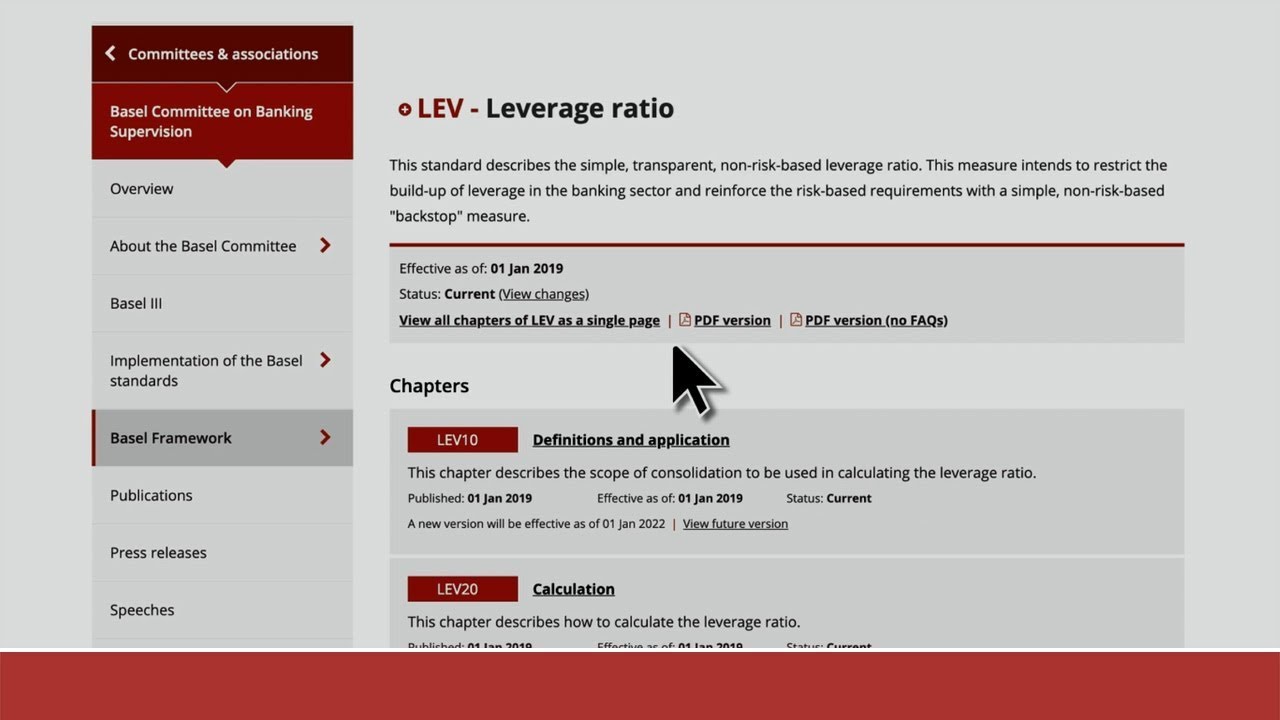
This standard describes the simple, transparent, non-risk-based leverage ratio. This measure intends to restrict the build-up of leverage in the banking sector and reinforce the risk-based requirements with a simple, non-risk-based "backstop" measure.
This standard describes the Liquidity Coverage Ratio, a measure which promotes the short-term resilience of a bank's liquidity risk profile.
The net stable funding ratio requires banks to maintain a stable funding profile in relation to the composition of their assets and off-balance-sheet activities.
Large exposures regulation limits the maximum loss that a bank could face in the event of a sudden counterparty failure to a level that does not endanger the bank's solvency. This standard requires banks to measure their exposures to a single counterparty or a group of connected counterparties and limit the size of large exposures in relation to their capital.
This standard establishes minimum standards for margin requirements for non-centrally cleared derivatives. Such requirements reduce systemic risk with respect to non-standardised derivatives by reducing contagion and spillover risks and promoting central clearing.
The Pillar 2 supervisory review process ensures that banks have adequate capital and liquidity to support all the risks in their business, especially with respect to risks not fully captured by the Pillar 1 process, and encourages good risk management.
This standard sets out disclosure requirements, which aim to encourage market discipline.
The Basel Core Principles provide a comprehensive standard for establishing a sound foundation for the regulation, supervision, governance and risk management of the banking sector.